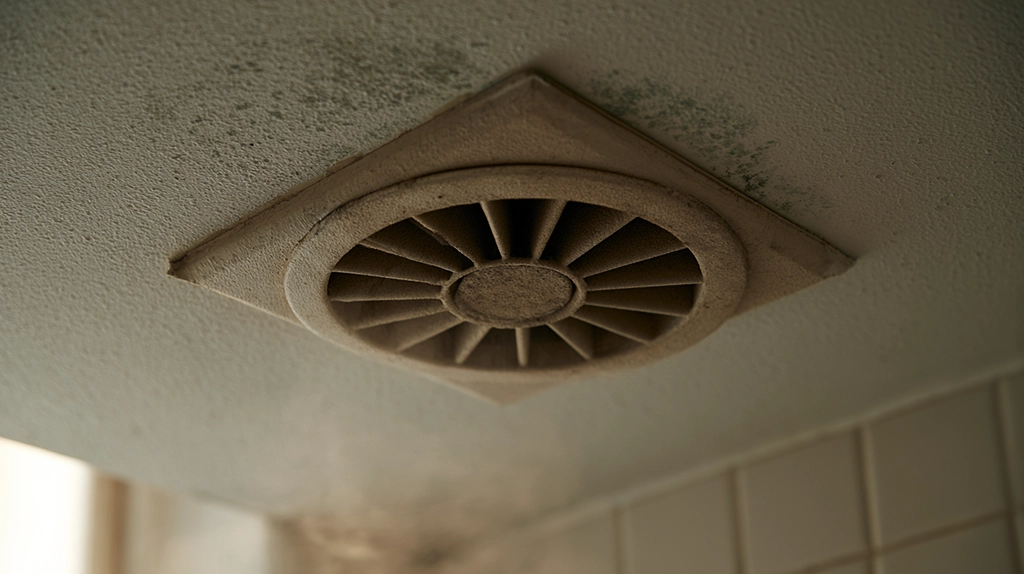

Many people notice the same frustrating pattern at home. A room may not feel especially damp, yet mold keeps returning to the same places: the corners of walls, behind wardrobes, along the back of sofas pressed against the wall, or on bathroom ceilings. These spots are cleaned, sometimes repeatedly, but the mold seems stubbornly loyal to them.
This pattern is not accidental. Research focusing on mold growth on building surfaces has found that air movement plays a real role in how quickly mold appears. Under equally humid conditions, surfaces exposed to moving air develop mold more slowly than surfaces where the air remains still. In simple terms, whether air flows across a wall matters.

The difference observed in the study was striking. When air around a surface was stagnant, visible mold could appear within just two to three days. When air movement was present, mold growth was delayed. On some materials, visible mold did not appear at all during the observation period. On others, mold eventually developed, but it took longer and covered a smaller area. Air movement did not eliminate mold, but it clearly slowed its progress.
This delay is more important than it may sound. Mold does not appear instantly. It needs time to establish itself, beginning at a microscopic level before spreading into visible patches. When that process is slowed, surfaces have more time to dry, and people have more time to notice early warning signs and respond. In everyday terms, slowing mold growth reduces the chance that a small problem becomes a widespread one.
These findings also help explain common household experiences. The places most prone to mold are often not the wettest parts of a home, but the most poorly ventilated. Areas behind furniture, inside cabinets, or at wall junctions tend to trap air. Moisture lingers longer on these surfaces because nothing carries it away. Even if the overall room feels dry, these stagnant zones quietly provide favorable conditions for mold to take hold.

It is important to understand what this research does and does not claim. The findings do not suggest that air movement can replace humidity control, fix leaks, or permanently prevent mold. Instead, they show that air movement influences the surface environment in a way that makes mold growth less immediate. When air flows across a surface, moisture does not remain undisturbed, and mold has a harder time getting started.
This perspective aligns with broader research on mold in residential buildings, which emphasizes that mold growth is not merely a cosmetic issue but part of a wider interaction between building design, indoor environments, and occupant well-being. Reviews of mold in modern housing have repeatedly shown that how buildings manage moisture and air movement plays an important role in long-term indoor environmental quality, as outlined in the WHO guidelines on indoor dampness and mould.
Seen this way, air movement is not a cure, but a moderator. It changes the timing of mold growth rather than eliminating the risk entirely. In buildings where moisture is unavoidable for short periods, such as after rain, condensation, or during humid seasons, this timing can make a meaningful difference.
The broader message is simple and practical. Mold thrives not just in damp places, but in damp places where air stands still. Allowing air to reach surfaces that are usually sealed off or ignored can slow the process that leads to visible mold. Even a small change in air circulation can shift conditions enough to reduce risk.
In the end, the study reinforces a familiar but often overlooked idea: mold prefers environments that are both moist and stagnant. When air moves, mold loses some of its advantage. Slowing mold growth may not sound dramatic, but in real homes, it can be the difference between a manageable issue and a recurring problem.

References
Academic sources
Grant, C., Hunter, C. A., Flannigan, B., & Bravery, A. F. (1989). The moisture requirements of moulds isolated from domestic dwellings. International Biodeterioration, 25(4), 259–284. https://doi.org/10.1016/0265-3036(89)90002-X
Viitanen, H. A., & Ojanen, T. (2007). Improved model to predict mold growth in building materials. Building and Environment, 42(8), 2622–2633. https://doi.org/10.1016/j.buildenv.2006.05.006
Official sources
World Health Organization (WHO). WHO guidelines for indoor air quality: dampness and mould. https://www.who.int/publications/i/item/WHO-EURO-2010-7821-41892-56883
Key Takeaways
- Please login Many people notice the same frustrating pattern at home.
- These spots are cleaned, sometimes repeatedly, but the mold seems stubbornly loyal to them.
- In simple terms, whether air flows across a wall matters.
- On some materials, visible mold did not appear at all during the observation period.
- It needs time to establish itself, beginning at a microscopic level before spreading into visible patches.
Frequently Asked Questions
What should you know about please login to bookmark?
Please login Many people notice the same frustrating pattern at home. A room may not feel especially damp, yet mold keeps returning to the same places: the corners of walls, behind wardrobes, along the back of sofas pressed against the wall, or on bathroom ceilings. These spots are cleaned, sometime
What should you know about academic sources?
Grant, C., Hunter, C. A., Flannigan, B., & Bravery, A. F. (1989). The moisture requirements of moulds isolated from domestic dwellings. International Biodeterioration, 25(4), 259–284. https://doi.org/10.1016/0265-3036(89)90002-X
What should you know about official sources?
World Health Organization (WHO). WHO guidelines for indoor air quality: dampness and mould. https://www.who.int/publications/i/item/WHO-EURO-2010-7821-41892-56883
What are the key findings about When Air Moves Along?
Please login Many people notice the same frustrating pattern at home. A room may not feel especially damp, yet mold keeps returning to the same places: the corners of walls, behind wardrobes, along the back of sofas pressed against the wall, or on bathroom ceilings. These spots are cleaned, sometime
How does When Air Moves Along affect public health or safety?
This pattern is not accidental. Research focusing on mold growth on building surfaces has found that air movement plays a real role in how quickly mold appears. Under equally humid conditions, surfaces exposed to moving air develop mold more slowly than surfaces where the air remains still