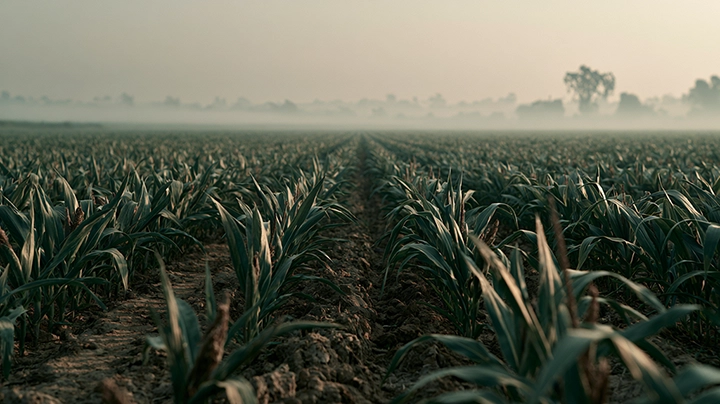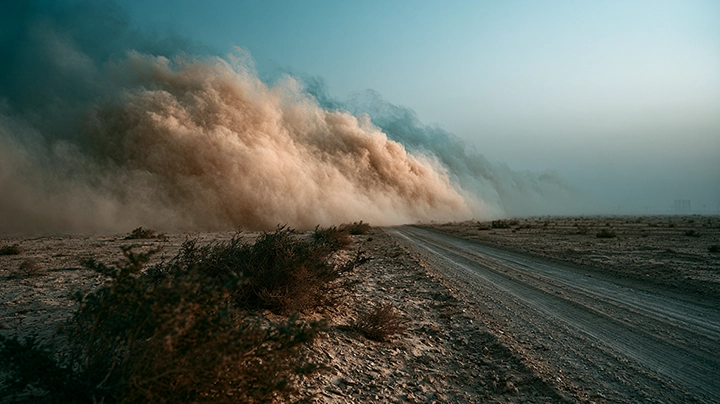
Valley fever infects an estimated 150,000 people in the United States every year, yet most cases go undiagnosed. The disease begins in soil — caused by Coccidioides fungi native to arid and semi-arid landscapes — and reaches human lungs when disturbed ground sends spores airborne. For decades, researchers have understood this basic pathway. What remained unclear is how spores survive atmospheric transit long enough to travel significant distances and remain infectious. A new hypothesis proposes the answer may lie not in the spore alone, but in what it travels with.
Dust as a Biological Transport Vehicle
The central idea is this: Coccidioides arthroconidia — the infectious spore form of the fungus — may attach to airborne dust particles during soil disturbance events. Once bonded to dust, these particles could provide both transportation and physical protection. The atmosphere is a hostile environment for unshielded biological particles: ultraviolet radiation, dehydration, and temperature swings degrade spore viability over time. Attached to a dust particle, a spore gains a layer of shielding that may extend its atmospheric persistence significantly.

If the hypothesis holds, dust stops being a passive background condition and becomes an active component of the disease transmission system. Soil disturbance events — construction, farming, earthquakes, road building — would become not merely correlates of Valley fever outbreaks but potential drivers of fungal dispersal across wide geographic areas.
Why Dust Storms Correlate With Outbreaks
Epidemiologists have long noted that Valley fever cases cluster around dust-generating events. Construction projects, agricultural activity, seismic events, and large dust storms in the southwestern United States and northern Mexico all show statistical associations with elevated case counts. These correlations have been documented, but the mechanism linking them was less well defined. The dust-transport framework offers a coherent causal explanation: if infectious spores travel as passengers on dust particles, then anything that mobilizes soil becomes capable of mobilizing the pathogen — transforming the correlation from a statistical pattern into a biological process that could eventually be modeled and anticipated.
Where Atmospheric Science Meets Medical Mycology
The hypothesis draws on an interdisciplinary tradition that places atmospheric processes at the center of disease ecology. Understanding Valley fever risk may require understanding how particles move through the lower atmosphere — wind dynamics, aerosol transport, land-surface conditions, and regional circulation patterns — as much as it requires understanding the fungus itself. This represents a meaningful shift: Valley fever has historically been approached through microbiology and clinical epidemiology. Incorporating atmospheric science expands the analytical toolkit and may reveal risk factors invisible to traditional disease surveillance systems.

Climate Change Widens the Problem
The implications become more significant when combined with climate projections. Warming temperatures, extended droughts, and expanding arid zones are already pushing the ecological range of Coccidioides northward and eastward in North America. Simultaneously, the conditions that generate dust events — reduced vegetation cover, drier soils, more intense wind events — are expected to become more frequent across many regions. If dust is a meaningful dispersal vehicle, climate-driven increases in dust generation could expand both the geographic reach and the seasonal duration of Valley fever risk well beyond its traditional endemic zones.
From Hypothesis to Forecasting Tool
One of the most practically relevant implications of the research is its potential contribution to predictive public health. If Valley fever transmission tracks dust transport, integrating atmospheric modeling with fungal ecology could enable risk forecasting that anticipates outbreaks rather than reacting to them. Future systems might combine dust-source mapping, satellite data, climate projections, and ground-based spore monitoring to identify periods and locations of elevated exposure — moving Valley fever management toward weather-style public health guidance. The hypothesis is not yet proven; the science requires field validation at scale. But the framework it proposes connects disciplines that have rarely spoken to each other, and the direction it points is significant.
Frequently Asked Questions
What is Valley fever?
Valley fever (coccidioidomycosis) is a fungal infection caused by Coccidioides species native to arid soils in the southwestern United States and parts of Mexico and Latin America. It is contracted by inhaling fungal spores that become airborne when soil is disturbed.
How does dust affect Valley fever risk?
The hypothesis discussed in this article proposes that Coccidioides spores may travel attached to airborne dust particles, which could shield them from UV radiation and dehydration during atmospheric transit. If confirmed, this would help explain why Valley fever clusters around dust-generating events such as construction activity and storms.
Where is Valley fever most common?
It is most common in the southwestern United States — particularly California’s San Joaquin Valley, Arizona, and Nevada — and in parts of northern Mexico. Climate change is associated with expanding endemic zones northward and eastward.
What are the symptoms of Valley fever?
Many infections produce no symptoms. When symptoms occur, they typically resemble flu — fatigue, cough, chest pain, and fever — appearing one to three weeks after exposure. Severe or disseminated disease is less common but can affect the bones, joints, and central nervous system.