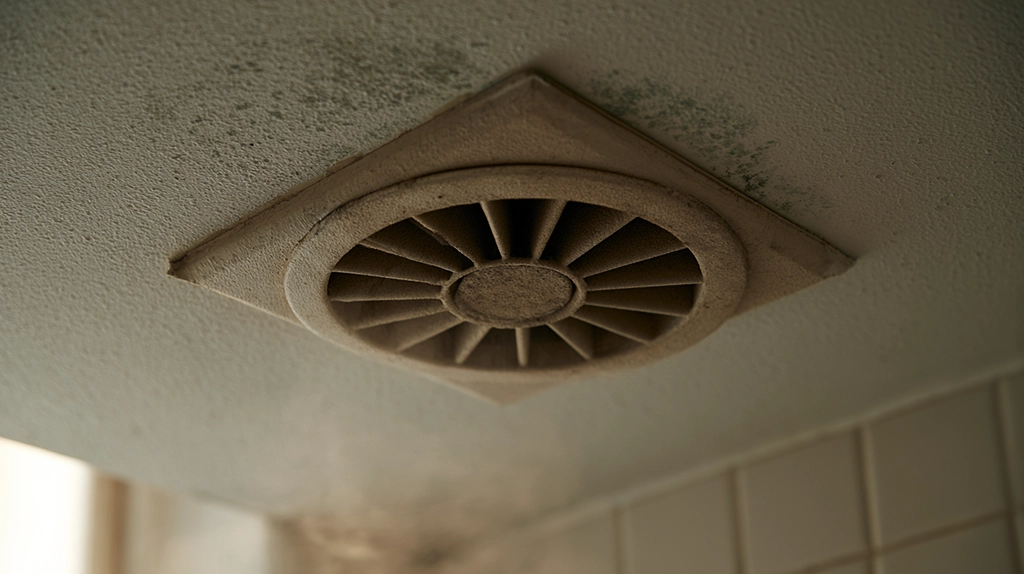
You finish a hot shower, step out, and notice a stale, musty smell near the ceiling fan. The fan cover looks dusty. Small gray specks dot the ceiling around it. The mirror stays foggy longer than it used to. These are not unrelated observations — they describe the same moisture problem from different angles. Bathroom exhaust fan mold is one of the most common indoor mold situations homeowners encounter, and it almost always begins with a drying failure, not a plumbing one.
Why Hot Showers Create Mold-Friendly Conditions
A hot shower fills a small enclosed space with warm vapor almost instantly. That vapor rises to the ceiling, where it meets cooler surfaces and condenses into droplets. In a well-functioning bathroom with adequate ventilation, the exhaust fan pulls humid air out before it settles. When the fan is weak, clogged, undersized, poorly vented, or turned off too soon, vapor lingers. It settles on dust covering the fan cover, on ceiling paint near the fixture, and on grout and caulk nearby. Damp dust — containing lint, hair, soap residue, and household particles — provides organic material mold can colonize when conditions stay humid long enough. A musty smell near the fan is often the first sign this combination is already under way.

Why Exhaust Fans Fail
A noisy fan is not necessarily an effective one. Many bathroom fans move little air because the cover is choked with dust, the motor is aging, the duct run is too long or kinked, or the duct was never properly connected to an outdoor exit. Some homes vent bathroom fans into attic spaces or wall cavities — this moves humid air out of the bathroom and deposits it somewhere it causes a different set of moisture problems. Behavioral habits compound the issue: turning the fan off immediately after the shower ends, leaving wet towels piled on hooks, or closing the bathroom door after showering all extend the time surfaces stay humid.
A Simple Test to Check Fan Performance
The tissue test requires nothing more than a single sheet of tissue paper. Turn on the exhaust fan and hold the tissue close to the cover. An effective fan pulls the tissue toward the cover firmly enough for it to stay without being held. A fan that produces little or no movement is not removing bathroom air effectively, regardless of how much noise it makes. A weak result narrows the cause: the cover needs cleaning, the motor needs service, the duct has an obstruction, or the unit is simply too small for the room.

What to Do Right Now
Run the exhaust fan during every shower and for at least 20 to 30 minutes afterward. When privacy allows, open the bathroom door after showering to let drier room air circulate in. Clean the fan cover regularly — turn off power at the circuit breaker first, remove the cover, wash it, dry it fully, and reinstall. For visible mold on hard, non-porous surfaces, clean carefully with an appropriate cleaner, wear gloves, and dry the area completely. If the same spot returns within weeks, the moisture source is still present and the ceiling, duct, or space above may need inspection.
When to Arrange a Professional Inspection
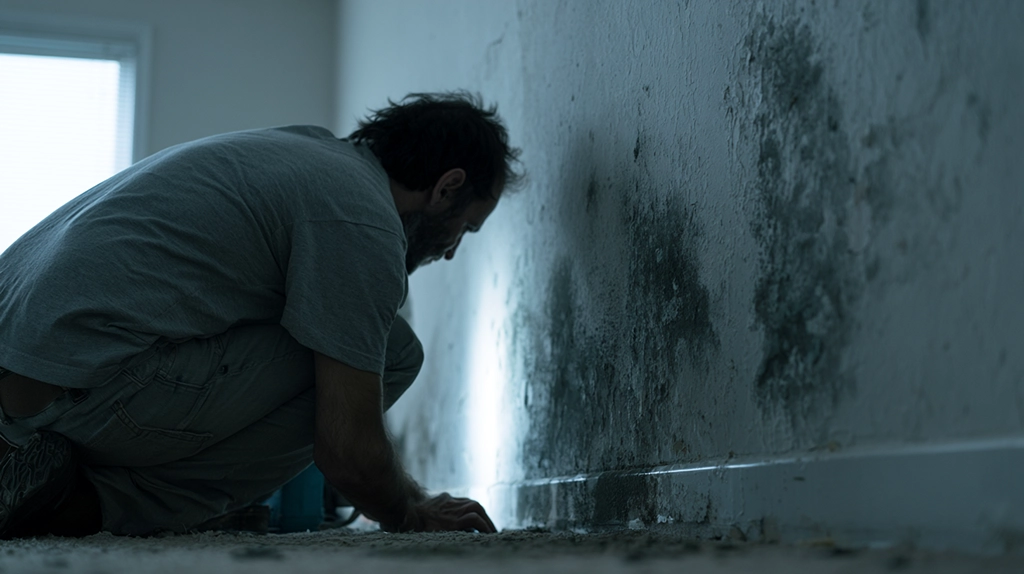
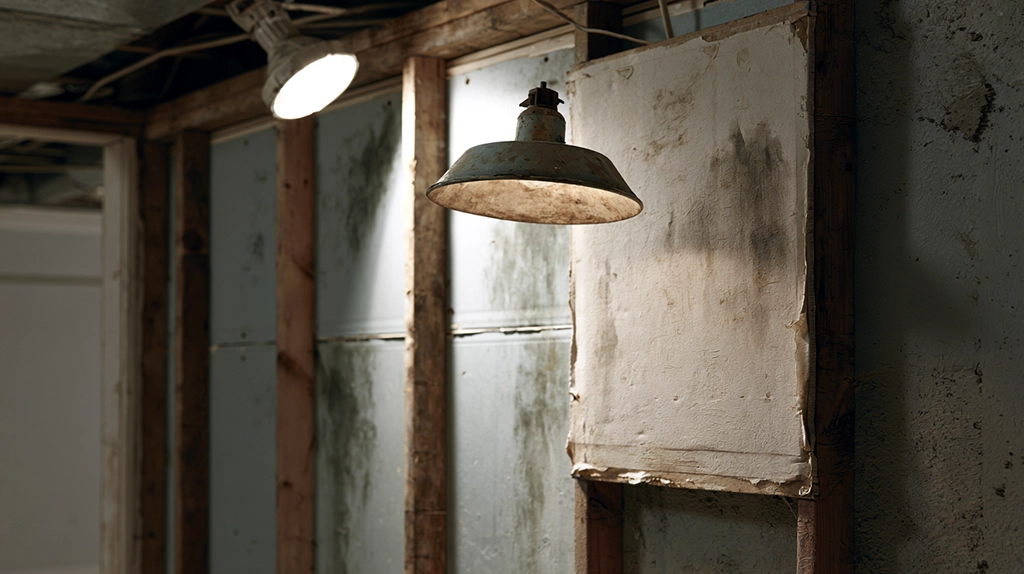
Most bathroom fan mold resolves with better ventilation habits and regular maintenance. A professional inspection becomes worthwhile when mold covers a large area, returns quickly after cleaning, is accompanied by a strong odor that cannot be located, appears on soft or damaged drywall, follows a visible water stain or ceiling sag, or is linked to a plumbing or roof issue you cannot resolve independently. Paint should not be applied over suspected mold — it hides the stain but does not remove the growth or correct the moisture condition beneath. If the ceiling material feels soft or has absorbed water, that material likely needs to be replaced, and the moisture pathway above it identified first.
Frequently Asked Questions
Why does my bathroom exhaust fan smell musty?
A musty smell near the fan indicates that humid air from showers is not being removed quickly enough. The fan cover and surrounding ceiling accumulate moisture and dust — a combination that supports mold growth. The odor is often the first sign that mold is already present, even before it is visible.
How long should I run the bathroom exhaust fan?
Run it during the entire shower and for at least 20 to 30 minutes afterward. A practical guide: leave it running until the mirror is clear of condensation. Turning it off immediately after showering leaves significant moisture in the air.
Can I just paint over bathroom mold?
No. Paint covers the discoloration but does not remove the mold or the moisture causing it. Mold under paint continues to grow and will typically break through the surface within weeks. The moisture source must be corrected first, and affected material cleaned or replaced before repainting.
How do I clean mold off a bathroom fan cover?
Turn off the circuit breaker for the fan first. Remove the cover and scrub it with a diluted cleaning solution. Dry it completely before reinstalling. If the fan housing itself shows mold, clean it carefully with power off and vacuum any loosened material before restoring power.