
Reinventing Crop Defenses in the Era of Smart Fungi
For thousands of years, the war between crops and fungal pathogens has played out in the world’s fields—an evolutionary arms race that’s left both sides battered, but fungi often with the upper hand. From medieval famines triggered by wheat rust to present-day harvests ruined by blight or rot, fungal pathogens have mastered the art of adaptation, always finding a way around the latest plant defense or chemical weapon. But in 2026, the ground is shifting. The next revolution in agriculture isn’t coming from a new pesticide, nor a breakthrough in traditional breeding, but from the invisible hand of artificial intelligence—and a radical vision for how plants can defend themselves.

Digital Blueprints: How AI and Synthetic Biology Are Rewriting Immunity
Scientists are moving beyond the old “one-gene, one-disease” model of plant defense. Instead, they are harnessing big data, machine learning, and the power of synthetic biology to create crops with immune systems that can recognize and counter a much broader spectrum of fungal threats. At the heart of this strategy are plant pattern recognition receptors (PRRs) and intracellular NLRs—molecular sentinels that detect specific signatures, or “patterns,” from would-be invaders.
Traditionally, these receptors have been limited, only recognizing a handful of known pathogens. The moment a fungus mutates or a new strain emerges, crops are left vulnerable once again.
Enter artificial intelligence. By analyzing mountains of genomic and protein-structure data from both plants and their fungal foes, AI algorithms can predict the molecular “moves” pathogens might make next.
Scientists are using these insights to design synthetic versions of immune receptors—some dubbed “pikobodies”—that are not just more robust, but programmable. These engineered proteins can be inserted into crop genomes, equipping them with a customizable, multi-layered defense that evolves slower than the fast-shifting fungal playbook.
Beyond Fungicides: Why Programmable Immunity Matters
Fungi are masters of stealth and surprise. Their spores travel by wind, survive in soil, hitch rides on tools, boots, and insects, and, above all, mutate at dazzling speeds. Chemical fungicides—once the front line of defense—are rapidly losing their edge as resistance spreads.
Meanwhile, global trade and climate change are moving both crops and pathogens into new territories, bringing once-local plagues to global prominence.
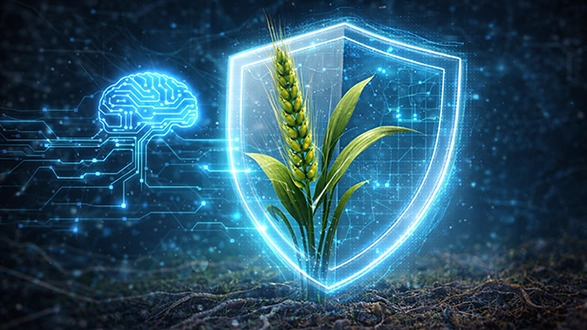
Programmable plant immunity, guided by AI and delivered through precision gene editing, changes the game. Instead of responding to each new fungal outbreak with an after-the-fact fix, scientists can equip crops with a broader, more anticipatory shield.
Synthetic immune receptors can be “stacked”—meaning plants carry a suite of detectors, each ready to catch a different class of threat. Because these can be shared across crop species, resistance learned in wheat, for example, can be ported into tomatoes or bananas.
The Changing Face of Crop Protection
Perhaps most transformative is the speed at which these new defenses can be deployed. Traditional plant breeding can take a decade or more to introduce a single new resistance gene, often only for it to be bypassed by the time it hits the market. With AI-guided design, scientists can anticipate not just the pathogens of today, but the ones likely to emerge in the coming seasons, factoring in shifts in temperature, humidity, and local fungal populations.

And the benefits go well beyond yield protection. Crops with in-built fungal resistance may need fewer chemical treatments, slashing pesticide use, reducing environmental contamination, and improving food safety for consumers.
Resilience Through Design: Custom Immunity for a Warming World
As weather patterns become more erratic, crops are increasingly stressed—not just by disease, but by heat, drought, and flooding. These conditions often create a perfect storm for fungal outbreaks. The new AI-driven approach allows researchers to fine-tune plant immune systems not only for specific fungi but for the complex, changing environments in which crops now grow.
By combining synthetic biology with detailed climate modeling, scientists are creating crops with immune systems calibrated for the conditions of the future, not the past.
This isn’t just theory. Gene stacks targeting notorious pathogens—like wheat and soybean rust fungi, Fusarium head blight, and gray mold in fruits and vegetables—are already being field-tested.
The New Agricultural Arms Race: Programmable, Predictive, and Precise
Critics rightly ask: can pathogens outmaneuver even synthetic immunity? Evolution never stands still, and fungi are nothing if not persistent. Yet by stacking multiple, broad-spectrum receptors and updating their genetic “signatures” as needed, crops gain a level of defense that’s both more durable and more flexible than anything yet achieved through conventional means.
There are, of course, questions of regulation, biosafety, and public acceptance to navigate. Will consumers embrace crops engineered with AI-designed genes? Will the benefits reach smallholder farmers as well as industrial agribusiness? As with all biotechnological advances, how and where these new defenses are rolled out will shape their impact as much as the science itself.
The emergence of AI-powered, synthetic plant immunity marks a turning point. We are entering a new phase of the plant–fungus conflict—one where intelligence and design matter as much as brute force. It’s not just a story about molds or crops, but about the fundamental ways we engineer resilience into food systems under unprecedented environmental stress.
As climate change and global trade redraw the maps of disease and opportunity, the world’s crops are getting an upgrade—from passive victims to programmable survivors. That’s not just a new defense. It’s a new kind of agricultural future.
Key Takeaways
- Scientists are moving beyond the old “one-gene, one-disease” model of plant defense.
- At the heart of this strategy are plant pattern recognition receptors (PRRs) and intracellular NLRs—molecular sentinels that detect specific signatures, or “patterns,” from would-be invaders.
- By analyzing mountains of genomic and protein-structure data from both plants and their fungal foes, AI algorithms can predict the molecular “moves” pathogens might make next.
- These engineered proteins can be inserted into crop genomes, equipping them with a customizable, multi-layered defense that evolves slower than the fast-shifting fungal playbook.
- Meanwhile, global trade and climate change are moving both crops and pathogens into new territories, bringing once-local plagues to global prominence.
Frequently Asked Questions
What should you know about please login to bookmark?
Please login Reinventing Crop Defenses in the Era of Smart Fungi For thousands of years, the war between crops and fungal pathogens has played out in the world’s fields—an evolutionary arms race that’s left both sides battered, but fungi often with the upper hand. From medieval famines triggered by
What should you know about reinventing Crop Defenses in the Era of Smart Fungi?
For thousands of years, the war between crops and fungal pathogens has played out in the world’s fields—an evolutionary arms race that’s left both sides battered, but fungi often with the upper hand. From medieval famines triggered by wheat rust to present-day harvests ruined by blight or rot, funga
What should you know about digital Blueprints: How AI and Synthetic Biology Are Rewriting Immunity?
Scientists are moving beyond the old “one-gene, one-disease” model of plant defense. Instead, they are harnessing big data, machine learning, and the power of synthetic biology to create crops with immune systems that can recognize and counter a much broader spectrum of fungal threats. At the heart
What should you know about beyond Fungicides: Why Programmable Immunity Matters?
Fungi are masters of stealth and surprise. Their spores travel by wind, survive in soil, hitch rides on tools, boots, and insects, and, above all, mutate at dazzling speeds. Chemical fungicides—once the front line of defense—are rapidly losing their edge as resistance spreads.
What should you know about the Changing Face of Crop Protection?
Perhaps most transformative is the speed at which these new defenses can be deployed. Traditional plant breeding can take a decade or more to introduce a single new resistance gene, often only for it to be bypassed by the time it hits the market. With AI-guided design, scientists can anticipate not