
Meta Description
Every time it rains, the story behind that rain is more complicated than you might think. Scientists are discovering that fungi — through the spores they release into the air — may play a subtle but measurable role in how clouds form and when precipitation falls.
Something Is Already Up There
Right now, floating invisibly through the air above you, there are fungal spores.
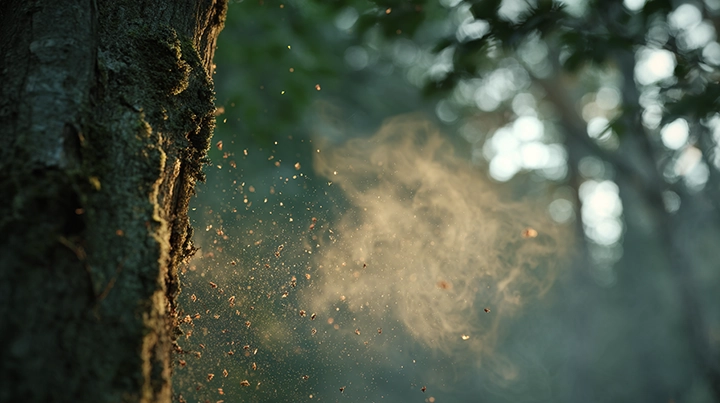
They were released from forest floors, from decaying wood, from the surfaces of leaves and soil. Wind carried them upward, into the lower atmosphere, where they join an invisible population of particles — dust, sea salt, pollutants, and biological material — that float through the sky in numbers most people never think about.
For a long time, atmospheric science treated these biological particles as largely irrelevant to weather. The real drivers of cloud formation and precipitation were physical: temperature, pressure, moisture, mineral dust. Life was something that happened on the ground, responding to the weather above.
That picture is becoming more complicated. A growing body of research suggests that the boundary between the living world and the atmospheric one is far more porous than we assumed — and that fungi, in particular, may have something to say about when and how it rains.

The Problem With Making Rain
Here is something counterintuitive about rain: water vapor in the atmosphere does not simply freeze or condense on its own.
Completely pure water will not freeze until it reaches around -46°C — far colder than clouds typically get. For ice crystals to form at the temperatures found in normal clouds, water molecules need something to build around: a surface, a nucleus, a starting point. These are called ice-nucleating particles, and without them, clouds would struggle to produce precipitation at all.
Most of what we know about ice-nucleating particles focuses on inorganic material — mineral dust carried from deserts, soot from combustion, sea salt from ocean spray. These particles are effective, plentiful, and well-studied. But at the warmer temperatures found in the lower parts of mixed-phase clouds — roughly between 0°C and -15°C — inorganic particles become less effective. And it is precisely at these temperatures that biological particles appear to have an outsized role.
Some fungal spores, it turns out, can trigger ice formation at temperatures significantly warmer than mineral dust. They carry proteins on their surfaces that interact with water molecules in ways that encourage ice crystal formation — a property that researchers have been investigating with increasing interest.
The Protein That Makes Ice
In 2023, researchers at the University of Utah, working with colleagues in Germany, published a study in PNAS that revealed something unexpected about how certain fungi nucleate ice.
Rather than requiring intact spores, the ice-nucleating activity was found to come from small protein subunits produced by the fungus — fragments far smaller and more numerous than whole spores. The common genus Fusarium, found in soils worldwide, produces these proteins, which can aggregate and act as highly efficient ice nuclei even after being separated from the fungal cells themselves.
This matters because it changes the scale of the question. Whole fungal spores are relatively large and not especially numerous in the atmosphere. But nanoscale biological fragments — tiny pieces of protein and cellular material shed continuously by living organisms — are present in far greater concentrations. If these fragments carry ice-nucleating activity, the influence of biological material on cloud processes could be substantially larger than earlier estimates suggested.
More recently, a 2026 study published in Science Advances by Virginia Tech scientists Xiaofeng Wang and Boris Vinatzer identified similar ice-nucleating proteins in the Mortierellaceae family of soil fungi — suggesting these abilities are more widespread across fungal species than previously known. The researchers also noted that fungal proteins differ from bacterial ice nucleators in a practically important way: they are cell-free and water-soluble, making them far easier to deploy — and potentially opening the door to safer alternatives to silver iodide in cloud seeding.

The Amazon as a Living Weather Machine
The most compelling evidence for fungal influence on precipitation comes from regions where biological particle concentrations are highest — particularly tropical forests.
Research conducted at the Amazon Tall Tower Observatory (ATTO) in Brazil found that biological aerosols, including fungal spores, contribute significantly to ice-nucleating particles in the atmosphere above the rainforest. The Amazon is an unusual environment in this regard: the sheer density of vegetation, fungi, and organic material means that the atmosphere above it is unusually rich in biological particles. In a region where rainfall is both locally generated and ecologically critical, this creates a feedback loop that researchers are only beginning to map.
Vegetation supports fungal growth. Fungi release spores and biological particles into the air. Those particles contribute to cloud formation. Rainfall sustains the vegetation that supports more fungal growth.
The forest, in a very real sense, participates in producing its own rain.
What the Evidence Actually Shows — and What It Doesn’t
Scientific honesty requires a note of caution here, because the picture is more nuanced than a simple “fungi make it rain” story.
Global modelling studies suggest that on a planetary scale, fungal spores and bacteria contribute only a small fraction — roughly 3 thousandths of a percent — to the average global ice nucleation rate. Mineral dust and soot dominate the global picture by a wide margin.
But averages can be misleading. At lower altitudes, in warmer cloud layers where mineral particles are less effective, biological particles appear to take on a larger role. In boreal forests and sub-Arctic regions, where fungal spore concentrations are high and other ice-nucleating particles are sparse, the effect becomes locally significant. In the Arctic, where the climate system is particularly sensitive, research published in Nature Communications found that biological particles — including fungal spores — play a crucial role in ice formation within clouds.
The honest summary: fungi are not orchestrating global weather patterns. But in specific environments and specific cloud conditions, they appear to matter more than most atmospheric models have accounted for.

What Changes When Ecosystems Change
The most practically important aspect of this research is not what fungi are currently doing to weather — it is what might happen if fungal populations change.
Deforestation, land degradation, and shifts in ecosystem composition driven by climate change could alter how many fungal spores enter the atmosphere and where. If biological particle concentrations in forested regions decline, the contribution to local cloud formation and precipitation could shift in ways that are difficult to predict and may not be captured by climate models that treat biological particles as negligible.
Conversely, as warming opens up new areas to fungal growth — in thawing Arctic soils, for instance — the input of biological particles to polar atmospheres could increase, with implications for the cloud systems that help regulate Arctic temperatures.
The atmosphere and the biosphere are coupled systems. Changes in one feed back into the other, and the connections run deeper than our models have typically assumed.
A Question Still Being Answered
The science here is genuinely unsettled in productive ways. Atmospheric researchers are still developing the tools to measure biological particles at the scale needed to understand their influence precisely. Climate models are only beginning to incorporate biological aerosols as variables rather than constants.
What is not in doubt is the underlying principle: life does not simply respond to weather. It participates in the conditions that produce it.
Every spore that drifts upward from a forest floor is carrying something into the atmosphere — not just the genetic information of a fungus trying to survive, but a small piece of the connection between the living world and the sky above it.

FAQ: Fungi, Spores, and Weather
Q: Can fungal spores actually influence rain? In certain environments — particularly forests and polar regions — yes. Some fungal spores carry proteins that promote ice crystal formation in clouds at warmer temperatures than inorganic particles can manage. However, their influence on global precipitation is limited; the effect is most significant locally, in areas with high spore concentrations and few competing particles.
Q: What is an ice-nucleating particle? It is a tiny particle — biological or inorganic — that provides a surface for water molecules to organize into ice crystals. Without these particles, clouds would struggle to produce precipitation. Mineral dust and soot are the dominant ice-nucleating particles globally, but biological particles including fungal spores can be important in specific conditions.
Q: Why are fungal spores in the atmosphere? Spore release is a fundamental part of the fungal life cycle — it is how fungi disperse and colonize new environments. Once released, spores can travel thousands of kilometres on wind currents, crossing continents and oceans before settling.
Q: What did the Amazon research find? Studies at the Amazon Tall Tower Observatory found that biological particles, including fungal spores, contribute meaningfully to ice nucleation in the atmosphere above the rainforest — supporting the idea that tropical forests participate in generating their own rainfall through biological pathways.
Q: Does deforestation affect this? Potentially. If forests are removed, the biological particles they contribute to the atmosphere decline. This could affect local precipitation patterns in regions where those particles play a significant role in cloud formation — though the magnitude of this effect is still being studied.
Q: Is this area of science well understood? Not yet. Climate models are only beginning to incorporate biological aerosols as variables. Measuring biological particle concentrations at the scale needed for accurate modelling remains technically challenging. It is an active area of research where significant discoveries are still being made.
References
Academic Sources
- Schwidetzky et al. (2023). Functional aggregation of cell-free proteins enables fungal ice nucleation. PNAS, 120(46). https://doi.org/10.1073/pnas.2303243120
- Freitas et al. (2023). Regionally sourced bioaerosols drive high-temperature ice nucleating particles in the Arctic. Nature Communications, 14. https://doi.org/10.1038/s41467-023-41696-7
- Patade et al. (2021). Empirical formulation for multiple groups of primary biological ice nucleating particles from field observations over Amazonia. Journal of Atmospheric Sciences. https://www.attoproject.org/parameterizing-bioaerosols-ice-nucleation/
- Spracklen & Heald (2014). The contribution of fungal spores and bacteria to regional and global aerosol number and ice nucleation immersion freezing rates. Atmospheric Chemistry and Physics. https://ui.adsabs.harvard.edu/abs/2014ACP….14.9051S
- Vogel et al. (2024). Ice-nucleating particles active below −24°C in a Finnish boreal forest. Atmospheric Chemistry and Physics. https://doi.org/10.5194/acp-24-11737-2024
News & Official Sources
- SciTechDaily — Can Fungi Control the Weather? Scientists Say It’s Possible (Virginia Tech / Science Advances, 2026): https://scitechdaily.com/can-fungi-control-the-weather-scientists-say-its-possible/
- ScienceDaily — Forming ice: There’s a fungal protein for that (University of Utah, 2023): https://sciencedaily.com/releases/2023/11/231113111714.htm
- ScienceDaily — Biological particles play crucial role in Arctic cloud ice formation (Stockholm University, 2023): https://www.sciencedaily.com/releases/2023/09/230928152149.htm
- Amazon Tall Tower Observatory (ATTO) — Bioaerosols and ice nucleation: https://www.attoproject.org/parameterizing-bioaerosols-ice-nucleation/
Article prepared by the MoldNewsHub editorial team based on peer-reviewed research and publicly available scientific literature.
Key Takeaways
- Please login Meta Description Every time it rains, the story behind that rain is more complicated than you might think.
- They were released from forest floors, from decaying wood, from the surfaces of leaves and soil.
- Life was something that happened on the ground, responding to the weather above.
- For ice crystals to form at the temperatures found in normal clouds, water molecules need something to build around: a surface, a nucleus, a starting point.
- These particles are effective, plentiful, and well-studied.
Frequently Asked Questions
What should you know about please login to bookmark?
Please login Meta Description Every time it rains, the story behind that rain is more complicated than you might think. Scientists are discovering that fungi — through the spores they release into the air — may play a subtle but measurable role in how clouds form and when precipitation falls.
What should you know about meta Description?
Every time it rains, the story behind that rain is more complicated than you might think. Scientists are discovering that fungi — through the spores they release into the air — may play a subtle but measurable role in how clouds form and when precipitation falls.
What should you know about something Is Already Up There?
Right now, floating invisibly through the air above you, there are fungal spores.
What should you know about the Problem With Making Rain?
Here is something counterintuitive about rain: water vapor in the atmosphere does not simply freeze or condense on its own.
What should you know about the Protein That Makes Ice?
In 2023, researchers at the University of Utah, working with colleagues in Germany, published a study in PNAS that revealed something unexpected about how certain fungi nucleate ice.