According to OUTSIDE
I. The Viral Trend of Fungal Frequencies
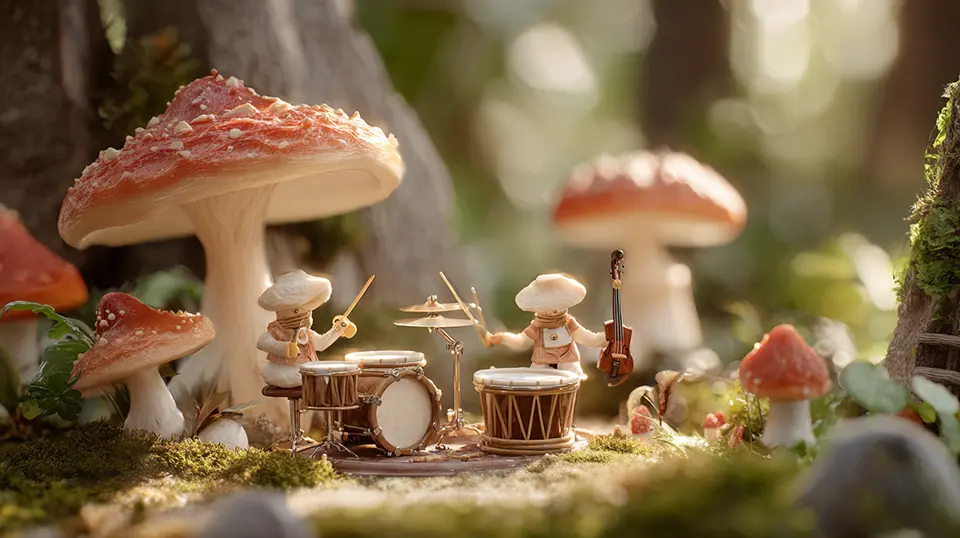
A new genre of ambient music is emerging from an unexpected source: the forest floor. Driven by viral social media videos from artists like Tarun Nayar (known as Modern Biology), the practice of “mushroom music” or fungal bio-sonification is gaining significant traction. These videos typically feature an artist in nature, hooking alligator clips to a wild mushroom—such as a red-belted conk growing on a log—which is then connected to a modular synthesizer. The result is often a gentle, rhythmic, and surprisingly melodic stream of electronic sounds that appears to be generated by the fungus itself.
This phenomenon has captured the public imagination, aligning with a broader cultural resurgence of interest in mycology (the study of fungi) and a desire for deeper connection with the natural world. It transforms silent, seemingly inanimate organisms into active participants in a sonic landscape.

Source: Wikimedia Commons, CC BY-SA 3.0
II. The Mechanism: Bioelectricity, Not a Symphony
While it is tempting to believe mushrooms are consciously composing melodies, the reality is a fusion of biology and technology. Fungi, like nearly all living organisms, are bioelectrical. They generate faint electrical signals—action potentials—in response to various environmental stimuli such as changes in light, moisture, temperature, or physical touch.
The process of “mushroom music” involves tapping into this activity:
Biodata Sonification: Artists use devices initially designed to measure plant bioelectricity. Electrodes are inserted into the mushroom’s flesh or the mycelial network underneath.
Measuring Resistance: The device measures tiny fluctuations in electrical resistance or conductivity within the fungal tissue.
Data to Sound: Crucially, this raw electrical data is not sound. It is converted into MIDI signals. These signals are fed into a synthesizer, where the human artist has pre-selected the specific instrument sounds, scales, and audio effects.
Therefore, the final output is a collaboration: the mushroom provides the raw rhythmic data based on its biological activity, and the human artist provides the aesthetic musical palette. Tarun Nayar acknowledges this, noting there is “a lot of creative liberty” involved in interpreting the signals.

Source: Wikimedia Commons, CC BY-SA 4.0
III. Pioneers of the Myco-Sonic Landscape
While currently trending, this practice has deeper roots. Artists like Tosca Terán have been working with fungal bio-sonification for years, creating immersive installations that translate the hidden processes of mycelium into audible experiences. Terán even presented a “non-human” audio installation featuring live fungi at the Venice Biennale. Other prominent figures in this niche community include Noah Kalos (Mycolyco), who builds his own specialized modules to interface with fungi.
For these practitioners, the goal is often less about creating a chart-topping hit and more about creating a bridge for human engagement. It is a way to make the invisible, complex, and dynamic processes of the fungal kingdom perceivable to human senses.

Source: Wikimedia Commons, CC BY-SA 3.0
IV. Viewpoint: A Powerful Tool for Ecological Connection
From an objective perspective, “mushroom music” resides at the fascinating intersection of art, technology, and ecology. It is important to clarify that this is not evidence of fungal “language” or “sentience” in the human sense. The mushroom is not “feeling sad” and playing a minor chord; it is reacting biologically to its environment, and a synthesizer is interpreting that reaction as a minor chord based on human programming.
However, the value of this practice lies in its ability to shift human perception. By turning biological data into sound, these artists highlight that fungi are not passive background scenery but active, responsive, and dynamic components of ecosystems. It serves as a powerful, accessible tool for science communication, fostering a sense of wonder and encouraging a deeper ecological awareness of the intricate life teeming beneath our feet.
References
Text References
According to OUTSIDE
Key Takeaways
- Artists such as Tarun Nayar (Modern Biology) are converting real bioelectrical signals from fungi into ambient music through synthesizers—a practice known as bio-sonification.
- A 2022 study by University of the West of England professor Andrew Adamatzky found that fungi generate electrical impulses that cluster into patterns resembling primitive signals.
- The viral trend has ignited mainstream interest in mycology, with mushroom music videos reaching millions of views across social media.
- Scientists caution that while bioelectrical signals in fungi are real and measurable, interpreting them as intentional “communication” remains scientifically speculative.
- The practice sits at the intersection of mycology, environmental art, and electronic music—reflecting a broader cultural reconnection with the natural world.
Frequently Asked Questions
What is fungal bio-sonification?
Bio-sonification is the process of converting biological signals—such as the bioelectrical impulses measured in fungi—into audible sound. Artists attach electrodes to mushrooms or mycelium, route the electrical output through MIDI converters or synthesizers, and produce music in real time that responds to the organism’s internal electrical activity.
Do fungi really produce electrical signals?
Yes. Research published in Royal Society Open Science (2022) by Professor Andrew Adamatzky of the University of the West of England found that several fungal species—including ghost fungi and caterpillar fungi—generate electrical impulses that travel through mycelial networks at speeds comparable to slow neural signals. These spikes cluster into patterns with a vocabulary of up to 50 distinct signal types.
Are fungi actually communicating through these signals?
Scientists maintain appropriate caution. While the electrical patterns are real and measurable, whether they constitute intentional communication is unproven. The signals may coordinate nutrient transport, respond to physical damage, or serve other regulatory functions. Attributing language-like intent to fungi—though culturally compelling—is not supported by current evidence.
Who is Tarun Nayar and why is his work significant?
Tarun Nayar, known as Modern Biology, is a Canadian musician and naturalist who popularised mushroom music through social media. His videos—typically filmed in forests, featuring fungi connected to modular synthesizers—have been viewed millions of times and inspired a new wave of artists exploring biological sound, bringing public attention to fungal research in the process.
What equipment is needed to make mushroom music?
Practitioners typically use two conductive electrodes (alligator clips) attached to a mushroom cap or inserted into mycelium, connected to a biosignal amplifier or interface (such as a custom bioelectrical transducer). The output is converted to MIDI control voltage and fed into a modular synthesizer or digital audio workstation, where the electrical variance is mapped to pitch, rhythm, or other musical parameters.