
When Climate Stress Weakens Crop Defenses
The conversation about mold and crops tends to focus on the fungus. Humidity levels, storage conditions, rainfall patterns, warming temperatures — these are the variables that dominate discussions about mycotoxin contamination and agricultural fungal disease. The plant itself is usually treated as a passive surface: something that gets infected, something that gets contaminated, something that needs to be protected by external intervention.
A recent review published in Frontiers in Plant Science challenges that framing directly. It examines the role of plant oxylipins — lipid-derived signaling molecules that help plants detect stress, coordinate defense, and respond to fungal attack. The review’s central argument is that climate change is not only altering where fungi grow and how aggressively they spread. It is also interfering with the internal chemistry that crops use to defend themselves.
The plant is not a passive actor in the mold-risk equation. Its stress chemistry helps determine whether fungal invasion succeeds, whether mycotoxins accumulate, and whether a contamination event becomes a food-safety crisis or is contained. Understanding that chemistry — and how climate disruption is changing it — may be as important as understanding the fungi themselves.
What Are Plant Oxylipins?
The name suggests complexity, but the underlying concept is intuitive.
Oxylipins are chemical alarm signals. When a plant is wounded, infected, drought-stressed, or otherwise under threat, it produces these molecules through enzyme-driven pathways — primarily through enzymes called lipoxygenases — that convert polyunsaturated fatty acids into a range of signaling compounds. Jasmonic acid is one of the most well-known; others include 12-OPDA, various ketols, and the green leaf volatiles that give freshly cut grass its characteristic smell.
These molecules do not act in isolation. They participate in coordinated signaling networks that help the plant assess what kind of threat it is facing and mobilize an appropriate response. Wound repair. Drought adaptation. Pathogen resistance. The prioritization of resources between growth and defense. Oxylipins are part of the molecular communication system through which plants make these decisions — not consciously, but biochemically, in real time, in response to environmental conditions.
In stable conditions, these systems function as designed. Under the kind of environmental stress that climate change is generating with increasing frequency, they can be disrupted.

Climate Change Is Reshaping the Mold–Crop Relationship
The review identifies a dangerous convergence that is developing as climate conditions become more volatile.
On one side: warming temperatures, unstable rainfall, prolonged drought, and flooding events are creating conditions that favor the growth and spread of toxin-producing fungi. Aspergillus flavus, Fusarium species, and other mycotoxin-producing pathogens are responding to environmental shifts in ways that increase agricultural risk.
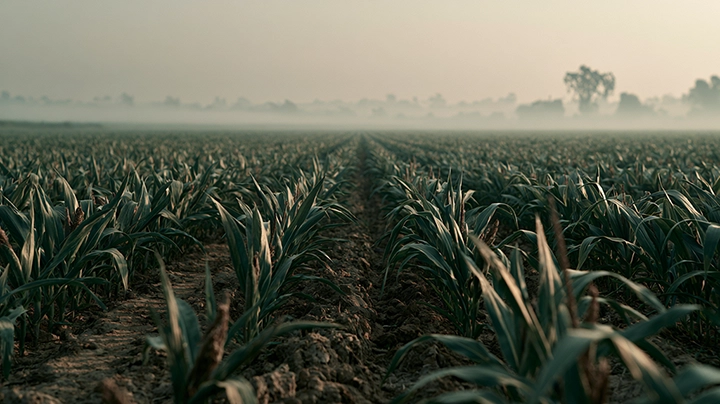
On the other side: the same environmental stresses are weakening crop physiology. Heat stress disrupts metabolic processes. Drought interferes with the enzymatic pathways plants rely on for defense signaling. Flooding damages root systems and alters tissue chemistry. Temperature instability prevents plants from mounting consistent immune responses.
The result is a compounding problem. Fungal pressure rises precisely when plant resistance is most compromised. The conditions that favor fungi are the same conditions that undermine the crop’s capacity to fight back.
This is where oxylipin research becomes directly relevant to food safety. Oxylipins are part of the defense network that should activate when fungi are present. When climate stress disrupts that network — when the alarm signals are weak, delayed, or misdirected — the plant’s response to fungal invasion is compromised before the infection even begins.
The Molecular Battle Behind Mycotoxin Contamination
One of the review’s most significant contributions is its reframing of mycotoxin contamination as a biochemical interaction rather than simply an environmental event.
Mycotoxins — the toxic compounds produced by certain fungi during colonization — do not appear automatically when a fungus encounters a crop. Their production depends partly on what the plant is doing in response. Oxylipin signaling pathways in the host plant can influence fungal development, sporulation patterns, and mycotoxin biosynthesis itself. The plant’s defense chemistry and the fungus’s toxin chemistry are in dialogue with each other.
The most concrete example in the review involves maize and the gene ZmLOX4. When this gene loses function — disrupting a specific step in the oxylipin signaling pathway — maize plants show increased susceptibility to Fusarium verticillioides and greater vulnerability to Aspergillus flavus and aflatoxin contamination. The molecular defense signal is compromised, and the fungal invasion proceeds further and produces more toxin as a result.
This is a direct demonstration of a principle that has broader implications: plant defense chemistry can determine whether fungal contamination becomes a food-safety problem or is contained at the cellular level before it escalates.

Mycotoxins: The Invisible Consequence
Mycotoxins are among the more underappreciated food safety hazards in global agriculture — partly because they are invisible, and partly because they persist after the visible fungal growth is gone.
When Aspergillus flavus colonizes a maize crop, for example, the aflatoxins it produces can remain in the grain long after the fungus itself is no longer active. Cooking and processing do not reliably eliminate them. The toxins can contaminate both human food and animal feed, creating health risks and generating significant economic losses through rejected shipments, trade restrictions, and regulatory enforcement.
Climate volatility makes this worse across multiple dimensions simultaneously. It increases fungal growth pressure. It weakens crop resistance. It alters the environmental conditions in storage facilities. And it affects the timing of harvest, drying, and transport in ways that influence how much exposure contaminated grain has to conditions favorable for further toxin accumulation.
The review’s argument is that future food safety cannot be adequately addressed by focusing only on the fungal side of this equation. The plant’s defense chemistry — including oxylipin signaling — is a variable that matters, and it is a variable that climate change is actively disrupting.
CRISPR and the Future of Climate-Resilient Crops
The review examines how gene-editing tools, particularly CRISPR/Cas systems, are being used to investigate and potentially strengthen oxylipin-related defense pathways in crops.
Genes including LOX3 in maize, LOX1 in rice, and related signaling genes in barley are being studied for their roles in drought response, disease resistance, seed storage quality, and fungal defense. By disrupting or modifying these genes in experimental settings, researchers can observe how specific components of the oxylipin network contribute to crop resilience — and identify which modifications might improve resistance to fungal invasion under stress conditions.
The review is careful not to present this as a solved problem or an imminent technology. CRISPR-based crop improvement in this area is early-stage research. The complexity of oxylipin signaling networks — which interact with many other defense pathways and environmental response systems — means that targeted modifications can have unexpected effects elsewhere in plant physiology.
What the research does offer is a direction: toward crops with stronger built-in stress signaling, capable of maintaining fungal resistance even when climate conditions are unfavorable. Rather than relying entirely on external protection — fungicide applications, storage management, post-harvest testing — future crop systems might incorporate biological intelligence that activates when needed, before contamination escalates.
From Fungicide Dependence to Biological Intelligence
Modern agricultural practice approaches fungal contamination largely through reactive systems: chemical fungicide application during the growing season, moisture control during harvest and storage, resistant variety selection, and post-harvest testing to catch contamination before food enters the supply chain.
These systems work, and they remain necessary. But they are designed around relatively stable environmental baselines. As drought frequency increases, as temperature extremes become more common, as flooding events disrupt growing seasons in ways that conventional agricultural planning did not anticipate, the limits of purely reactive approaches become more apparent.
A crop that enters a stress period with robust oxylipin signaling intact — capable of responding quickly to fungal attack even under drought conditions — is fundamentally more resilient than one whose defense chemistry has already been compromised before the fungus arrives. The difference is not visible in the field. It plays out at the molecular level, in the signaling cascades that determine whether a fungal encounter becomes a contamination event.
Oxylipin research contributes to a longer-term shift: toward agricultural systems where biological resilience is designed in, not only bolted on.
Why This Matters Beyond the Laboratory
The molecular biology of plant defense signaling can seem remote from the practical realities of food production. The connection becomes clearer when the scale of mycotoxin contamination is considered.
Aflatoxins and other mycotoxins affect some of the world’s most critical food staples — maize, wheat, rice, soybeans. They create health risks for human populations and animals, disrupt international trade through regulatory rejections, and generate economic losses that fall disproportionately on farmers in regions already facing climate stress and limited storage infrastructure.
As climate volatility intensifies in coming decades, the agricultural systems most vulnerable to these losses are those where both fungal pressure is highest and crop defense systems are most likely to be compromised by environmental stress. Understanding how oxylipin signaling functions, how climate disruption affects it, and how it might be strengthened through breeding or biotechnology is not an abstract scientific exercise. It is preparation for a food-safety challenge that is already developing.
The Future of Food Safety May Begin Inside the Plant
The framework the review offers is a useful reorientation. Mold risk in agriculture is not only a story about fungi, humidity, and storage. It is also a story about stressed plants, disrupted defense chemistry, and the molecular signals that determine whether a crop can resist contamination under adverse conditions.
Plants are not passive victims of fungal attack. They are active participants in a biochemical negotiation — constantly assessing environmental conditions, producing alarm signals, coordinating defense responses. When climate stress disrupts those systems, the outcome of that negotiation shifts in favor of the fungus.
Understanding how to support plant defense chemistry — and how climate conditions are currently undermining it — may become one of the more important contributions plant science can make to food security in a warming world. The alarm systems are there. The question is whether they can be kept functional when environmental conditions are working against them.
FAQ
What are plant oxylipins? Lipid-derived signaling molecules produced by plants under stress — including wounding, drought, and pathogen attack — that help coordinate defense responses and environmental adaptation.
How do oxylipins affect mold and mycotoxins? By influencing the plant–fungus interaction at the molecular level, including fungal growth, toxin production, and the crop’s capacity to resist colonization.
Why does climate change increase mycotoxin risk? Because environmental stress simultaneously weakens crop defense systems and creates conditions favorable for fungal growth and toxin production — compounding the contamination risk.
Can CRISPR help reduce crop contamination? Potentially. Gene-editing tools are being used to study and potentially strengthen oxylipin defense pathways, though practical applications remain in early-stage research.
Why are plant defense signals important for food safety? Because stronger crop defense systems may reduce fungal invasion and toxin accumulation before contaminated food enters the supply chain — addressing the problem at an earlier stage than post-harvest intervention.
References
- Frontiers in Plant Science — Plant Oxylipins in Climate Stress and Fungal Defense: https://www.frontiersin.org/journals/plant-science/articles/10.3389/fpls.2025.1739321/full
Key Takeaways
- Please login When Climate Stress Weakens Crop Defenses The conversation about mold and crops tends to focus on the fungus.
- The plant itself is usually treated as a passive surface: something that gets infected, something that gets contaminated, something that needs to be protected by external intervention.
- It examines the role of plant oxylipins — lipid-derived signaling molecules that help plants detect stress, coordinate defense, and respond to fungal attack.
- The plant is not a passive actor in the mold-risk equation.
- Understanding that chemistry — and how climate disruption is changing it — may be as important as understanding the fungi themselves.
Frequently Asked Questions
What should you know about please login to bookmark?
Please login When Climate Stress Weakens Crop Defenses The conversation about mold and crops tends to focus on the fungus. Humidity levels, storage conditions, rainfall patterns, warming temperatures — these are the variables that dominate discussions about mycotoxin contamination and agricultural f
When Climate Stress Weakens Crop Defenses?
The conversation about mold and crops tends to focus on the fungus. Humidity levels, storage conditions, rainfall patterns, warming temperatures — these are the variables that dominate discussions about mycotoxin contamination and agricultural fungal disease. The plant itself is usually treated as a
What Are Plant Oxylipins?
The name suggests complexity, but the underlying concept is intuitive.
What should you know about climate Change Is Reshaping the Mold–Crop Relationship?
The review identifies a dangerous convergence that is developing as climate conditions become more volatile.
What should you know about the Molecular Battle Behind Mycotoxin Contamination?
One of the review’s most significant contributions is its reframing of mycotoxin contamination as a biochemical interaction rather than simply an environmental event.