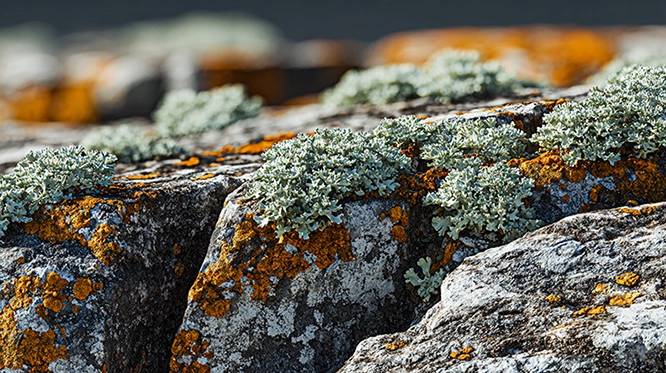
Lichens usually appear in textbooks as a triumph. They grow on bare rock, survive arctic cold and desert heat, and persist in places where almost nothing else establishes itself. The standard explanation is simple: a fungal partner handles structure and protection; a photosynthetic partner — algal or cyanobacterial — handles energy production. Together they form something more durable than either could become alone.
That story is accurate as far as it goes. The problem is how far it goes.
A study in Proceedings of the Royal Society B offers a more granular view of what happens inside these partnerships when environmental conditions change. What it finds complicates the resilience narrative considerably — and raises questions that extend well beyond lichen biology.

Multiple lichen species colonizing a single rock surface at Joshua Tree National Park — each a partnership between fungal and photosynthetic partners that appears stable from the outside, even when internal function has begun to change. Credit: Joshua Tree National Park / Alessandra Puig-Santana, via Wikimedia Commons, Public DomainTwo Partners, Two Response Curves
The study examines how the fungal and algal components of a lichen respond independently to temperature shifts and moisture stress. The central finding is consistent: they don’t respond the same way.
In many cases, the fungal partner maintains its structural role under stress — holding moisture, protecting the partnership from desiccation, keeping the physical system intact. The algal partner, responsible for photosynthesis, shows something different: a measurable decline in energy production efficiency before any structural change is visible.
This creates a functional mismatch inside what looks, from the outside, like a stable organism.
It’s not a collapse. It doesn’t register as one. The lichen is still there, still physically present, still holding its position on the rock or bark. But internally, the two partners have begun responding to the same stress in different ways — and that divergence has consequences that accumulate over time.
The Difference Between Being Present and Functioning

Cross-section through a heteromeric lichen thallus, showing the distinct layers: upper cortex (a), photobiont/algal layer (b), medulla (c), lower cortex (d), and rhizines (e). The fungal and algal components occupy separate structural zones — and respond to environmental stress independently.Credit: Nefronus, via Wikimedia Commons, CC BY-SA 4.0Standard ecological monitoring tends to treat presence as the primary signal. An organism is there or it isn’t. That binary captures something real, but it misses a category that turns out to matter.
Lichens make this visible. Under moderate stress, the fungal framework remains intact. Moisture regulation continues. The physical structure of the partnership holds. By most conventional measures, the organism is doing fine.
Simultaneously, the photosynthetic partner may be losing efficiency. Energy production drops. The system is running on less than it was. That shortfall doesn’t trigger immediate collapse — lichens are genuinely stress-tolerant — but it accumulates. The imbalance grows. Eventually, the system reaches a threshold it can no longer sustain.
The result is what might be called delayed failure. Not sudden, not legible in real time, but progressive and, by the time it becomes visible, already far along.
In conservation terms, that’s a significant problem. Systems showing early functional decline may look indistinguishable from healthy systems until the damage is difficult to reverse.
Why the Two Partners Diverge
The mismatch isn’t a flaw in the partnership. It’s a consequence of how the partners evolved.
Fungi and photosynthetic algae optimized for different problems. The fungal component developed tolerance for desiccation, structural stress, and water management — problems relevant to building and maintaining a protective body across variable conditions. The algal component developed efficiency in light capture and energy conversion — a different optimization, tuned to different variables.
Under stable conditions, those specializations complement each other. Under stress, they diverge. Temperature increases tend to affect photosynthetic systems more acutely. Prolonged dryness creates pressure that the fungal partner can buffer longer than the algal one can sustain productive function. The two partners don’t reach their stress limits at the same time.
So when the environment shifts, the partnership doesn’t adapt as a single unit. It adapts as two organisms with different tolerances — and the gap between those tolerances is where the system weakens.
What This Means in a Warming World

Xanthoria parietina — a lichen-forming fungus widely used as an environmental indicator — on the bark of a fruit tree. Its sensitivity to air quality and moisture fluctuation makes it a sentinel species for detecting environmental stress. Credit: Uoaei1, via Wikimedia Commons, CC BY-SA 4.0Lichens are already used as environmental indicators, particularly for air quality and climate conditions. They’re sensitive in ways that make them useful for early detection of environmental change.
This research suggests they’re even more informative than previously understood — and also more vulnerable.
In regions experiencing sustained temperature increases, the internal balance of lichen partnerships may begin shifting before any visible decline appears. The algal partner comes under heat stress; photosynthesis becomes less efficient; the fungal partner compensates as long as it can. The lichen looks intact. The decline has already begun.
In areas with fluctuating moisture — oscillating between wet and dry periods as precipitation patterns shift — the stress cycle may be especially damaging. Brief recoveries can mask persistent underlying instability. The partnership spends more time managing stress and less time in the productive equilibrium that sustains it over years and decades.
When visible lichen decline does appear, the process has typically been underway for longer than the detection point suggests.
A Pattern That Appears Across Systems

A reef showing healthy and bleaching corals side by side — the same pattern seen in lichen partnerships under stress: the system still looks intact, but internal function has already begun to diverge. Credit: NOAA, via Wikimedia Commons, Public DomainLichens are useful as a model because they’re legible — two partners, a relatively controlled system, easy to observe in isolation. But the principle they illustrate is not unique to them.
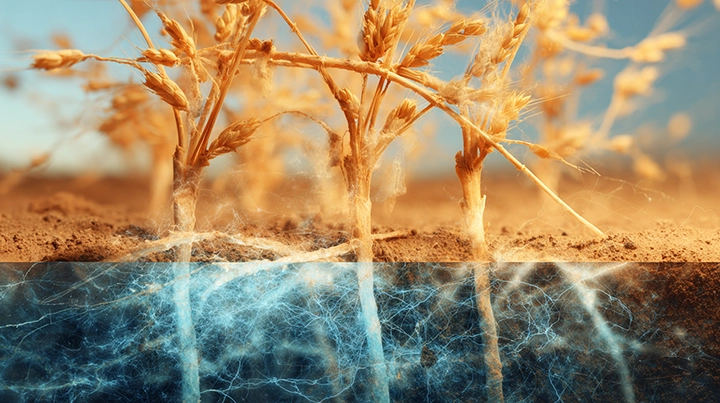
Coral reefs depend on a photosynthetic relationship with algae that is sensitive to temperature. When that relationship breaks under thermal stress, bleaching follows — and what looks like sudden failure is often the endpoint of a longer divergence. Plant roots depend on fungal networks for nutrient exchange; when those exchanges fall out of balance, growth changes in ways that don’t always register immediately. Even in the human body, health depends on alignment between host physiology and microbial communities that respond to environmental change on their own timescales.
In each case, the system functions as long as responses are coordinated. When coordination breaks down, the system doesn’t necessarily collapse at once. It stops functioning as it should — quietly, progressively, often invisibly until the deficit becomes too large to absorb.
Lichens make this visible in a context simple enough to study. The lesson they offer scales considerably further.
Rethinking Resilience
Symbiosis has a reputation for generating resilience. Two organisms supporting each other, filling in each other’s weaknesses, creating something more durable than either alone. That reputation is earned — under the right conditions.
The qualification matters. Stability in a symbiotic system depends not just on the presence of both partners, but on their responses remaining aligned as conditions change. When those responses drift apart — when one partner’s tolerance curve no longer tracks the other’s — the system becomes fragile in a way that doesn’t show on the surface.
That’s the more precise insight from this research. In a stable environment, a lichen is robust. In a shifting environment, it is a system held together by two organisms that may no longer be responding to the same pressures in the same way.
The first sign of that failure isn’t disappearance. It’s quiet imbalance — the kind that accumulates before anyone notices it has begun.
FAQ: Lichens, Symbiosis, and Environmental Stress
Are lichens truly single organisms? No. Lichens are composite systems formed by a fungal partner and a photosynthetic partner — typically an alga or cyanobacterium. They function as a unit under stable conditions, but their responses to environmental stress can diverge independently.
Why do lichens show delayed failure under stress? Because the two partners have different stress tolerances. The fungal component tends to maintain structural integrity longer, while the photosynthetic partner often loses efficiency earlier. The organism can appear intact while its energy production is already compromised.
Does climate change affect all lichens equally? No. In warmer or drier regions, heat and moisture stress tend to reduce photosynthetic efficiency more acutely. In regions with fluctuating humidity, repeated stress-and-recovery cycles may cause cumulative instability even without sustained extreme conditions.
What makes lichens useful as environmental indicators? Their sensitivity to air quality, temperature, and moisture makes them early signals of environmental change. This research suggests they may reveal functional stress before structural decline is visible, making them useful for detecting subtle environmental shifts.
Do these findings apply to other symbiotic systems? Yes. Coral bleaching, plant–fungal root networks, and host–microbiome relationships all depend on coordinated responses between partners. When that coordination breaks down, functional decline can precede visible collapse across all of these systems.
References
- Fungal and algal lichen symbionts show different responses to environmental stress — Proceedings of the Royal Society B, 2025