

The Invisible Enemies Undermining Vaccination
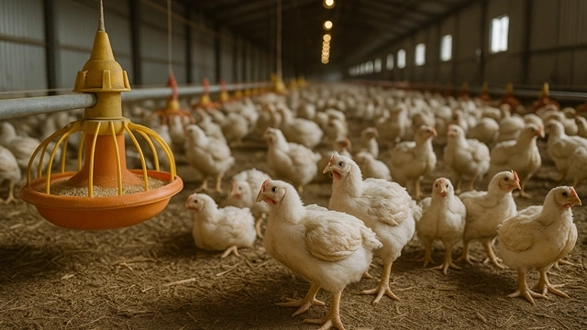
Step inside a broiler house at sunrise and it all looks reassuringly routine: the steady hum of feeders, the familiar rustle of feathers, the soft bustle of birds that seem content in their predictable world. But beneath this surface calm lies a quieter kind of conflict — one that unfolds inside the birds themselves, where immunity and intestinal integrity are constantly balancing the odds.
Vaccination is supposed to tip the scale in their favor, particularly against formidable threats such as Newcastle Disease (ND). Yet even the most carefully timed vaccines can falter when a far more insidious enemy enters the picture: mycotoxins hidden in contaminated feed.
A recent study has drawn attention to how aflatoxin B1 (AFB1) and ochratoxin A (OTA) — two notorious mold-derived toxins — quietly sabotage poultry health. These contaminants do not cause dramatic outbreaks or swooping mortality events. Instead, they chip away at the immune system and gut tissues, weakening vaccinated birds until the protection they received becomes little more than a muted signal.
But research also suggests that with the right mycotoxin binder — and more importantly, the right dosage — broilers can regain the immune resilience that toxins so effectively erode.
Aflatoxin & Ochratoxin: Small Molecules, Big Damage
AFB1 and OTA have a way of slipping into broiler diets when feed storage goes awry or grain quality dips, and their effects rarely announce themselves loudly. They hinder immune organ development, disrupt gut barriers, and diminish the bird’s ability to mount a strong response to vaccines.
In essence, they interfere with the very foundation upon which preventive medicine relies. When these toxins are present, even a perfectly timed ND vaccination cannot perform as expected — because the bird’s internal defenses are no longer in shape to respond.
This new experiment approached the problem with a clear question:
If mycotoxin binders are added to the feed, can they help vaccinated broilers maintain their immune response despite toxin exposure? And does dosage make a meaningful difference?
The answer, as it turns out, is yes — and dosage matters more than producers may realize.
Inside the Study: Four Groups, Four Different Outcomes
Researchers worked with twenty broilers divided equally among four feeding regimens. One group received clean, uncontaminated feed, representing the ideal baseline. A second group ate feed spiked with AFB1 and OTA, exposing them to the full toxic challenge.
Two additional groups consumed the same contaminated feed, but with different doses of a mycotoxin binder mixed in — a lower dose of 1.1 g/kg and a higher dose of 1.6 g/kg. All birds were vaccinated against Newcastle Disease on days 7 and 21, ensuring that any differences in immune performance would be tied to feed quality rather than vaccine timing.
Over thirty-five days, the birds’ immune responses were evaluated using hemagglutination inhibition (HI) titers, while microscopic examinations of the cecum and colon revealed how their intestinal tissues were coping with the toxins.
What unfolded was a remarkably clear picture: the higher binder dose produced results that closely resembled those in the clean control group. The immune titers of these birds rose to levels nearly identical to birds never exposed to toxins at all, while their gut tissues displayed healthier architecture, fewer lesions, and markedly less damage.
Restoring the Birds’ Internal Defenses
The contrast between the binder-protected birds and the toxin-only group was unmistakable. Birds receiving no binder showed classic signs of mycotoxin harm — reduced immune titers, ruptured mucosa, hemorrhaging tissues, and necrotic patches scattered across the gut lining.
Even the lower binder dose provided only partial relief; immunity remained suppressed, and the intestinal damage was still pronounced. But birds given the 1.6 g/kg binder displayed a near-complete turnaround. Their tissues appeared stable and intact, their mucosal layers more consistent with normal physiology, and their antibody levels strong enough to confirm that the vaccines were doing their job once the toxins were neutralized.
This outcome underscores an essential principle in poultry health:
Vaccines rely on a functioning immune system, and a functioning immune system relies on a healthy gut.
Mycotoxin binders, when dosed appropriately, act not merely as feed additives but as defenders of the internal environment vaccines depend upon.
Why This Matters for Modern Broiler Operations

The post-vaccination period is a sensitive and strategically important window for flock immunity. Any disruption during this phase — especially one caused by invisible feed contaminants — can compromise disease resistance, slow growth, elevate mortality risk, and weaken overall flock performance.
The economic repercussions can ripple across an entire production cycle, even when management practices appear to be flawless.
This study confirms a reality the poultry industry sometimes hesitates to confront:
You can vaccinate perfectly, follow the schedule meticulously, implement textbook biosecurity — and still lose the immunological battle if mycotoxins infiltrate the diet.
Feed hygiene, therefore, cannot be an afterthought. It must be as central to flock immunity as vaccination itself. The results further highlight that not all binder doses are equally protective; the difference between partial restoration and near-complete recovery in this study hinged on a small but critical shift in concentration.
A New Chapter in Poultry Immunity
As producers face increasing disease pressure, tighter margins, and fluctuating feed quality, mycotoxin binders are transforming from optional support tools into essential components of post-vaccination strategy.
The binder used at 1.6 g/kg gave broilers the chance to mount a full immune response, preserve intestinal integrity, and maintain their overall health even under toxin exposure. That level of resilience is something no vaccine alone can guarantee.
The takeaway is both simple and profound: vaccines cannot function if mycotoxins are quietly dismantling the body’s ability to use them.
Protecting the feed is protecting the immune system itself.
In the complex dance between poultry health and environmental challenges, this study delivers a clear message:
Mycotoxins are more than contaminants; they are saboteurs capable of rendering vaccination efforts fragile.
Yet with an effective binder at the right dosage, broilers can reclaim the immunity that toxins try to steal.
For an industry that depends on strong, healthy flocks, mycotoxin binders may well be the missing link in a truly robust health program.
References
- PubChem Database: Aflatoxin B1 (CID 186907), Ochratoxin A (CID 442530)
- Wikipedia: Mycotoxin, Newcastle disease, Hemagglutination inhibition test, Broiler chicken, Aflatoxin, Ochratoxin
- Poultry Science Journal. (2025). Effects of AFB1 and OTA on immune response and gut morphology in vaccinated broilers.
- Frontiers in Veterinary Science. (2024). Efficacy of mycotoxin binders in counteracting immunosuppression induced by feed contamination.
Key Takeaways
- But beneath this surface calm lies a quieter kind of conflict — one that unfolds inside the birds themselves, where immunity and intestinal integrity are constantly balancing the odds.
- Yet even the most carefully timed vaccines can falter when a far more insidious enemy enters the picture: mycotoxins hidden in contaminated feed.
- Instead, they chip away at the immune system and gut tissues, weakening vaccinated birds until the protection they received becomes little more than a muted signal.
- AFB1 and OTA have a way of slipping into broiler diets when feed storage goes awry or grain quality dips, and their effects rarely announce themselves loudly.
- When these toxins are present, even a perfectly timed ND vaccination cannot perform as expected — because the bird’s internal defenses are no longer in shape to respond.
Frequently Asked Questions
What should you know about please login to bookmark?
Please login Broiler chickens feeding in controlled poultry facility — Source: Pixabay (CC0) The Invisible Enemies Undermining Vaccination Step inside a broiler house at sunrise and it all looks reassuringly routine: the steady hum of feeders, the familiar rustle of feathers, the soft bustle of
What should you know about the Invisible Enemies Undermining Vaccination?
Step inside a broiler house at sunrise and it all looks reassuringly routine: the steady hum of feeders, the familiar rustle of feathers, the soft bustle of birds that seem content in their predictable world. But beneath this surface calm lies a quieter kind of conflict — one that unfolds inside the
What should you know about aflatoxin & Ochratoxin: Small Molecules, Big Damage?
AFB1 and OTA have a way of slipping into broiler diets when feed storage goes awry or grain quality dips, and their effects rarely announce themselves loudly. They hinder immune organ development, disrupt gut barriers, and diminish the bird’s ability to mount a strong response to vaccines.
What should you know about inside the Study: Four Groups, Four Different Outcomes?
Researchers worked with twenty broilers divided equally among four feeding regimens. One group received clean, uncontaminated feed, representing the ideal baseline. A second group ate feed spiked with AFB1 and OTA, exposing them to the full toxic challenge.
What should you know about restoring the Birds’ Internal Defenses?
The contrast between the binder-protected birds and the toxin-only group was unmistakable. Birds receiving no binder showed classic signs of mycotoxin harm — reduced immune titers, ruptured mucosa, hemorrhaging tissues, and necrotic patches scattered across the gut lining.