
The Forest You Cannot See
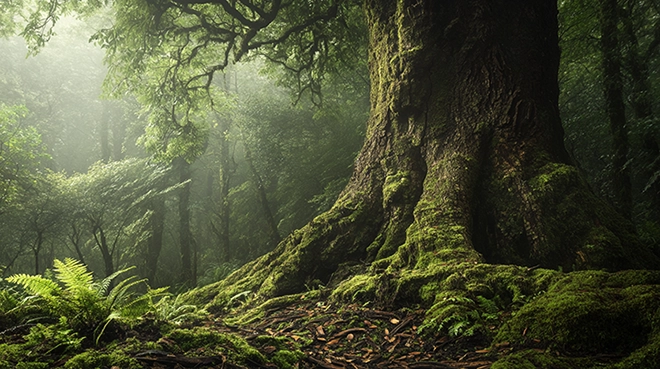
Old-growth forests inspire awe for the obvious reasons. The trees are massive, ancient, and visually overwhelming — trunks wider than cars, canopies that block the sky, bark scarred by centuries of weather. Visitors to these forests tend to look up.
But a 2026 study published in Biodiversity and Conservation makes a case for looking down. Examining soil and mycorrhizal fungal communities beneath Alerce trees (Fitzroya cupressoides) in southern Chile — including the famous “Alerce Abuelo,” an ancient conifer estimated to be more than 2,400 years old — researchers found that the oldest, largest trees support a disproportionately rich underground ecosystem that is invisible from above and largely unknown to conservation planning.
The forest beneath the forest turns out to be as complex as the one we can see. And considerably more vulnerable.
What the Alerce Abuelo Holds Underground
The Alerce (Fitzroya cupressoides) grows in the temperate rainforests of southern Chile and Argentina and is one of the longest-lived tree species on Earth. The oldest known specimens have survived more than three millennia. The forests they inhabit are not scenery — they are ecological archives, their soils layered with centuries of accumulated root systems, fungal networks, organic matter, and microbial interactions.
The study compared fungal communities across trees of different sizes, using trunk diameter as a proxy for age. The central question: do older, larger trees support different belowground communities than younger ones?
The answer was clear. The Alerce Abuelo hosted fungal richness approximately 2.25 times higher than the mean richness per sample across the study site. Arbuscular mycorrhizal fungal richness beneath the ancient tree was 1.75 times higher than average. Researchers identified 361 unique fungal operational taxonomic units associated with the tree alone.
One ancient tree. Hundreds of distinct fungal taxa growing in its root zone that would not be there without it.

The Alerce Abuelo — an ancient *Fitzroya cupressoides* estimated to be more than 2,400 years old, located in Parque Nacional Alerce Costero, Chile. Soil samples beneath this tree revealed fungal richness 2.25 times higher than the site average, including 361 unique fungal taxa.Credit:
Gonzalo Zúñiga Solís, via Wikimedia Commons, CC BY-SA 4.0Why Fungal Biodiversity Is Forest Infrastructure
Soil fungi are not passive background organisms filling ecological space. They are active drivers of forest function.
Decomposer fungi break down organic matter — leaves, wood, roots, plant debris — cycling nutrients back into forms that living plants can use. Mycorrhizal fungi do something different and arguably more fundamental: they form symbiotic partnerships with plant roots, extending far beyond the reach of roots alone to access water and nutrients, particularly phosphorus, that plants could not obtain independently. In exchange, the plant supplies carbon to the fungal network.
This exchange supports nutrient cycling, drought resilience, seedling survival, soil structure stability, and long-term forest regeneration. Globally, mycorrhizal networks transfer enormous quantities of carbon into soils each year and play a central role in terrestrial nutrient dynamics.
The study focused especially on arbuscular mycorrhizal fungi — the group that forms the most widespread plant-fungal associations on Earth. Their richness beneath the Alerce Abuelo was not incidental. It reflected centuries of accumulated partnership between an ancient root system and the fungal communities that developed alongside it.
Ancient Trees as Umbrellas for Underground Life
Conservation biology has a concept called the umbrella species — an organism whose protection inadvertently protects many other species sharing its habitat. The idea is usually applied to large, charismatic animals: protecting wolves protects the prey populations and vegetation structures that wolves require, which in turn protects dozens of other species in the same ecosystem.
This study extends the umbrella concept underground.
If ancient Alerce trees support fungal communities 2.25 times richer than surrounding forest averages, then protecting those trees means protecting hundreds of associated fungal taxa that exist nowhere else in the landscape. The tree is the visible anchor. The fungal community is the invisible beneficiary of its protection.

How arbuscular mycorrhizal fungi (AMF) extend plant nutrient access: the hyphal network reaches beyond the root phosphate depletion zone, transferring phosphorus, nitrogen, zinc, and water while enhancing systemic resistance to pathogens. Beneath ancient Alerce trees, arbuscular mycorrhizal fungal richness was 1.75 times higher than the site average.Credit:
Catherine N. Jacott, Jeremy D. Murray and Christopher J. Ridout, via Wikimedia Commons, CC BY-SA 4.0This reframes what old-growth conservation actually preserves. A forest plantation may contain trees. It will not contain the accumulated fungal relationships that developed beneath a 2,400-year-old root system. Old-growth systems are not collections of large trunks — they are layered ecological histories that cannot be recreated by planting seedlings, regardless of how many are planted or how carefully they are tended.
Phosphorus, Soil Chemistry, and the Fungal Signature of Age
The study identified available phosphorus as one of the strongest predictors of fungal community composition across sampling sites. This finding connects the fungal results to a broader ecological reality.
Phosphorus is essential for plant growth but frequently locked in chemical forms that roots cannot directly access. Mycorrhizal fungi solve this problem by chemically mobilizing phosphorus from soil particles and transporting it to plant roots — one of the core services that make mycorrhizal partnerships so ecologically valuable.
Over centuries, large trees create stable root environments where fungal recruitment, nutrient exchange, and microbial specialization continue developing. Soil chemistry, moisture gradients, root architecture, and accumulating organic matter all interact to produce the specific fungal community signature that the study detected beneath the oldest trees.
This is not coincidence. It is the outcome of long-term ecological negotiation between biology, chemistry, and time.
The Invisibility Problem
One reason fungal biodiversity is routinely overlooked in conservation planning is that it cannot be directly observed. Birds, mammals, tree canopies, and flowering plants can be counted by walking through a forest. Soil fungi cannot.
To study the fungal communities beneath Alerce trees, researchers used DNA metabarcoding — sequencing genetic material directly from soil samples and matching sequences against fungal reference databases including UNITE, MaarjAM, and EUKARYOME. This approach can detect organisms that would otherwise leave no trace.
But the method has limits. Fungal biodiversity estimates depend heavily on the quality of reference databases. If a fungal taxon is not in the database, it cannot be identified even if its DNA is present. The true richness of the belowground system may be even greater than what the study measured.
Modern fungal conservation increasingly depends on sequencing technology, bioinformatics capacity, and expanding global fungal reference systems. Without these tools, the underground ecosystem remains largely unmappable — and therefore largely unprotected.
What Disturbance Destroys and Cannot Easily Restore
Alerce forests face mounting pressure from habitat destruction, road construction, land-use change, wildfire risk, and climate instability. Ancient trees cannot be rapidly replaced. A seedling planted today cannot recreate centuries of accumulated fungal relationships within a human lifetime, or several human lifetimes.
Climate change adds a layer of urgency. Rising temperatures, altered rainfall patterns, drought stress, and more frequent wildfire events will affect both the trees and the fungal systems beneath them. Forests that appear visually intact may already be experiencing significant changes within their soil microbiomes as conditions shift.
This is the gap between the visible and the invisible. A forest can look healthy from above while losing the functional complexity of its belowground system. By the time the above-ground damage is visible, the underground damage may already be severe.
A Different Conservation Imperative
The Alerce study offers a specific and transferable conclusion: protecting the oldest, largest trees in old-growth ecosystems may preserve disproportionate amounts of belowground fungal biodiversity that cannot be easily recreated elsewhere.
The implication extends beyond Chile. Across the world, old-growth ecosystems contain microbial relationships that developed under stable ecological conditions over centuries. These fungal systems regulate nutrient cycling, carbon storage, water balance, and resilience against environmental stress.
Once destroyed, those relationships may take far longer to rebuild than the trees themselves — if they can be rebuilt at all.
Forests store carbon in their wood. They also store biological complexity in their soils. Conservation that protects the visible structure while ignoring the invisible one is incomplete in ways that matter for long-term ecosystem function.
The visible forest may eventually return after disturbance. The invisible forest beneath it may not.
FAQ
Why are old-growth trees important for soil fungi? Old-growth trees create stable, long-term root environments and accumulated soil chemistry that support complex fungal communities developed over centuries — communities that cannot form rapidly in younger forests.
What are mycorrhizal fungi? Fungi that form symbiotic partnerships with plant roots, helping plants absorb nutrients and water — especially phosphorus — while receiving carbon from the plant in return.
How did researchers study fungal diversity beneath Alerce trees? Using DNA metabarcoding with ITS2 and SSU markers to identify fungal taxa from soil samples, matched against reference databases including UNITE, MaarjAM, and EUKARYOME.
What makes the Alerce Abuelo significant? The ancient tree hosted fungal richness 2.25 times higher than the site average and 361 unique fungal taxa, suggesting that very old trees function as reservoirs of belowground biodiversity.
Can replanting restore old-growth fungal ecosystems? Not rapidly. Old-growth fungal systems develop through centuries of interactions among roots, soil chemistry, organic matter, and microbial networks that cannot be recreated by planting trees alone.
References
- Biodiversity and Conservation (2026). Soil and mycorrhizal fungal diversity beneath ancient Alerce trees in southern Chile. Biodiversity and Conservation. https://link.springer.com/article/10.1007/s10531-026-03277-0
Key Takeaways
- Please login The Forest You Cannot See Old-growth forests inspire awe for the obvious reasons.
- But a 2026 study published in Biodiversity and Conservation makes a case for looking down.
- The Alerce (Fitzroya cupressoides) grows in the temperate rainforests of southern Chile and Argentina and is one of the longest-lived tree species on Earth.
- The study compared fungal communities across trees of different sizes, using trunk diameter as a proxy for age.
- The Alerce Abuelo hosted fungal richness approximately 2.25 times higher than the mean richness per sample across the study site.
Frequently Asked Questions
What should you know about please login to bookmark?
Please login The Forest You Cannot See Old-growth forests inspire awe for the obvious reasons. The trees are massive, ancient, and visually overwhelming — trunks wider than cars, canopies that block the sky, bark scarred by centuries of weather. Visitors to these forests tend to look up.
What should you know about the Forest You Cannot See?
Old-growth forests inspire awe for the obvious reasons. The trees are massive, ancient, and visually overwhelming — trunks wider than cars, canopies that block the sky, bark scarred by centuries of weather. Visitors to these forests tend to look up.
What the Alerce Abuelo Holds Underground?
The Alerce (Fitzroya cupressoides) grows in the temperate rainforests of southern Chile and Argentina and is one of the longest-lived tree species on Earth. The oldest known specimens have survived more than three millennia. The forests they inhabit are not scenery — they are ecological archives, th
Why Fungal Biodiversity Is Forest Infrastructure?
Soil fungi are not passive background organisms filling ecological space. They are active drivers of forest function.
What should you know about ancient Trees as Umbrellas for Underground Life?
Conservation biology has a concept called the umbrella species — an organism whose protection inadvertently protects many other species sharing its habitat. The idea is usually applied to large, charismatic animals: protecting wolves protects the prey populations and vegetation structures that wolve