
Black Gold, Red Flag
Extra-heavy crude oil (EHCO) is one of the most challenging pollutants on the planet. It doesn’t spill so much as ooze, resisting dispersants, natural degradation, and even the most aggressive remediation efforts. As the world leans more heavily on unconventional petroleum reserves, we’re also staring down the environmental risks that come with them. Traditional cleanup approaches have proven nearly useless against EHCO.
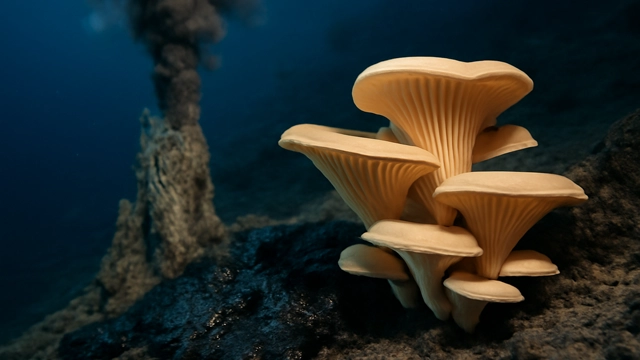
But now, deep below the ocean’s surface, in the boiling hydrothermal vent fields of the Gulf of California, scientists have discovered a remarkable cleanup crew: fungi that eat oil.

The Deep-Sea Degraders
Researchers from Mexico collected sediment samples from the Pescadero Basin, an extreme environment of scalding heat and crushing pressure. From these samples, they isolated eight fungal strains. Then came the real test: could these fungi survive—and grow—on nothing but pure EHCO?
Five of the eight passed the test. Among them, Aspergillus sydowii stood out as the MVP. In just 15 days, under low-light, nutrient-starved conditions, it degraded more than 40% of the oil mass and 38.26% of its saturated hydrocarbons. These numbers make A. sydowii the most effective fungal EHCO-degrader reported to date.

How Fungi Fight Oil
Using scanning electron microscopy, the researchers captured stunning images of fungi in action. Some strains formed protective biofilms around oil droplets, while others infiltrated the oil clumps directly. A. sydowii built dense fungal networks that wrapped around the crude, launching what can only be described as a biochemical siege.
To confirm this wasn’t just surface contact, scientists measured intracellular protein production as a proxy for fungal growth. Strains like Penicillium miczynskii and Penicillium sp. 1 showed significant biomass increases when grown on EHCO, proving they weren’t just surviving—they were thriving.

The Unexpected Alchemist
Not all fungi played the same game. One isolate, Aspergillus sp. 4, barely reduced the overall mass of the oil. But it transformed the oil’s composition, increasing its saturated hydrocarbon content by 21.79% — a process similar to aquathermolysis, a thermal method used in petroleum upgrading. In other words, this fungus didn’t just break down oil; it restructured it.
Why This Matters
Fungi from hydrothermal vents are polyextremophiles: organisms evolved to thrive under intense heat, salinity, pressure, and toxicity. These adaptations make them uniquely suited for bio-based oil cleanup operations, especially in environments where conventional approaches fail.
Their enzymes—extremoenzymes—can break down complex hydrocarbons under harsh conditions, making them valuable not only for bioremediation but also for industrial applications like green chemistry, waste management, and even synthetic biology.
Aspergillus sydowii, in particular, is no stranger to toxic environments. It’s been shown to degrade pesticides, survive in hypersaline lakes, and detoxify heavy metals. Its success with EHCO simply adds another badge to its microbial resume.

A New Chapter in Mycoremediation
The implications of this study stretch far beyond academic interest. As oil exploration pushes into deeper, more extreme environments, the need for sustainable, scalable, and field-ready cleanup tools grows. Fungal spores from deep-sea vents could be cultured and deployed as bio-remediation agents in oil-contaminated sites that are currently unreachable or untreatable.
Rather than relying solely on chemical dispersants or mechanical recovery methods, future spill response might involve introducing tailored fungal consortia—each selected for its ability to degrade specific petroleum fractions under defined conditions.
The Final Word
The discovery of fungi that can degrade or even transform extra-heavy crude oil under extreme oceanic conditions marks a turning point in environmental science. It challenges our assumptions about where solutions to complex pollution problems might be found.
Sometimes, the answer isn’t in high-tech labs or expensive engineering. Sometimes, it’s growing in the dark, three kilometers under the sea, waiting for us to look closely enough.
These fungi don’t just survive the impossible. They change the rules of the game.

Key Takeaways
- Please login Black Gold, Red Flag Extra-heavy crude oil (EHCO) is one of the most challenging pollutants on the planet.
- As the world leans more heavily on unconventional petroleum reserves, we’re also staring down the environmental risks that come with them.
- Then came the real test: could these fungi survive—and grow—on nothing but pure EHCO?Five of the eight passed the test.
- In just 15 days, under low-light, nutrient-starved conditions, it degraded more than 40% of the oil mass and 38.26% of its saturated hydrocarbons.
- Some strains formed protective biofilms around oil droplets, while others infiltrated the oil clumps directly. A.
Frequently Asked Questions
What should you know about please login to bookmark?
Please login Black Gold, Red Flag Extra-heavy crude oil (EHCO) is one of the most challenging pollutants on the planet. It doesn’t spill so much as ooze, resisting dispersants, natural degradation, and even the most aggressive remediation efforts. As the world leans more heavily on unconventional pe
What are the key findings about Fungi vs. Crude?
Please login Black Gold, Red Flag Extra-heavy crude oil (EHCO) is one of the most challenging pollutants on the planet. It doesn’t spill so much as ooze, resisting dispersants, natural degradation, and even the most aggressive remediation efforts. As the world leans more heavily on unconventional pe
How does Fungi vs. Crude affect public health or safety?
Researchers from Mexico collected sediment samples from the Pescadero Basin, an extreme environment of scalding heat and crushing pressure. From these samples, they isolated eight fungal strains. Then came the real test: could these fungi survive—and grow—on nothing but pure EHCO?Five of t
What do researchers and experts say about Fungi vs. Crude?
Using scanning electron microscopy, the researchers captured stunning images of fungi in action. Some strains formed protective biofilms around oil droplets, while others infiltrated the oil clumps directly. A. sydowii built dense fungal networks that wrapped around the crude, launching wh
What are the main risks associated with Fungi vs. Crude?
Not all fungi played the same game. One isolate, Aspergillus sp. 4, barely reduced the overall mass of the oil. But it transformed the oil’s composition, increasing its saturated hydrocarbon content by 21.79% — a process similar to aquathermolysis, a thermal method used in petroleum upgrading.