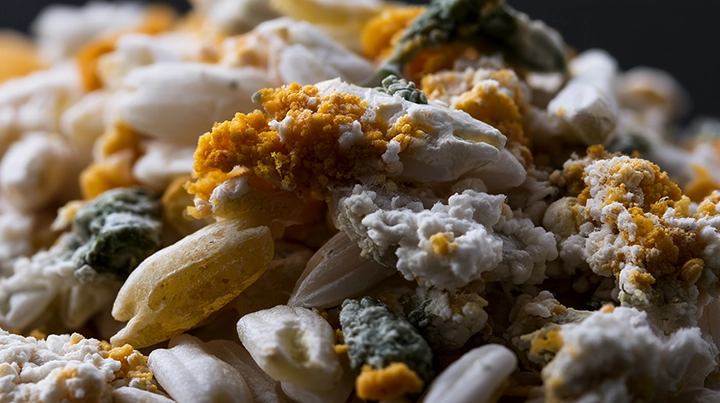

Rice is one of the world’s most important staple foods. For billions of people, it is not simply another agricultural commodity — it is a daily source of calories, nutrition, and food security. Yet because rice is grown in flooded paddy ecosystems, it can also become a pathway through which environmental contaminants move from water, soil, fungi, and agricultural systems into the human food chain.
A 2026 study explored this challenge from a combined-exposure perspective. Rather than examining a single contaminant, researchers assessed heavy metals, pesticide residues, and mycotoxins in rice-producing regions of northern Iran across two cropping seasons. The approach reflects a fundamental reality of food safety: consumers are rarely exposed to one contaminant at a time.
In rice production, the field, the water, the soil, and the storage facility do not operate independently. The grain at the end of the chain carries traces of everything upstream.
Looking Beyond a Single Contaminant
The research evaluated rice, soil, and irrigation-water samples from multiple regions. Scientists measured contaminants from several distinct sources.
Heavy metals included lead, cadmium, chromium, and nickel. The pesticide diazinon represented agricultural chemical exposure. The mycotoxin analysis covered ochratoxin A (OTA), aflatoxins, aflatoxin B1, zearalenone, and deoxynivalenol (DON).
Each contaminant group has a different origin. Heavy metals may enter from irrigation water, soil characteristics, industrial influence, or long-term fertilizer use. Pesticide residues reflect crop-protection practices. Mycotoxins reflect fungal activity that may occur during cultivation, drying, storage, or post-harvest handling.
Most food-safety studies evaluate one category in isolation. This study treated rice safety as a food-system problem.
The Main Finding: Combined Exposure Exceeded Safety Benchmarks
One of the study’s most significant findings involved cumulative risk. Researchers used established models to estimate potential non-carcinogenic health effects from long-term dietary exposure. Rather than evaluating contaminants individually, they calculated a combined hazard index representing the overall burden from multiple simultaneous exposures.
Across all sampled regions and seasons, the combined hazard index exceeded the threshold typically used to indicate potential concern. The highest cumulative exposure occurred in Sari during the second cropping season, where both adult and child risk estimates were substantially elevated.
A hazard index is not a diagnosis. Risk-assessment models depend on assumptions about consumption rates, body weight, contaminant concentrations, exposure duration, and toxicological reference values — and they model potential risk rather than observed disease. However, the results indicate that combined exposure deserves serious attention.
When multiple contaminants occur together in a staple food, their cumulative burden may become more important than any individual contaminant measured alone.
Ochratoxin A Emerged as the Major Mycotoxin Concern

Many discussions of fungal food safety focus primarily on aflatoxins, given their well-documented carcinogenic potential. In this study, however, ochratoxin A emerged as the dominant mycotoxin signal.
OTA levels exceeded 5 parts per billion in all sampled regions except Kalat, while aflatoxins, aflatoxin B1, zearalenone, and deoxynivalenol remained below their respective stated limits.
Different fungal toxins dominate under different environmental and storage conditions. OTA-producing fungi are particularly capable of persisting when moisture, temperature, and storage conditions remain favorable after harvest. For rice systems, contamination risk is shaped by harvest timing, grain drying practices, storage humidity, temperature control, and the overall quality of post-harvest handling.
Good storage management is not merely an operational preference. In this context, it functions as a direct food-safety intervention.
Why Moisture Control Remains Critical
The study identified post-harvest moisture management as one of the most effective strategies for reducing OTA risk. Fungi require suitable environmental conditions to grow and produce toxins, and moisture is consistently the most critical variable.
When rice is inadequately dried, exposed to re-wetting, stored under humid conditions, or held in poorly ventilated facilities, fungal growth becomes more likely. Under these circumstances, toxin production can continue long after harvest is complete.
The most powerful preventive measures in this context are operationally straightforward: rapid drying, moisture monitoring, proper ventilation, prevention of water intrusion, clean storage facilities, and routine mycotoxin testing. The simplicity of these interventions does not diminish their importance — it reflects where the greatest practical leverage actually exists.
Chromium Was the Other Major Driver of Risk

While OTA dominated the fungal side of the contamination profile, chromium emerged as one of the most significant environmental contributors to cumulative risk. The metal contributed heavily in several regions, particularly within parts of Mazandaran Province, while OTA played a proportionally larger role in the more humid rice-growing areas of Guilan Province.
This regional variation is one of the study’s most instructive findings. Food-safety priorities are not identical across geographies or production contexts.
In one location, improving storage conditions and fungal control may provide the greatest risk reduction. In another, irrigation-water quality, soil contamination, fertilizer management, or environmental remediation may be the more urgent priority. The researchers recommended chromium source control through improved fertilizer management and stronger water-quality safeguards.
A rice-safety program focused only on mold would miss chromium. A program focused only on metals would miss OTA. Effective food safety requires both perspectives operating simultaneously.
Why Children Faced Higher Modeled Risk
The study consistently found higher hazard-index values for children than for adults. This does not reflect observed disease — the difference arises from how dietary exposure is calculated.
Children consume less food in absolute terms, but relative to body weight, their intake of a given contaminant through a staple food can be substantially greater. Even moderate contaminant concentrations may represent a larger burden per kilogram of body mass when that food is consumed daily.
The distinction between modeled risk and observed disease should be maintained clearly when communicating these findings. The study identifies potential concern under specific exposure assumptions; it does not document illness rates. Nonetheless, it reinforces why routine monitoring of staple foods matters across all demographic groups, including the most vulnerable.
Climate, Humidity, and the Future of Rice Safety
The study also highlights a broader environmental dimension. Northern Iranian rice-growing regions experience humid conditions that can favor fungal growth and toxin formation, particularly during second-crop production cycles and post-harvest storage periods.
Mold risk is environmental. It depends on moisture, temperature, airflow, storage conditions, harvest timing, and time. Climate variability may complicate these challenges further. Higher humidity, unpredictable rainfall patterns, delayed harvests, and warmer storage conditions can all increase pressure on grain-management infrastructure.
As climate patterns shift, maintaining appropriate moisture levels throughout the post-harvest chain may become increasingly important for preventing OTA contamination and protecting grain quality at scale.
Food Safety Is a Connected System

One of the most instructive aspects of the study is that contamination pathways do not operate in isolation. Water quality influences soil conditions. Soil conditions influence crop uptake. Climate affects fungal activity. Storage conditions affect mycotoxin formation. Agricultural practices shape pesticide residue levels. Each stage contributes to the contaminant profile ultimately found within the grain.
The study therefore supports an integrated food-system approach in which environmental management and post-harvest management are treated as equally essential. Mycotoxin prevention is not only a storage issue. It is part of a longer chain connecting irrigation sources, field management, climate conditions, harvest practices, and storage infrastructure.
The rice grain, as the study’s findings demonstrate, reflects the entire system that produced it.
OTA-Producing Fungi Associated With Rice Contamination
The ochratoxin A documented in this study is primarily produced by Aspergillus ochraceus, Aspergillus carbonarius, and Penicillium verrucosum. Aspergillus flavus and Aspergillus parasiticus are associated with aflatoxin contamination and were also assessed across the sampled regions. These species represent the principal fungal contributors to the combined mycotoxin risk profile analyzed in northern Iranian rice production.
FAQ: Rice Safety and Combined Contaminant Exposure
Why can rice contain both heavy metals and mycotoxins?
Rice is grown in flooded environments where contaminants may enter from irrigation water, soil, fertilizers, and environmental sources, while mycotoxins develop through fungal growth during production or storage.
What was the main mycotoxin concern in this study?
Ochratoxin A (OTA) was the primary fungal toxin of concern, exceeding 5 ppb in most sampled regions.
Why was chromium important?
Chromium contributed substantially to cumulative non-carcinogenic risk in several regions and was one of the major drivers of the overall hazard index.
Does this study mean rice is unsafe everywhere?
No. The study focused on specific regions in Iran. Its exact findings should not be generalized globally, although the integrated-risk approach it employs is relevant to rice safety worldwide.
How can OTA contamination be reduced?
Rapid drying, moisture control, good ventilation, clean storage conditions, prevention of re-wetting, and routine mycotoxin monitoring can significantly reduce OTA risk.
References
- Combined contaminant exposure in northern Iranian rice-producing regions. Scientific Reports (2026). https://www.nature.com/articles/s41598-025-34310-x