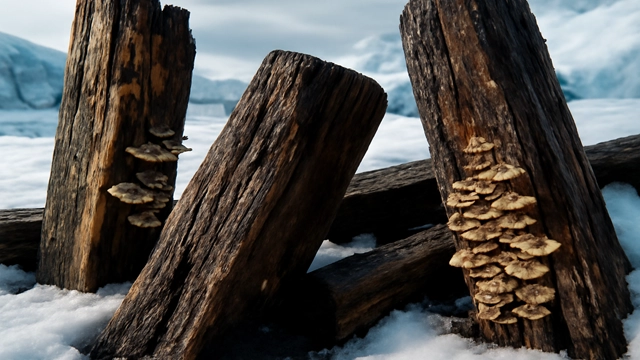

When most people think of the Arctic, they picture pristine glaciers, polar bears, and vast, silent landscapes. But beneath the frozen soil of Svalbard, Norway, researchers are uncovering a very different story—one where fungi are actively degrading wooden structures that were once thought preserved by the cold.
In the world of conservation, this is more than an ecological curiosity. It’s a warning.

A Timeline Hidden in Timber
The focus of the study was a network of old wooden pylons once used for transporting coal—remnants of Svalbard’s industrial history. These pylons were constructed between 1910 and 1960 and offer a unique scientific opportunity: the same structural design across decades of exposure, with some still standing upright and others partially collapsed.
Researchers took full advantage of this “natural decay gradient” to investigate how wood breaks down under Arctic conditions.
They combined light microscopy, DNA metabarcoding, chemical decay profiling, and wood anatomy analysis. This integrated approach allowed them not just to observe structural damage, but to track which fungal species were active, how they spread, and how the material composition of the wood changed over time.
What They Found: Arctic Fungal Communities Are More Complex Than Expected
Using microscopy, researchers identified that the pylons were made from two main species: Picea abies (Norway spruce) and Pinus sylvestris (Scots pine). Although both are commonly used in construction, they decay differently depending on moisture exposure and fungal type.
At the base of the pylons—closest to soil and water contact—researchers found extensive signs of brown rot and soft rot, both known for their ability to degrade wood’s cellulose structure while leaving behind lignin.
But the game-changing insight came from the DNA data.
With metabarcoding, the team revealed that fungal diversity was significantly higher at the ground interface compared to higher-up sections. More concerning: several of the identified fungal taxa had never been previously reported in Svalbard, suggesting that fungal migration into the Arctic is already underway.
This is important because many of these fungi are generalist decomposers—highly efficient at colonizing and degrading lignocellulosic material. As Arctic conditions become more favorable to their growth, their impact could expand beyond heritage structures to broader ecological and infrastructure systems.

The Chemistry of Decay: What’s Left Behind Tells You What’s Been Lost
To quantify the progress of decay, researchers analyzed lignin-to-cellulose ratios within the wood. As expected in brown rot-dominated environments, the cellulose content decreased over time, while lignin—more resistant to microbial attack—accumulated as a residual component.
This chemical fingerprint allows researchers to estimate the degree of degradation without relying solely on visual inspection. It’s particularly useful in cold environments where external signs may lag behind internal rot progression.
Moreover, the study suggests that chemical decay indicators can help predict future structural failure in similar permafrost-adjacent constructions.
Climate Change: Fuel for Fungal Activity
Traditionally, permafrost regions were considered low-risk for biological decay due to cold, dry conditions. But this assumption no longer holds.
Rising Arctic temperatures, increased seasonal thawing, and changes in snow cover are all contributing to a more hospitable environment for fungi. In the Svalbard study, this meant fungi were not only surviving but actively degrading structural wood—even in places that would have once been frozen solid year-round.
The implication is clear: frozen does not mean preserved. For Arctic heritage management, this challenges long-standing conservation strategies based on passive preservation.

Implications for Conservation and Infrastructure
The study’s authors stress the need for updated fungal inventories and routine biological monitoring of heritage structures in cold regions. DNA-based tools like metabarcoding are now proving to be not just useful—but necessary—for proactive maintenance and conservation.
Beyond heritage, these insights could also impact engineering assessments of Arctic infrastructure: from power lines to polar research stations and even wooden components of newer constructions.
Recommendations include:
- Installing environmental sensors to track humidity and temperature at soil–wood interfaces
- Creating regional fungal reference databases to detect invasive decomposers early
- Integrating chemical decay markers into standard wood integrity inspections
A Silent Shift Beneath the Surface
What this research makes clear is that the Arctic is not a preservation chamber. As the climate shifts, fungi are expanding their range, increasing their metabolic activity, and taking advantage of wood that was once protected by sub-zero conditions.
The decaying pylons of Svalbard are not just historical artifacts—they are bioindicators of a region in transition. And the microbes that inhabit them are offering early clues about what a warmer Arctic will bring: more rot, more risk, and more urgent questions for preservation science.
Bottom Line:
What appears stable on the surface may already be degrading from within. With the right tools—DNA sequencing, chemical profiling, and decay diagnostics—we can listen to what the wood is telling us. And it’s telling us the clock is ticking.

Key Takeaways
- When most people think of the Arctic, they picture pristine glaciers, polar bears, and vast, silent landscapes.
- This integrated approach allowed them not just to observe structural damage, but to track which fungal species were active, how they spread, and how the material composition of the wood changed over time.
- As Arctic conditions become more favorable to their growth, their impact could expand beyond heritage structures to broader ecological and infrastructure systems.
- But this assumption no longer holds.Rising Arctic temperatures, increased seasonal thawing, and changes in snow cover are all contributing to a more hospitable environment for fungi.
- The study’s authors stress the need for updated fungal inventories and routine biological monitoring of heritage structures in cold regions.
Frequently Asked Questions
What should you know about bottom Line:?
What appears stable on the surface may already be degrading from within. With the right tools—DNA sequencing, chemical profiling, and decay diagnostics—we can listen to what the wood is telling us. And it’s telling us the clock is ticking.
What are the key findings about Arctic Fungi?
When most people think of the Arctic, they picture pristine glaciers, polar bears, and vast, silent landscapes. But beneath the frozen soil of Svalbard, Norway, researchers are uncovering a very different story—one where fungi are actively degrading wooden structures that were once thought preserved
How does Arctic Fungi affect public health or safety?
The focus of the study was a network of old wooden pylons once used for transporting coal—remnants of Svalbard’s industrial history. These pylons were constructed between 1910 and 1960 and offer a unique scientific opportunity: the same structural design across decades of exposure, with some still s
What do researchers and experts say about Arctic Fungi?
Using microscopy, researchers identified that the pylons were made from two main species: Picea abies (Norway spruce) and Pinus sylvestris (Scots pine). Although both are commonly used in construction, they decay differently depending on moisture exposure and fungal type.At the base of the pylons—cl
What are the main risks associated with Arctic Fungi?
To quantify the progress of decay, researchers analyzed lignin-to-cellulose ratios within the wood. As expected in brown rot-dominated environments, the cellulose content decreased over time, while lignin—more resistant to microbial attack—accumulated as a residual component.This chemical fingerprin