
Buildings Are Not Sealed Systems
There is a version of a building that exists only in theory — a box with fixed boundaries, where inside stays inside and outside stays outside. Real buildings do not work this way.
Walls, ceilings, and windows create the impression of enclosure. But the boundary between indoor and outdoor environments is far more permeable than it appears. Air moves through buildings continuously — not only through open windows or visible gaps, but through material joints, structural connections, electrical penetrations, and the accumulated small imperfections that exist in every built structure. This movement is driven by pressure differences, temperature gradients, and the mechanical systems installed to regulate comfort.
None of this requires a failure. It is simply how buildings behave.
And the air that moves carries moisture with it.
Airflow as a Moisture Transport System
Water vapor is always present in indoor air. Every activity that introduces heat or humidity — cooking, showering, breathing, even running appliances — adds moisture to the air inside a building. The concentration varies hour by hour, room by room, season by season.
As air moves through a building, it transports this moisture. When it reaches cooler parts of the structure — exterior walls, ceiling cavities, attic spaces — the drop in temperature changes what the air can hold. Warm air carries more moisture than cold air. When warm, humid air contacts a cool surface, that moisture has to go somewhere. It condenses into liquid water.
This process requires no leak. No burst pipe. No flooding. It only depends on three conditions: moisture in the air, a cold surface, and airflow to deliver that moisture to where the cold surface is. All three are present in almost every building, all the time.
This is the mechanism through which mold can develop in buildings that appear completely dry.

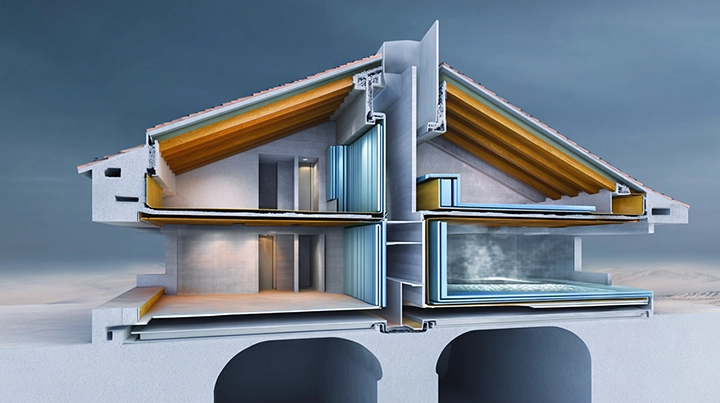
Credit: Dan Zen from Dundas, Canada, via Wikimedia Commons, CC BY 2.0
The Stack Effect: Vertical Air Movement
The stack effect is one of the primary engines of airflow inside buildings, and it operates without any mechanical assistance.
Warm air is less dense than cold air, so it rises. Inside a heated building during colder months, this creates a continuous vertical pressure gradient. Warm indoor air rises toward the upper parts of the structure — ceilings, attics, roof assemblies — and escapes through whatever openings exist at those levels. As it exits, cooler outdoor air is drawn in from below to replace it.
The loop runs continuously: air enters at lower levels, warms, rises, carries moisture upward, reaches cooler surfaces, and condenses. Then the process begins again.
This explains a pattern that building professionals encounter regularly — mold appearing in attics, upper wall cavities, and roof structures in buildings with no roof leaks and no obvious water source. The water did not come from outside. It arrived from below, carried upward by air.
Wind Pressure: Uneven Air Entry
Wind adds a second layer of complexity to how air moves through a building.
When wind strikes a building face, it creates a zone of elevated pressure on the windward side and reduced pressure on the leeward side. Air is pushed into the structure through any available pathway on the high-pressure side and pulled out on the opposite side.
This is not uniform. Wind pressure varies by location on the building envelope, by wind direction, and by the specific geometry of the structure. The result is that some areas experience significantly more air infiltration than others — and the air entering under wind pressure can carry moisture into hidden spaces such as wall cavities and insulation layers.
Over time, repeated cycles of moist air entry followed by limited drying create conditions where moisture accumulates faster than it can escape.

Mechanical Systems and Pressure Imbalance
Heating, ventilation, and air conditioning systems are designed to control indoor conditions. They also reshape how air moves through a building — and when they are improperly designed or balanced, they can create problems that neither occupants nor building owners anticipate.
Fans and air handlers generate pressure differences. If return air pathways are restricted, or if supply and exhaust are not properly balanced, the system can depressurize parts of the building — drawing air in from unintended sources. That might mean air from an attic, a crawl space, or a wall cavity: air that is likely to be more humid, less filtered, and potentially carrying contaminants.
The mechanical system then distributes this air throughout the building. In some configurations, it concentrates humid air in specific zones or increases condensation in concealed areas where drying is already limited.
Mechanical systems do not simply heat and cool. They actively participate in how moisture moves through a structure.
Where Problems Begin: Hidden Spaces
Moisture problems driven by airflow rarely announce themselves on exposed surfaces. The process begins in the spaces that cannot be seen: inside wall assemblies, behind insulation, above ceiling panels, beneath floor systems.
These areas share a common set of conditions. Airflow is present — often more than expected, given the cumulative effect of imperfect sealing across a large structure. Temperature differences exist between the interior and exterior sides of the assembly. And drying is limited, because the same barriers that slow air movement also slow the evaporation that would otherwise remove accumulated moisture.
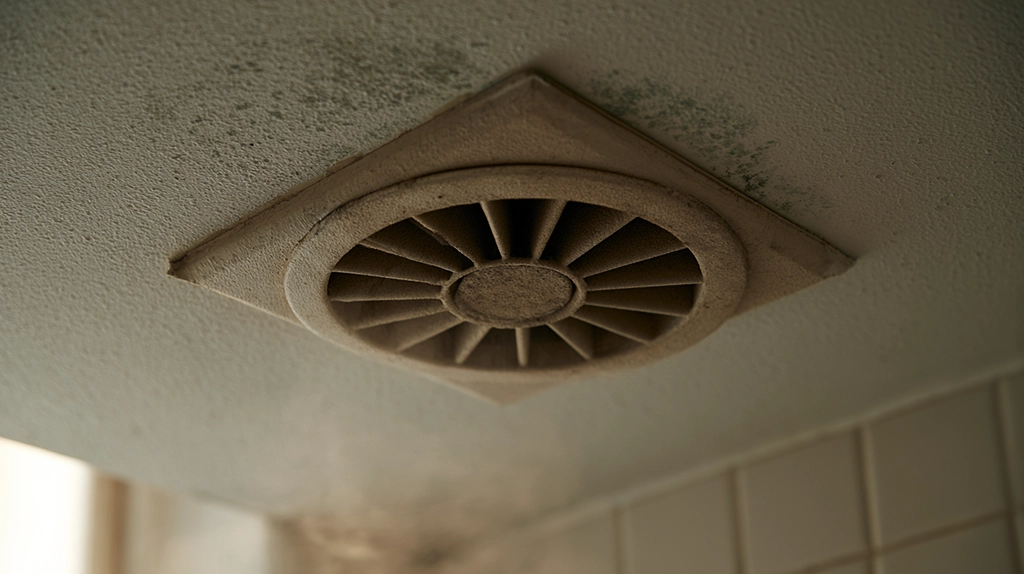
The result is that moisture can build up for months before any visible sign appears. By the time mold becomes detectable — a stain on a ceiling, a smell from a wall — the underlying process has typically been active for a significant period.
Why Mold Forms Without Leaks
The assumption that mold requires a leak is one of the most common and consequential misunderstandings in building diagnostics.
Mold requires sustained moisture — not liquid water from an identifiable source, but conditions where surfaces remain damp long enough for fungal growth to establish. Airborne moisture, repeatedly delivered by airflow and condensed on cool surfaces, is fully capable of providing those conditions. The moisture is diffuse, invisible, and arrives gradually. But it arrives consistently.
This is why mold can be found in buildings that have passed every inspection, where no plumbing has failed, where the roof is intact, and where occupants report no awareness of any water problem. The building is not leaking. It is breathing — and in breathing, it is moving moisture into places where that moisture cannot easily escape.
The Limits of Surface Cleaning
When mold appears on a surface, removing it is the obvious response. It is also an incomplete one.
Cleaning removes visible growth. It does not change the airflow patterns that delivered moisture to that surface. It does not alter the temperature differential that caused condensation. It does not improve the drying capacity of the assembly. If none of those conditions change, the surface will become moist again, and mold will return.
Effective remediation requires addressing the system — identifying where air is entering the building, where it is moving, where it is losing moisture, and why those surfaces are cold enough to cause condensation. The solutions involve air sealing, insulation improvements, pressure balancing, and ventilation management. Surface treatment follows from that work, not instead of it.
Without system correction, remediation is temporary by definition.
Air as the Invisible Driver
Mold in buildings is often treated as a localized surface problem — something to be cleaned, painted over, or cut out and replaced. The framework that produces that response is incomplete.
The visible growth is the endpoint of a process that began with air movement. Air carrying moisture. Temperature differences creating condensation. Structural pathways allowing the same process to repeat day after day until the conditions for growth are met and sustained.
Shifting from surface response to system understanding changes what questions get asked. Not just: where is the mold? But: where is the air coming from, where is it going, and what is it carrying when it gets there?
In buildings, what cannot be seen is often what matters most.
FAQ
Can airflow inside a house really cause mold? Yes. Air carries moisture, and when it moves through cooler areas of the structure, condensation can occur on surfaces — creating the sustained moisture conditions that mold requires.
What is the stack effect? The upward movement of warm air inside a building, which draws cooler air in from below and carries moisture into upper structural areas where it can condense.
Why does mold appear inside walls? Because airflow carries moisture into wall cavities, where it condenses on cooler surfaces and remains trapped with limited opportunity to dry out.
Does wind affect mold growth in buildings? Indirectly, yes. Wind pressure drives air — and the moisture it carries — into and through the building envelope, with uneven distribution across different areas of the structure.
Can HVAC systems contribute to mold problems? Yes. Improperly balanced systems can draw humid air from unintended spaces and redistribute it through the building, increasing moisture accumulation in concealed areas.
References
- Taylor & Francis — Indoor Air Quality and Building Environments: https://www.tandfonline.com/doi/full/10.1080/15459624.2015.1019076
- EPA — Mold Course Chapter 2: https://www.epa.gov/mold/mold-course-chapter-2
Key Takeaways
- Please login Buildings Are Not Sealed Systems There is a version of a building that exists only in theory — a box with fixed boundaries, where inside stays inside and outside stays outside.
- But the boundary between indoor and outdoor environments is far more permeable than it appears.
- Every activity that introduces heat or humidity — cooking, showering, breathing, even running appliances — adds moisture to the air inside a building.
- When it reaches cooler parts of the structure — exterior walls, ceiling cavities, attic spaces — the drop in temperature changes what the air can hold.
- It only depends on three conditions: moisture in the air, a cold surface, and airflow to deliver that moisture to where the cold surface is.
Frequently Asked Questions
What should you know about please login to bookmark?
Please login Buildings Are Not Sealed Systems There is a version of a building that exists only in theory — a box with fixed boundaries, where inside stays inside and outside stays outside. Real buildings do not work this way.
What should you know about buildings Are Not Sealed Systems?
There is a version of a building that exists only in theory — a box with fixed boundaries, where inside stays inside and outside stays outside. Real buildings do not work this way.
What should you know about airflow as a Moisture Transport System?
Water vapor is always present in indoor air. Every activity that introduces heat or humidity — cooking, showering, breathing, even running appliances — adds moisture to the air inside a building. The concentration varies hour by hour, room by room, season by season.
What should you know about the Stack Effect: Vertical Air Movement?
The stack effect is one of the primary engines of airflow inside buildings, and it operates without any mechanical assistance.
What should you know about wind Pressure: Uneven Air Entry?
Wind adds a second layer of complexity to how air moves through a building.