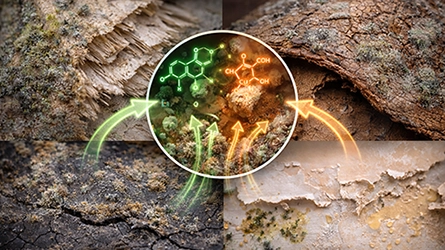

Mold does not damage materials by simply sitting on the surface.
What really matters is what mold releases while it grows.
These substances, known as metabolic byproducts, are not meant to destroy materials. They exist so mold can survive. But once released onto plastics, rubber, leather, paper, or coatings, they can slowly alter how those materials behave. Reviews on fungal degradation of plastics describe how fungi rely on extracellular chemistry and enzymes to fragment or modify polymer-related materials, even when full breakdown is limited.
The change is rarely dramatic.
It is gradual, persistent, and difficult to reverse.

What mold leaves behind
As mold grows, it releases a range of chemical substances into its surroundings. Among the most important are enzymes and organic acids.
Enzymes act as molecular tools. Their role is to break complex structures into smaller pieces that mold can absorb. For synthetic polymers, the best-documented actors are fungal enzymes involved in plastics biodegradation, including oxidoreductases and hydrolytic enzymes that can modify surfaces or cleave certain bonds.
Organic acids work more quietly. They change the local chemical environment, often lowering pH at the surface of a material. That shift can make some bonds more vulnerable and can speed up other forms of deterioration, especially in damp storage conditions.
Neither process is fast.
Both can be effective.

Paper loses strength before it looks damaged
Paper is largely made of cellulose fibers. These fibers provide structure and flexibility. Mold commonly produces enzymes that break down cellulose, cutting the fibers into shorter segments. Conservation-focused literature discussing fungal biodeterioration of paper emphasizes that fungal growth and its biochemical activity are central concerns for long-term paper stability.
At first, the paper may still look intact. But its strength decreases. Pages tear more easily. Edges crumble. The paper no longer responds the way it once did to folding or handling.
Microscopy-based work, including a SEM study of fungal spoilage on paper under controlled conditions, shows how fungal presence aligns with fiber-level damage and surface changes that are not always obvious at a glance.

Leather changes from the inside out
Leather owes its durability to collagen, a structural protein. Mold can release enzymes that target proteins, gradually weakening collagen networks. A focused review on biodeterioration of collagen-based materials describes how microbial activity can affect appearance and physical properties when humidity and storage conditions allow growth.
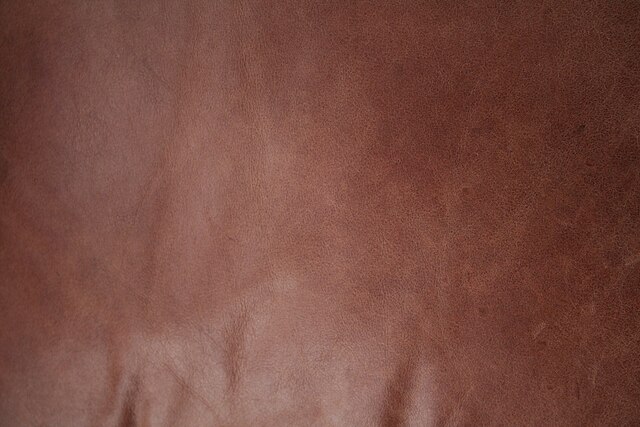
As this happens, leather becomes stiff or brittle. Its surface may lose uniform color and develop uneven texture. Even after visible mold is removed, the material rarely returns to its original condition.
The damage is not cosmetic.
It reflects a change in structure.
Plastics are not immune
Plastics are often seen as resistant to biological damage. In many cases, mold cannot directly break down the main polymer chains quickly or completely. But plastics and coatings frequently include additives or segments that are easier to attack than the “backbone” of the material.
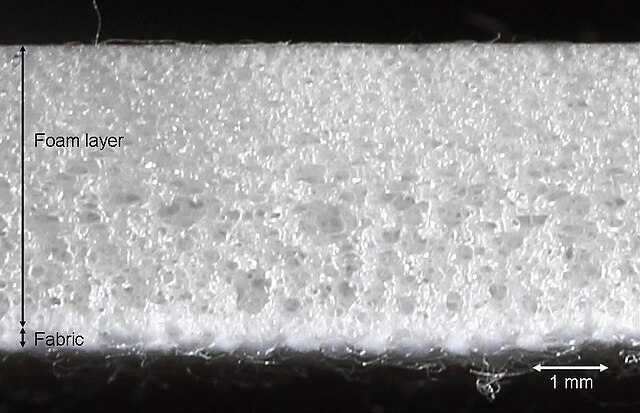
For example, polyurethane is widely discussed because some of its bonds can be targets for hydrolytic activity. A recent review on polyurethane biodegradation mechanisms summarizes how specific enzymes are implicated in attacking ester or urethane linkages, helping explain why surfaces may change even when the bulk material still looks present.
Plastics may become brittle, sticky, or rough at the surface. The shape remains, but the performance does not.
This is not consumption in the usual sense.
It is alteration.
Coatings show early warning signs
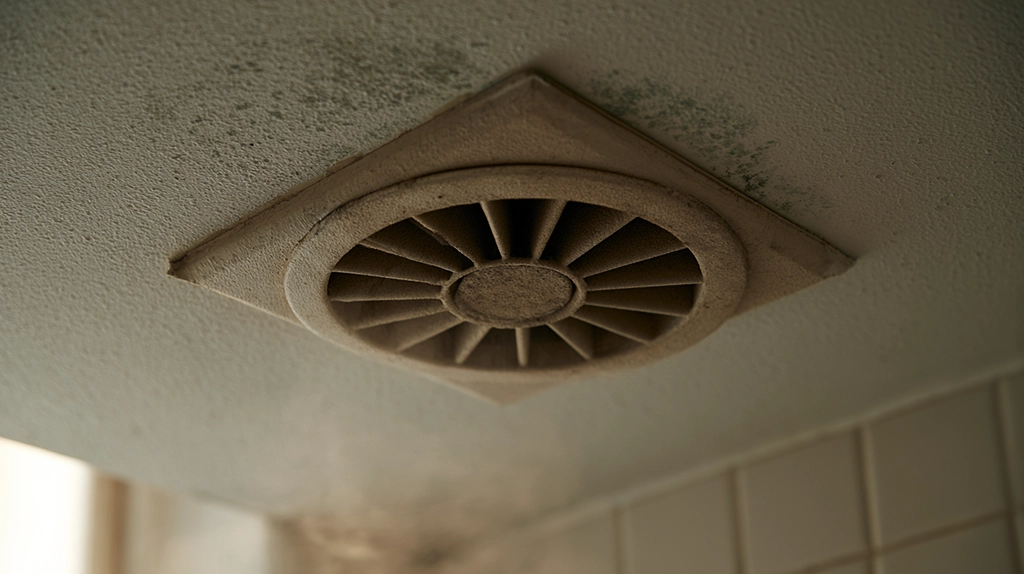
Coatings are particularly vulnerable in humid, poorly ventilated environments. Their surfaces can provide enough moisture and residue for mold to establish itself.
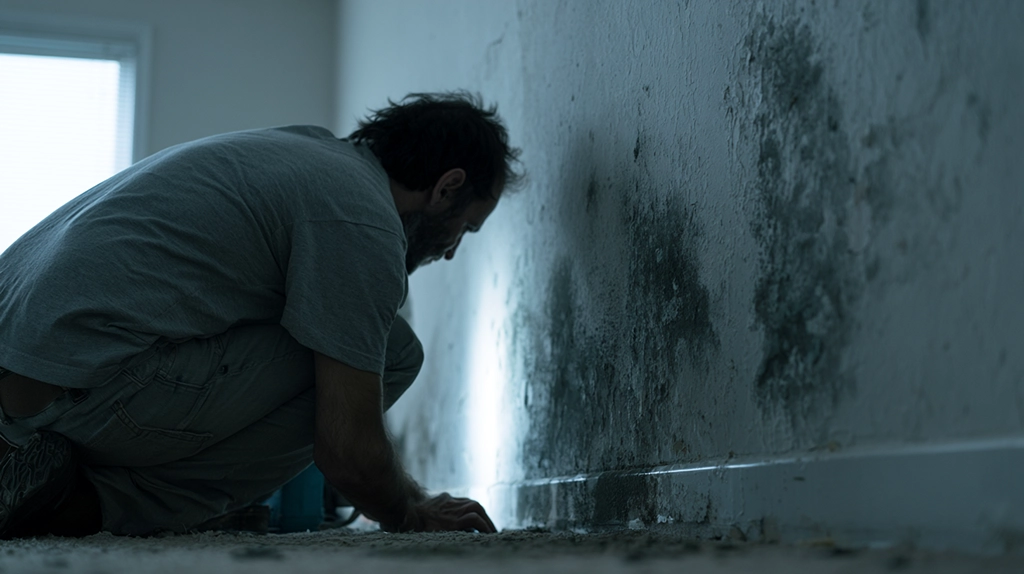
Once established, metabolic byproducts can disrupt surface chemistry. Discoloration, blistering, or peeling may follow, often in patches that reflect where growth and moisture were most persistent.

Mold accelerates what was already possible
Mold is rarely the sole cause of material failure. Instead, it accelerates processes that were already underway.
High humidity, limited airflow, and moderate temperatures create conditions where mold metabolism becomes more active. Under these conditions, deterioration that would normally take years may appear much sooner.
Many materials fail not because they were used incorrectly, but because they were stored or left idle under conditions that favored microbial activity.
Reading mold as a signal
Understanding mold metabolism is not about assigning blame to microorganisms. It is about recognizing patterns.
When materials degrade in the presence of mold, they reveal where stability was already fragile. Mold does not invent weaknesses. It exposes them and pushes them forward.
From this perspective, mold is not only a contaminant. It is also an indicator of how materials interact with time, environment, and design choices.
The changes it causes are quiet.
But they are real.
References
Academic Sources
- Temporiti, M. E. E., Nicolaus, B., & Scozzafava, A. (2022). Fungal Enzymes Involved in Plastics Biodegradation.Microorganisms. https://doi.org/10.3390/microorganisms10071270
- Okal, E. J., Aslam, M. M., & Othman, A. M. (2023). Insights into the mechanisms involved in the fungal degradation of plastics. Ecotoxicology and Environmental Safety. https://doi.org/10.1016/j.ecoenv.2023.115531
- Pinzari, F., Pasquariello, G., & De Mico, A. (2006). Biodeterioration of Paper: A SEM Study of Fungal Spoilage Reproduced Under Controlled Conditions. Macromolecular Symposia. https://doi.org/10.1002/masy.200650609
- Zhang, M., et al. (2022). Biodeterioration of collagen-based cultural relics: A review. Fungal Biology Reviews. https://doi.org/10.1016/j.fbr.2021.12.002
- Raczyńska, A., et al. (2024). An overview on polyurethane-degrading enzymes. Biotechnology Advances.
Official Sources
- PubChem — Deoxynivalenol (DON): https://pubchem.ncbi.nlm.nih.gov/compound/Deoxynivalenol
- PubChem — Zearalenone (ZEN): https://pubchem.ncbi.nlm.nih.gov/compound/Zearalenone
Key Takeaways
- Mold does not damage materials by simply sitting on the surface.
- But once released onto plastics, rubber, leather, paper, or coatings, they can slowly alter how those materials behave.
- Among the most important are enzymes and organic acids.Enzymes act as molecular tools.
- That shift can make some bonds more vulnerable and can speed up other forms of deterioration, especially in damp storage conditions.Neither process is fast.
- Mold can release enzymes that target proteins, gradually weakening collagen networks.
Frequently Asked Questions
What mold leaves behind?
As mold grows, it releases a range of chemical substances into its surroundings. Among the most important are enzymes and organic acids.Enzymes act as molecular tools. Their role is to break complex structures into smaller pieces that mold can absorb. For synthetic polymers, the best-documented acto
What should you know about paper loses strength before it looks damaged?
Paper is largely made of cellulose fibers. These fibers provide structure and flexibility. Mold commonly produces enzymes that break down cellulose, cutting the fibers into shorter segments. Conservation-focused literature discussing fungal biodeterioration of paper emphasizes that fungal growth and
What should you know about leather changes from the inside out?
Leather owes its durability to collagen, a structural protein. Mold can release enzymes that target proteins, gradually weakening collagen networks. A focused review on biodeterioration of collagen-based materials describes how microbial activity can affect appearance and physical properties when hu
What should you know about plastics are not immune?
Plastics are often seen as resistant to biological damage. In many cases, mold cannot directly break down the main polymer chains quickly or completely. But plastics and coatings frequently include additives or segments that are easier to attack than the “backbone” of the material.For example, polyu
What should you know about coatings show early warning signs?
Coatings are particularly vulnerable in humid, poorly ventilated environments. Their surfaces can provide enough moisture and residue for mold to establish itself.Once established, metabolic byproducts can disrupt surface chemistry. Discoloration, blistering, or peeling may follow, often in patches