
Three rules. That’s all you need.
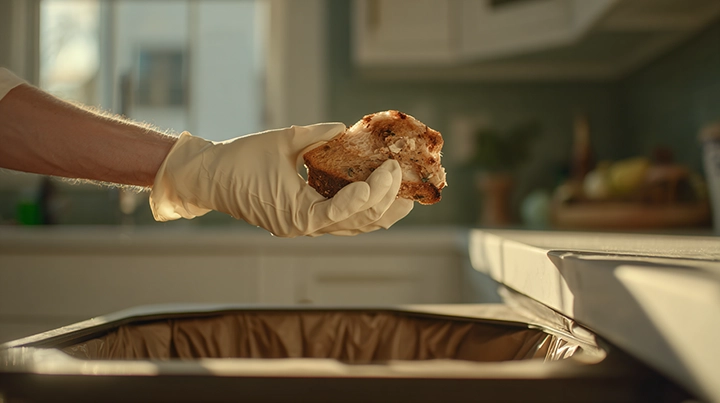
If the food is soft — bread, cooked leftovers, soft fruit, yogurt, deli meat — throw it out. The mold has already spread through the interior. Cutting the visible part off doesn’t fix anything.
If the food is hard and dense — a block of aged cheese, a firm carrot, a head of cabbage — you may be able to salvage it. Cut at least 2 to 3 centimeters around and below the visible mold, keep the knife away from the clean portion, and check that the rest of the food hasn’t softened or changed smell.
If the mold is supposed to be there — blue cheese, brie, camembert — eat it normally. The mold is part of the product.
Everything else that follows is the reasoning behind these three rules.
Why Visible Mold Is Already Late News
Mold doesn’t start when you see it. A faint discoloration or fuzzy patch on the surface is the reproductive structure of an organism that has already been growing for some time. The part you see is built to release spores. The part you don’t see is what has been feeding.
This matters because it reframes the question. The relevant issue isn’t whether the spot is big or small. It’s what the organism has been doing in the interior of the food — and whether that food’s structure allowed it to spread.
Structure Is Everything
Microscopic filaments called hyphae are how mold moves through food. They push into the material, extending well beyond the visible boundary, using the food’s internal architecture as a pathway.
The critical factor is what that architecture looks like. Open, porous structures — the air pockets in bread, the high moisture content of cooked grains, the soft cellular structure of ripe fruit — offer almost no resistance. Hyphae travel through them easily and quickly. By the time surface mold appears on a piece of bread, the network has typically already extended through a significant portion of the loaf.
Dense, compact structures are different. Hard cheese, firm root vegetables, and whole uncut produce have tightly packed cells that slow hyphal movement. The contamination is more likely to remain localized, which is why cutting with adequate margins can actually work in these cases.

Why Cutting It Off Usually Doesn’t Work
The instinct to remove the visible portion and keep the rest assumes that mold behaves like a stain — something that sits on a surface and can be wiped away.
Soft and porous foods don’t work that way. The mold is a network. The part you cut away is connected to parts you didn’t cut away, through pathways that don’t show up on the surface. The knife line doesn’t correspond to where the organism actually ends.
This is also why smell and taste are unreliable indicators in porous foods. The compounds produced by mold — including, in some cases, mycotoxins — can be distributed through the interior without producing obvious sensory changes in every part of the food.
The Decision Framework in Practice
Discard immediately:
- Bread, rolls, tortillas, pita — any baked goods
- Cooked grains, pasta, or rice
- Soft cheeses (ricotta, cottage cheese, cream cheese, brie if unexpected mold appears)
- Yogurt, sour cream, and other soft dairy
- Deli meats and cooked meat
- Soft fruits — berries, peaches, tomatoes, cucumber
- Jams and preserves (mold penetrates downward through the liquid)
- Any food that smells or tastes off regardless of visible mold
May be salvageable with care:
- Hard cheeses (cheddar, parmesan, aged gouda) — cut 2–3 cm around and below, use clean knife, rewrap
- Firm vegetables — carrots, cabbage, bell peppers — same approach, provided texture is intact
- Firm fruits — apples, pears — with visible mold cut away generously
Safe as produced:
- Blue-veined cheeses (Roquefort, Gorgonzola, Stilton)
- Surface-ripened soft cheeses (Brie, Camembert) — the white rind is Penicillium camemberti
- Dry-cured meats where surface mold is part of the aging process

The Mycotoxin Caveat
Even in cases where the mold itself is removed, one risk remains: mycotoxins. Some mold species produce these compounds as metabolic byproducts, and the compounds are chemically stable. They don’t degrade when the mold is removed. They don’t break down with cooking. They can be distributed through the food independently of visible growth.
Not all molds produce mycotoxins, and not all contaminated food carries them at harmful levels. But there is no practical way to test for them in a household setting, and no visual or sensory indication of their presence. This is the underlying logic of the conservative guidance on soft foods: the risk isn’t just the mold you can see.
What “When in Doubt” Actually Means
Food safety guidance frequently ends with “when in doubt, throw it out.” This phrase is more specific than it sounds.
Doubt, in this context, means: you cannot determine whether the mold has spread internally. If you’re looking at a dense food with a small, clearly localized spot and the rest of the food is firm and smells normal, that is not doubt — that is information. The salvage approach applies.
If you’re looking at a soft food, a food with widespread growth, a food that has changed texture or smell beyond the mold spot, or any food where you genuinely cannot assess the extent of the problem — that is doubt. And the food should go.

FAQ
Can moldy food ever be safe to eat? Yes — in two situations. When the mold is part of a controlled production process (certain cheeses, aged meats), and when mold on a hard, dense food can be removed with sufficient margins. In all other cases, discard.
Why can’t mold just be cut off? Because mold grows as a network of microscopic filaments that extend below the visible surface. In soft or porous foods, these filaments can reach throughout the interior before surface growth appears. Cutting removes the visible portion but not the underlying organism.
Which foods are most at risk? Soft and high-moisture foods — bread, cooked leftovers, soft fruit, yogurt, deli meats, soft cheese. Their structure allows rapid internal spread.
When is salvaging food safe? In hard, dense foods where mold growth is likely to remain localized — hard cheeses, firm vegetables, whole firm fruit. Remove at least 2 to 3 centimeters around and below the mold, and only if the rest of the food is otherwise intact.
What is the safest general rule? If you cannot determine whether the mold has spread internally, discard the food. The cost of throwing away food is low. The risk of consuming internally contaminated food — particularly if mycotoxins are present — is not.
References
- USDA Food Safety and Inspection Service — Molds on Food: Are They Dangerous?: https://www.fsis.usda.gov/food-safety/safe-food-handling-and-preparation/food-safety-basics/molds-food-are-they-dangerous
- Springer — Fungal Spread in Food Structures: https://link.springer.com/article/10.1007/s00226-023-01473-7
- USDA FSIS — Molds on Food (PDF): https://www.fsis.usda.gov/sites/default/files/media_file/2021-02/Molds_on_Food.pdf
Key Takeaways
- If the food is soft — bread, cooked leftovers, soft fruit, yogurt, deli meat — throw it out.
- If the food is hard and dense — a block of aged cheese, a firm carrot, a head of cabbage — you may be able to salvage it.
- Everything else that follows is the reasoning behind these three rules.
- It’s what the organism has been doing in the interior of the food — and whether that food’s structure allowed it to spread.
- The critical factor is what that architecture looks like.
Frequently Asked Questions
Why Visible Mold Is Already Late News?
Mold doesn’t start when you see it. A faint discoloration or fuzzy patch on the surface is the reproductive structure of an organism that has already been growing for some time. The part you see is built to release spores. The part you don’t see is what has been feeding.
What should you know about structure Is Everything?
Microscopic filaments called hyphae are how mold moves through food. They push into the material, extending well beyond the visible boundary, using the food’s internal architecture as a pathway.
Why Cutting It Off Usually Doesn’t Work?
The instinct to remove the visible portion and keep the rest assumes that mold behaves like a stain — something that sits on a surface and can be wiped away.
What should you know about the Mycotoxin Caveat?
Even in cases where the mold itself is removed, one risk remains: mycotoxins. Some mold species produce these compounds as metabolic byproducts, and the compounds are chemically stable. They don’t degrade when the mold is removed. They don’t break down with cooking. They can be distribut
What “When in Doubt” Actually Means?
Food safety guidance frequently ends with “when in doubt, throw it out.” This phrase is more specific than it sounds.