
I. A Subtle Autumn That Revealed a Bigger Shift
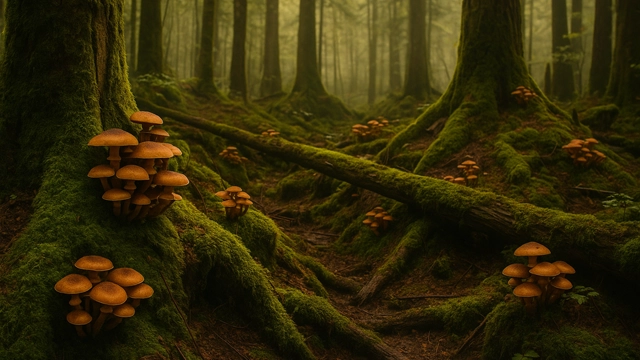
In the autumn of 2025, the United Kingdom entered a season that felt slightly wetter, heavier, and stranger than usual. What seemed like an ordinary climate fluctuation turned into something more telling: a sudden surge of honey fungus—Armillaria mellea—across multiple regions. Its activity doubled compared with the previous year.
To many, this may sound like a problem limited to forests or garden landscapes. But when viewed against the backdrop of a warming, moistening world, the outbreak reads more like a preview of a future in which fungi become some of the most responsive winners of climate change.

II. When Forest Fungi Become an Urban Warning
The threat of honey fungus doesn’t lie in its appearance or in the aggressive drama of its infection. It lies in how quietly it works. It can hollow out the roots of a tree long before any symptoms appear above ground, leaving a seemingly healthy tree fragile from the inside. One strong wind or heavy rain is enough to bring it down.
As climate shifts push the UK’s forests into more stressful conditions, urban trees are drawn into the same vulnerability. And when street trees begin to fail, the consequences ripple directly into daily urban life.

III. History Shows How Fungi Can Reshape Cities
This isn’t the first time a fungal outbreak has reshaped the human environment. In the 20th century, Dutch elm diseasebecame one of the most striking examples of how a forest pathogen can spill over into everyday life.
At the time, elms were iconic street trees across Europe and North America. They framed boulevards, softened city skylines, and cast long corridors of shade. But once the fungus Ophiostoma novo-ulmi entered the picture, millions of elms vanished within decades.
Streets lost their shade, neighborhoods lost familiar silhouettes, and cities spent enormous sums removing dead trees and attempting to replant what was lost. The disappearance of elms didn’t just alter scenery—it changed how cities felt, how hot they became, and how people experienced public spaces.

IV. An Expensive Lesson From Ash Dieback
A more recent example comes from the ash dieback epidemic in the UK. Caused by Hymenoscyphus fraxineus, the outbreak is projected to cost the country up to £15 billion. That figure covers everything from removing hazardous trees along roadsides to repairing public spaces, mitigating safety risks, and coping with the ecological losses that follow the decline of a dominant tree species.
These cases make one point very clear: tree diseases are never purely ecological events. They spill across boundaries, affect cities and rural areas alike, and eventually show up as economic and social burdens.

V. The Real Message Behind the Honey Fungus Surge
Viewed in this context, the honey fungus outbreak becomes more than a woodland anomaly. The conditions that enabled it—heat and moisture—are becoming part of the new climatic baseline.
For fungi, this translates into:
- longer growing seasons
- faster reproductive cycles
- fewer natural constraints
And while honey fungus itself doesn’t target building materials or furniture, the climate pattern that fuels it will inevitably seep into cities and homes. When the outdoors grows more humid, the indoors follows.
Dampness lingers longer. Wooden floors warp more easily. Cabinets, closets, and balconies begin to show familiar signs of fungal activity. Older buildings, already dealing with moisture issues, see their vulnerabilities deepen.
VI. A Warmer, Wetter Climate Reaches the Kitchen Too
The same climatic shift reaches into food storage as well. Although honey fungus does not contaminate food, warm and humid conditions activate other fungi that do.
Species such as Aspergillus flavus and Aspergillus parasiticus, which produce aflatoxins, thrive in these environments. They share no connection with honey fungus, yet they benefit from the same weather pattern.
In this way, climate change accelerates multiple fungal risks simultaneously—some affecting forests and streets, others affecting kitchens, warehouses, and the food supply.

VII. Fungi Are Built for the Climate to Come
Fungi excel at survival. They flourish when conditions are wet. They wait patiently when conditions turn dry. They adapt when temperatures rise, sometimes developing greater heat tolerance within surprisingly short spans of time.
Extreme weather events, instead of suppressing them, often expand their opportunities. This makes fungi unusually well suited to the volatile climate landscape ahead.
The surge in honey fungus activity is not an isolated occurrence; it’s part of a slow but steady shift in which fungi take advantage of every crack opened by a changing climate.
VIII. Reading the Future Through a Fungus
Rather than viewing the honey fungus outbreak as a purely woodland phenomenon, it may be more accurate to treat it as a signal.
Fungi are rising—not in a dramatic, catastrophic wave, but in a steady, climate-driven expansion that touches forests, cities, buildings, and food systems at once. Their influence will be increasingly woven into daily life, from the safety of street trees to the longevity of building materials and the security of food storage.
In this new climate era, understanding fungi becomes more than a scientific curiosity. It becomes a matter of reading early signs of how our cities, homes, and ecosystems will need to adapt. The honey fungus outbreak is one such sign—quiet, persistent, and impossible to ignore once you know where to look.
References
Academic
- Brown, N. et al. (2022). “Armillaria root rot and forest resilience under climate change.” Forest Pathology. DOI: 10.1111/efp.12789
- Ghelardini, L. et al. (2017). “Pathways of fungal invasions affecting urban and rural trees.” Biological Reviews. DOI: 10.1111/brv.12320
- Mitchell, R. et al. (2014). “Economic impacts of ash dieback in the UK.” Journal of Environmental Management. DOI: 10.1016/j.jenvman.2014.06.006
Official Sources
- UK Forestry Commission — Honey fungus information
- FAO — Aflatoxin and food safety: https://www.fao.org
- WHO — Fungal risk under climate change: https://www.who.int
Key Takeaways
- In the autumn of 2025, the United Kingdom entered a season that felt slightly wetter, heavier, and stranger than usual.
- To many, this may sound like a problem limited to forests or garden landscapes.
- It can hollow out the roots of a tree long before any symptoms appear above ground, leaving a seemingly healthy tree fragile from the inside.
- And when street trees begin to fail, the consequences ripple directly into daily urban life.
- At the time, elms were iconic street trees across Europe and North America.
Frequently Asked Questions
What should you know about i. A Subtle Autumn That Revealed a Bigger Shift?
In the autumn of 2025, the United Kingdom entered a season that felt slightly wetter, heavier, and stranger than usual. What seemed like an ordinary climate fluctuation turned into something more telling: a sudden surge of honey fungus—Armillaria mellea—across multiple regions. Its activity doubled
What should you know about iI. When Forest Fungi Become an Urban Warning?
The threat of honey fungus doesn’t lie in its appearance or in the aggressive drama of its infection. It lies in how quietly it works. It can hollow out the roots of a tree long before any symptoms appear above ground, leaving a seemingly healthy tree fragile from the inside. One strong wind or heav
What should you know about iII. History Shows How Fungi Can Reshape Cities?
This isn’t the first time a fungal outbreak has reshaped the human environment. In the 20th century, Dutch elm diseasebecame one of the most striking examples of how a forest pathogen can spill over into everyday life.
What should you know about iV. An Expensive Lesson From Ash Dieback?
A more recent example comes from the ash dieback epidemic in the UK. Caused by Hymenoscyphus fraxineus, the outbreak is projected to cost the country up to £15 billion. That figure covers everything from removing hazardous trees along roadsides to repairing public spaces, mitigating safety risks, an
What should you know about v. The Real Message Behind the Honey Fungus Surge?
Viewed in this context, the honey fungus outbreak becomes more than a woodland anomaly. The conditions that enabled it—heat and moisture—are becoming part of the new climatic baseline.