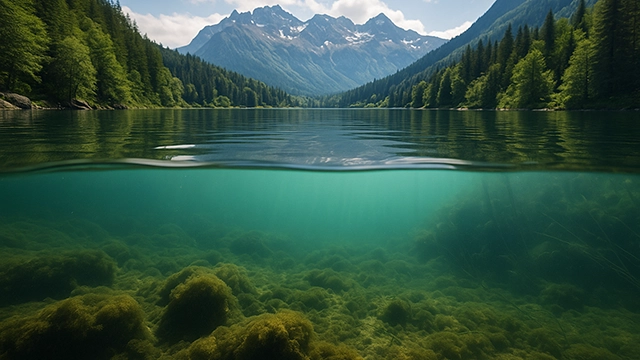

When most people think of fungi, they imagine damp forest floors or decaying logs. But a silent fungal world exists beneath the water’s surface—especially in high-altitude freshwater lakes. A recent study from China’s Yunnan Plateau has pulled back the curtain on this overlooked domain, revealing that aquatic fungi are not just passive decomposers, but active architects of lake ecology.
Using high-throughput DNA sequencing, researchers explored fungal communities in three ecologically distinct lakes: Chenghai, Erhai, and Lugu. What they found wasn’t just diversity, but patterns of ecological strategy, functional roles, and biotic networking that mirror the complexity of terrestrial ecosystems.

Diversity Written in Altitude and Chemistry
Not all lakes are created equal. The study showed that fungal diversity (both α-diversity and β-diversity) was shaped by environmental gradients. Chenghai Lake, with lower water quality, hosted fewer fungal species and a more uniform community. In contrast, Lugu and Erhai, located at higher altitudes and with better water conditions, revealed richer and more complex fungal assemblages.
Interestingly, nutrient levels and water chemistry correlated negatively with diversity—suggesting that eutrophication or pollution may suppress fungal richness. Meanwhile, altitude showed a positive correlation, hinting that elevation may offer a kind of fungal refuge, with lower human disturbance and more stable ecological dynamics.
Teslo’s insight: The fungal map of a lake is not drawn just by geography, but by the chemical pulse and climatic pressures that shape life below the surface.

Functional Guilds: Fungi With Jobs to Do
Beyond identifying species, the researchers classified fungi into functional guilds such as saprotrophs and potential pathogens. These groups were not randomly distributed. Their abundance and roles varied with nutrient gradients, pH levels, and altitude, suggesting that fungi shift strategies depending on environmental context.
Saprotrophs—the ecosystem’s recyclers—dominated healthier lakes, where they likely contribute to organic matter turnover. Potential pathogens, on the other hand, clustered under different environmental conditions, possibly reflecting competition or opportunistic dynamics in stressed systems.
Teslo’s view: Fungal guilds are not just categories. They are behavioral strategies, optimized for survival in water under stress.

Fungal Networks: Connections Beneath the Surface
To understand how aquatic fungi coexist, the study built co-occurrence networks. Each lake displayed a unique network architecture, suggesting that local conditions not only determine which fungi are present, but how they interact.
Chenghai’s simplified network reflected low diversity and potential ecological collapse. In contrast, Lugu’s and Erhai’s networks suggested higher connectivity and community complexity, possibly supporting more resilient ecosystem functions.
Still, the researchers urge caution: these networks are built on correlation, not causation. We know who appears together, not whether they collaborate, compete, or merely share a niche.
Teslo’s note: Network science gives us blueprints. But only experiments will tell us if the circuits conduct life.

Study Limitations and Future Currents
Like all good science, this study maps new terrain but doesn’t claim to chart every detail. Key limitations include:
- No biological replicates within each lake, limiting generalizability.
- Single time-point sampling, omitting seasonal dynamics.
- Correlation-only networks, lacking functional validation.
The authors call for deeper dives: sampling more lakes across seasons, deploying functional assays, and tracking how stressors like eutrophication, climate change, or invasive species reshape fungal community roles.

Why Aquatic Fungi Deserve Our Attention
This work challenges the notion that fungi are background players in aquatic systems. It shows they are active agents in nutrient cycling, microbial balance, and possibly even ecosystem resilience.
In a world facing freshwater stress from pollution, warming, and biodiversity loss, fungal communities might serve as bioindicators of ecosystem health—early warning systems encoded in DNA. They might also be ecosystem buffers, holding the line when environmental pressures rise.
To simplify, the fungal story in lakes is not about spores drifting silently. It’s about adaptive engineers maintaining balance in ecosystems under siege.
This study doesn’t just open a window into aquatic fungal ecology. It opens a door to a broader rethinking of freshwater science, where mycology meets limnology and DNA meets planetary stewardship.
As researchers begin to map aquatic fungi with the same rigor applied to soil or forest microbiomes, we inch closer to a unified model of fungal function across the biosphere. From leaf litter to lakebeds, fungi aren’t passengers—they are pilots, steering ecosystem dynamics from the shadows.
And now, thanks to tools like high-throughput sequencing and functional guild analysis, we are finally starting to see them.
The next time you look into a clear mountain lake, remember: the quietest organisms may be doing the loudest ecological work.

References
Academic
- Grossart HP, et al. (2019). Fungi in aquatic ecosystems. Nature Reviews Microbiology. Nature
Official
Key Takeaways
- Please login When most people think of fungi, they imagine damp forest floors or decaying logs.
- A recent study from China’s Yunnan Plateau has pulled back the curtain on this overlooked domain, revealing that aquatic fungi are not just passive decomposers, but active architects of lake ecology.
- The study showed that fungal diversity (both α-diversity and β-diversity) was shaped by environmental gradients.
- In contrast, Lugu and Erhai, located at higher altitudes and with better water conditions, revealed richer and more complex fungal assemblages.
- Teslo’s insight: The fungal map of a lake is not drawn just by geography, but by the chemical pulse and climatic pressures that shape life below the surface.
Frequently Asked Questions
What should you know about please login to bookmark?
Please login When most people think of fungi, they imagine damp forest floors or decaying logs. But a silent fungal world exists beneath the water’s surface—especially in high-altitude freshwater lakes. A recent study from China’s Yunnan Plateau has pulled back the curtain on this overlooked do
What should you know about diversity Written in Altitude and Chemistry?
Not all lakes are created equal. The study showed that fungal diversity (both α-diversity and β-diversity) was shaped by environmental gradients. Chenghai Lake, with lower water quality, hosted fewer fungal species and a more uniform community. In contrast, Lugu and Erhai, located at higher altitude
What should you know about functional Guilds: Fungi With Jobs to Do?
Beyond identifying species, the researchers classified fungi into functional guilds such as saprotrophs and potential pathogens. These groups were not randomly distributed. Their abundance and roles varied with nutrient gradients, pH levels, and altitude, suggesting that fungi shift strate
What should you know about fungal Networks: Connections Beneath the Surface?
To understand how aquatic fungi coexist, the study built co-occurrence networks. Each lake displayed a unique network architecture, suggesting that local conditions not only determine which fungi are present, but how they interact.
What should you know about study Limitations and Future Currents?
Like all good science, this study maps new terrain but doesn’t claim to chart every detail. Key limitations include: