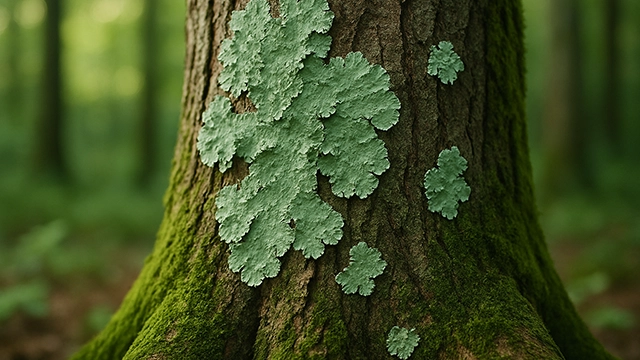

If you’ve ever walked through a damp forest or past an old oak in your backyard and spotted green fuzz clinging to the bark, you may have wondered: Is that mold? Algae? Some kind of rot? The truth is less alarming and far more fascinating. That gentle green veil is often not a threat, but a quiet marvel of nature: lichen. Encyclopedia Britannica

Lichens: A Fungal-Algal Alliance
Lichens are one of nature’s most remarkable partnerships—a union between fungi and either algae or cyanobacteria. They don’t feed on the tree, nor do they signal rot. Instead, they simply live on the bark, not from it. The fungus provides the structure, while the algae photosynthesize, creating food for both. Encyclopedia BritannicaUS Forest Service
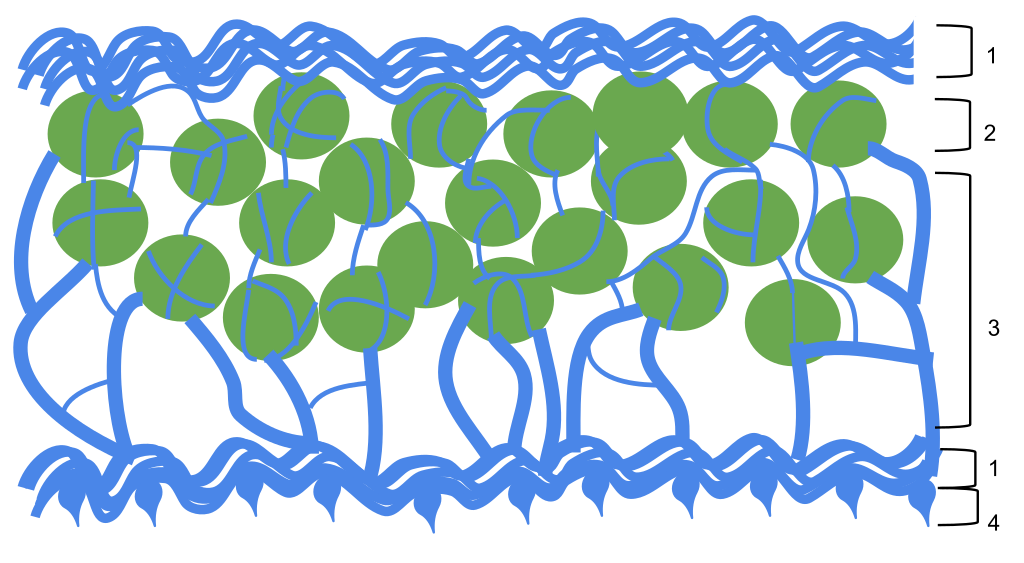
They come in all forms: crusty gray patches, leafy green mats, even spidery yellow veils. Far from being invaders, lichens thrive in places with clean air and rain, making them excellent indicators of environmental health.
False Alarms: Not All Green Is Trouble
Homeowners often panic at any green growth on trees, assuming it’s a fungal pathogen or dangerous mold. True pathogens, like Armillaria (honey fungus) or oozing cankers, usually come with other symptoms: mushroom fruiting bodies, weeping bark, thinning canopy. But lichens? They cling peacefully, sometimes choosing older or stressed trees simply because the light reaches the trunk more easily.


Algae, too, can appear on bark in humid climates, forming green films. These are also surface-dwellers and rarely cause harm. The confusion arises when both algae and lichens colonize the same spot. The key? Lichens are patchy and textured; algae, more like a smear.

A Living Air Monitor
Lichens are more than bark decoration—they’re natural bioindicators. Because they absorb nutrients and moisture directly from the atmosphere, they are extremely sensitive to air pollution. A tree covered in lichen might be telling you that the air around you is surprisingly clean.

Scientists also study lichens for their chemical compounds: some produce antimicrobial agents or pigments that could inspire new biotechnologies. And in a warming , polluted world, lichens might help us understand which ecosystems are still in balance.
What Should You Do?
Leave them be.
Unless you’re seeing clear signs of tree distress (like bark lesions, leaf loss, or structural damage), lichens don’t need removal. In fact, they often mark trees that are part of stable or recovering ecosystems. Scrubbing them off may do more harm than good. extension.umd.edu

Next time you see a pale green crust or ruffled patch on bark, think of it not as a symptom, but as a story. A reminder that even on the quiet surface of a tree, there are ancient alliances at work, keeping the air clean, the soil balanced, and the planet quietly ticking forward.
Because in the wild, not all signs of life are loud. Some just quietly glow green and go unnoticed—until you learn to look.
References
Authoritative definitions & ecology
- Encyclopaedia Britannica. “Lichen.” (updated 2025). https://www.britannica.com/science/lichen. Encyclopedia Britannica
- Encyclopaedia Britannica. “Fungus — Lichens.” (updated 2025). https://www.britannica.com/science/fungus/Lichens. Encyclopedia Britannica
- USDA Forest Service. “About Lichens.” https://www.fs.usda.gov/wildflowers/beauty/lichens/about.shtml. US Forest Service
Bioindicator & air quality
- U.S. National Park Service. “Lichens as Bioindicators.” https://www.nps.gov/articles/lichens-as-bioindicators.htm.
- U.S. National Park Service. “Bioindicators — Air.” https://www.nps.gov/subjects/air/bioindicators.htm.
- World Health Organization. “Ambient (outdoor) air pollution: Key facts.” https://www.who.int/news-room/fact-sheets/detail/ambient-%28outdoor%29-air-quality-and-health.
- IPCC AR6 Synthesis Report (2023), Summary for Policymakers (PDF). doi:10.59327/IPCC/AR6-9789291691647.001. https://www.ipcc.ch/report/ar6/syr/ ; PDF: https://www.ipcc.ch/report/ar6/syr/downloads/report/IPCC_AR6_SYR_SPM.pdf.
Pathogens & look-alikes
- Wikipedia. “Armillaria.” https://en.wikipedia.org/wiki/Armillaria.
- Wikipedia. “Canker (plant pathology).” https://en.wikipedia.org/wiki/Canker.
Lichen chemistry
- Cocchietto M. et al. “Usnic acid: a natural compound for topical use in the treatment of wounds and superficial burns.” Planta Medica 75(4): 2009. PMID: 19844848. https://pubmed.ncbi.nlm.nih.gov/19844848/ .
- Manojlović N. et al. “Antimicrobial Activity of Lichen Secondary Metabolites.” Frontiers in Microbiology 11: 2020. https://www.frontiersin.org/articles/10.3389/fmicb.2020.00826/full . Encyclopedia Britannica
Management guidance
- University of Maryland Extension. “Lichens on Trees and Shrubs.” https://extension.umd.edu/resource/lichens-trees-and-shrubs. extension.umd.edu
Key Takeaways
- If you’ve ever walked through a damp forest or past an old oak in your backyard and spotted green fuzz clinging to the bark, you may have wondered: Is that mold?
- Lichens are one of nature’s most remarkable partnerships—a union between fungi and either algae or cyanobacteria.
- They come in all forms: crusty gray patches, leafy green mats, even spidery yellow veils.
- True pathogens, like Armillaria (honey fungus) or oozing cankers, usually come with other symptoms: mushroom fruiting bodies, weeping bark, thinning canopy.
- Algae, too, can appear on bark in humid climates, forming green films.
Frequently Asked Questions
What should you know about lichens: A Fungal-Algal Alliance?
Lichens are one of nature’s most remarkable partnerships—a union between fungi and either algae or cyanobacteria. They don’t feed on the tree, nor do they signal rot. Instead, they simply live on the bark, not from it. The fungus provides the structure, while the algae photosynthesize, creating food
What should you know about false Alarms: Not All Green Is Trouble?
Homeowners often panic at any green growth on trees, assuming it’s a fungal pathogen or dangerous mold. True pathogens, like Armillaria (honey fungus) or oozing cankers, usually come with other symptoms: mushroom fruiting bodies, weeping bark, thinning canopy. But lichens? They cling peacefull
What should you know about a Living Air Monitor?
Lichens are more than bark decoration—they’re natural bioindicators. Because they absorb nutrients and moisture directly from the atmosphere, they are extremely sensitive to air pollution. A tree covered in lichen might be telling you that the air around you is surprisingly clean.
What Should You Do?
Leave them be.Unless you’re seeing clear signs of tree distress (like bark lesions, leaf loss, or structural damage), lichens don’t need removal. In fact, they often mark trees that are part of stable or recovering ecosystems. Scrubbing them off may do more harm than good. extension.umd.edu
What are the key findings about The Green Mystery on?
If you’ve ever walked through a damp forest or past an old oak in your backyard and spotted green fuzz clinging to the bark, you may have wondered: Is that mold? Algae? Some kind of rot? The truth is less alarming and far more fascinating. That gentle green veil is often not a threat, but a quiet ma