
The Field Is Not the System
Conventional soil disease management treats the field as the primary unit of analysis. Moisture levels, soil pH, organic matter content, crop rotation history — these are the variables that drive most field-level fungal risk assessments, and they remain genuinely important.
But a global-scale study published in Nature Communications adds a layer that field-level analysis consistently misses: the surrounding landscape. Analyzing 511 soil samples collected across multiple ecosystems worldwide, researchers found that land-use patterns and vegetation structure at the landscape scale contribute significantly to soil pathogenic fungal diversity — independently of local soil conditions.
The operational implication is direct. Managing fungal risk at the field level addresses the proximate environment. Managing it effectively may require accounting for the landscape surrounding that field.
What the Data Shows
The study examined soil samples across a range of ecosystem types, assessing pathogenic fungal diversity alongside both local soil properties and landscape-scale variables including crop cover, grass cover, tree cover, landscape complexity, and climatic conditions.
Key findings:
Crop-dominated landscapes correlate with higher pathogenic fungal diversity. Agricultural land with high proportions of cultivated area tended to support greater diversity of soil pathogens. Stable host availability, reduced ecological variation, and repeated cultivation appear to create favorable conditions for pathogenic fungi to persist and specialize.
Grass and tree cover associate with lower pathogenic diversity. Landscapes with higher proportions of grassland and forest showed reduced pathogenic fungal diversity. Vegetation complexity introduces biological competition and ecological variability that limits pathogen dominance.
Landscape complexity does not uniformly reduce risk. More heterogeneous landscapes were associated with increased pathogenic fungal diversity in certain contexts — particularly in grassland systems. Greater ecological complexity creates more niches, which can support a wider range of organisms including pathogens.
Ecosystem type modifies the response. Grassland systems showed stronger responses to landscape variables than forest systems. There is no single landscape configuration that minimizes fungal risk across all ecosystem types.

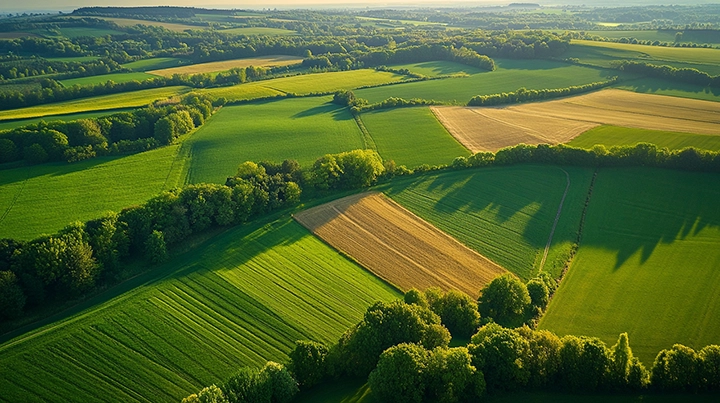
Agricultural fields alongside the Mühlenbach stream near Dülmen, North Rhine-Westphalia — a landscape where cultivated land and natural vegetation meet. Research shows that surrounding land-use structure significantly influences soil pathogenic fungal diversity beyond what local soil conditions alone can explain.Credit:
Dietmar Rabich / Wikimedia Commons, CC BY-SA 4.0Why Agricultural Landscapes Amplify Pathogen Diversity
The association between intensive cropping and elevated pathogenic fungal diversity follows a recognizable ecological logic.
Monoculture and near-monoculture systems reduce biological diversity at multiple levels — fewer plant species, less varied root chemistry, reduced invertebrate and microbial competition. For pathogenic fungi that specialize on particular host types, this simplification is advantageous. Hosts are abundant, competition is reduced, and conditions are stable across seasons.
Crop expansion and agricultural intensification over recent decades have extended these conditions across larger and larger areas. The study’s global dataset captures the result: where agricultural land use dominates the landscape, pathogenic fungal communities tend to be more diverse and more persistent.
This does not mean agriculture creates new pathogens. It means that landscape-scale land use decisions influence which pathogens the soil community selects for — and how many.
Vegetation as Functional Infrastructure
The inverse relationship between vegetation cover and pathogenic fungal diversity has practical relevance for agricultural planning and landscape design.
Grasslands and forests introduce what ecologists describe as structural complexity — varied plant communities, diverse root systems, richer invertebrate communities, and more competitive microbial environments. These conditions make it harder for any single pathogenic group to dominate.

A monoculture strawberry field in Kirchspiel, Dülmen, Germany. Crop-dominated landscapes with reduced ecological variation are associated with higher diversity of soil pathogenic fungi — a pattern documented across global soil samples in a 2025 Nature Communications study.Credit:
Dietmar Rabich / Wikimedia Commons, CC BY-SA 4.0From a land management perspective, this frames vegetation not as an economic cost but as functional ecological infrastructure. Field margins, buffer strips, hedgerows, and integrated grassland areas within agricultural landscapes may contribute to microbial balance in ways that conventional soil management does not address.
The research does not provide quantified thresholds — how much vegetation cover reduces pathogen diversity by how much — but the directional relationship is consistent across the dataset.
Landscape Complexity: A Non-Linear Risk Factor
One finding that complicates straightforward management prescriptions is the relationship between landscape complexity and fungal risk.
Increased landscape heterogeneity — a mix of different land-use types, vegetation patches, and ecological zones — is generally associated with higher biodiversity and ecosystem resilience. In fungal ecology, however, the relationship is more nuanced. Greater complexity can support a wider range of microbial communities, including pathogenic ones, by creating more available niches.
Grassland systems showed this pattern more strongly than forest systems, suggesting that the effect is context-dependent. In transitional agricultural landscapes where grassland fragments are embedded within cropped areas, landscape complexity may increase rather than reduce pathogenic diversity.
For land managers, this means that biodiversity-positive interventions — habitat mosaics, ecological corridors, diversified land use — should be evaluated for their fungal risk implications alongside their broader ecological benefits. The two are not always aligned.
Implications for Agricultural and Environmental Planning
The study’s findings suggest several areas where landscape-scale thinking should be integrated into existing frameworks:
Regional disease risk assessment should incorporate land-cover data alongside local soil monitoring. Areas with high proportions of agricultural cover and low vegetation diversity may warrant elevated baseline monitoring for soil pathogenic fungi.
Agricultural landscape design — decisions about field margins, cover crops, buffer zones, and habitat strips — has microbial consequences that are rarely considered in current planning frameworks. The evidence base for incorporating fungal risk into these decisions is strengthening.
Environmental change scenarios that involve crop expansion, deforestation, or habitat fragmentation are likely to affect pathogenic fungal distribution. Land-use change modeling should include pathogen diversity as one outcome variable alongside carbon stocks, water quality, and biodiversity metrics.
Predictive monitoring systems that combine satellite-derived land-cover data with soil sampling could potentially identify emerging risk zones before outbreaks occur — a meaningful operational advantage over current reactive approaches.
Limitations and Scope
The study’s global scope is both its strength and its constraint. A 511-sample dataset spanning multiple continents and ecosystem types provides pattern-level evidence, but it cannot resolve the mechanisms driving specific local outcomes. The findings identify associations; they do not establish causal pathways between individual land-use decisions and specific fungal population changes.
Ecosystem-type effects also limit generalizability. Results that hold in grassland systems do not necessarily apply in forest systems, and neither may translate directly to specific crop systems in specific regions. Site-level management decisions should not be derived from global associations alone.
What the study establishes is a consistent directional signal: landscape structure matters for soil pathogenic fungal diversity, the relationship is detectable at global scale, and current field-level management frameworks are operating without accounting for it.
Conclusion
Soil pathogenic fungi are not contained within individual fields. Their diversity is shaped by the landscape in which those fields are embedded — the proportion of cultivated land, the presence or absence of vegetation buffers, the ecological complexity of the surrounding area.
A global analysis of 511 soil samples across multiple ecosystems demonstrates this relationship with sufficient consistency to warrant its incorporation into agricultural planning, regional disease risk assessment, and environmental change modeling.
Field-level management remains necessary. It is no longer sufficient on its own.
FAQ
Does soil alone determine fungal disease risk? No. This study demonstrates that surrounding landscape structure — crop cover, vegetation diversity, and land-use patterns — also significantly influences soil pathogenic fungal diversity.
Do agricultural landscapes increase fungal risk? Crop-dominated landscapes are associated with higher pathogenic fungal diversity, likely due to stable host availability, reduced ecological variation, and repeated cultivation conditions.
Can vegetation reduce fungal disease risk? Grasslands and forests are associated with lower pathogenic fungal diversity. Vegetation complexity increases biological competition and ecological variability that limits pathogen dominance.
Does landscape complexity always reduce risk? Not necessarily. Increased heterogeneity can support broader microbial diversity including pathogens, particularly in grassland systems. The relationship is context-dependent.
Can fungal risk be predicted from landscape data? Combining land-cover analysis with soil monitoring and ecological modeling may allow predictive identification of elevated-risk zones — an area of active research development.
References
- Nature Communications (2025). Land-use patterns shape soil pathogenic fungal diversity across global ecosystems. Nature Communications. https://www.nature.com/articles/s41467-025-67929-5
Key Takeaways
- Please login The Field Is Not the System Conventional soil disease management treats the field as the primary unit of analysis.
- But a global-scale study published in Nature Communications adds a layer that field-level analysis consistently misses: the surrounding landscape.
- Crop-dominated landscapes correlate with higher pathogenic fungal diversity. Agricultural land with high proportions of cultivated area tended to support greater diversity of soil pathogens.
- Grass and tree cover associate with lower pathogenic diversity. Landscapes with higher proportions of grassland and forest showed reduced pathogenic fungal diversity.
- Greater ecological complexity creates more niches, which can support a wider range of organisms including pathogens.
Frequently Asked Questions
What should you know about please login to bookmark?
Please login The Field Is Not the System Conventional soil disease management treats the field as the primary unit of analysis. Moisture levels, soil pH, organic matter content, crop rotation history — these are the variables that drive most field-level fungal risk assessments, and they remain genui
What should you know about the Field Is Not the System?
Conventional soil disease management treats the field as the primary unit of analysis. Moisture levels, soil pH, organic matter content, crop rotation history — these are the variables that drive most field-level fungal risk assessments, and they remain genuinely important.
What the Data Shows?
The study examined soil samples across a range of ecosystem types, assessing pathogenic fungal diversity alongside both local soil properties and landscape-scale variables including crop cover, grass cover, tree cover, landscape complexity, and climatic conditions.
Why Agricultural Landscapes Amplify Pathogen Diversity?
The association between intensive cropping and elevated pathogenic fungal diversity follows a recognizable ecological logic.
What should you know about vegetation as Functional Infrastructure?
The inverse relationship between vegetation cover and pathogenic fungal diversity has practical relevance for agricultural planning and landscape design.