
When “Safe” Isn’t Safe Anymore
For most of modern conservation history, museums have relied on a simple assumption: dryness equals safety. If the air remained stable, cool, and moisture-poor, the classic molds that cause foxing on paper, staining on canvas, and softness in leather would have no foothold. This belief shaped decades of preservation policy, storage design, and HVACengineering.
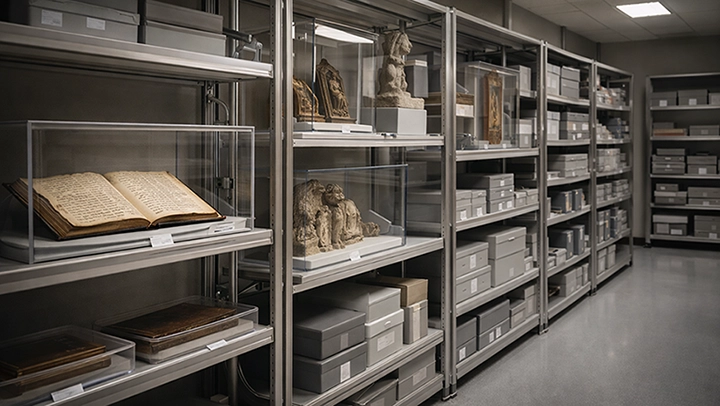
A report discussed in Scientific American shows that this framework is cracking. In controlled vaults designed to be inhospitable, a different group of fungi — extremophiles adapted to deserts, salt flats, and chronically dry microhabitats — are quietly colonizing irreplaceable objects. These organisms are not hindered by dry air; they require it. What museums built as protective cocoons have, unintentionally, become environments perfectly suited to fungi that survive on scarcity.
This reversal forces a rethinking of what “safe conditions” actually mean. Dryness can deter conventional molds, but it can also welcome life forms that evolved to thrive in drought.

Xerophiles: The Dry-Loving Invaders
Xerophilic fungi such as Aspergillus restrictus, Wallemia sebi, and species of Eurotium operate with an entirely different biological strategy from their moisture-loving relatives. Instead of waiting for leaks, spills, or condensation, they activate in response to minute humidity fluctuations — the kind produced when a display case is briefly opened or when a visitor exhales near a fragile object.
These fungi feed on microscopic traces of organic material: airborne dust, traces of collagen from leather, cellulose fragments from paper fibers, or residual binders in pigments. Even the slightest residue becomes enough fuel to launch colonization. Conservators report seeing faint white films, tiny crystalline patches, or delicate networks of hyphaeweaving themselves into fibers long before any visible mold spot appears.
Once these hyphae penetrate the interior layers of an artifact, the damage is no longer superficial. Structural weakening begins quietly, chemically, and often irreversibly. Unlike ordinary mold that sometimes remains on the surface, xerophiles burrow, digest, and destabilize.
They do not need damp walls; they need opportunity — and opportunity is now found in the very conditions museums were designed to maintain.

Why Museums Never Saw This Coming
The rise of extremophile mold is the product of two intersecting forces.
Climate volatility.
As outdoor temperatures and humidity swing more dramatically from one day to the next, even sophisticated HVAC systems cannot maintain perfect stability. These subtle shifts create microclimates inside display cases, drawers, or archival boxes. A brief spike — even one lasting only hours — can awaken dormant xerophilic spores, launching their growth cycle.
Institutional silence.
Mold outbreaks are reputationally sensitive. Many museums, fearing panic or funding impacts, choose to handle incidents quietly. Cases go unreported, leaving researchers without a comprehensive dataset on frequency, severity, or distribution. Without shared knowledge, patterns remain hidden, and the scientific community cannot respond as quickly as the threat requires.
The result is a blind spot: a growing fungal problem operating beneath the radar of both institutions and academia.

What These Extremophiles Can Destroy
The materials endangered by xerophilic fungi form the backbone of cultural heritage:
- Cellulose-based materials — books, manuscripts, archival records, historical textiles.
- Collagen-rich artifacts — leather bindings, parchment, vellum, natural glues.
- Traditional paint layers — especially those containing egg tempera, fish glue, or plant oils.
- Mineral surfaces with organic dust — stone sculptures, ceramics, even metal objects with biofilms.
What makes these fungi particularly destructive is their ability to penetrate deeply before any outward sign appears. When visible spots or discolorations finally emerge, the underlying deterioration may already be advanced. Attempts to clean or stabilize affected objects often reveal internal weakness, flaking surfaces, or fiber loss that cannot be reversed.
The stakes are not simply aesthetic. These organisms threaten the long-term survivability of historical records, artworks, and archaeological materials — the physical memory of human civilization.

A New Preservation Challenge
The discovery of xerophilic activity in controlled vaults pushes conservationists toward a new paradigm. The humidity ranges long considered safe — typically 40–55% relative humidity (RH) — may inadvertently favor extremophile molds.
As a result, museums are beginning to test new strategies:
- dynamic humidity modulation to disrupt fungal activity
- microclimate sensors placed inside display cases and storage boxes
- molecular screening for xerophilic spores
- inert-gas or low-oxygen storage for highly sensitive artifacts
The shift is profound: preventing mold is no longer about eliminating moisture. It is about eliminating the signals that encourage growth — signals as subtle as a 2% humidity fluctuation.

The Ecological Lesson Beneath the Crisis
Extremophile molds highlight a deeper truth about fungi: their adaptability is extraordinary. Species honed in deserts, dry cliffs, and salt-laden landscapes have evolved biochemical tools that make climate-controlled vaults feel unexpectedly comfortable. Stability, stillness, and low humidity mimic their natural niches more closely than living forests do.
This is not a failure of museum practice. It is a testament to the versatility of fungal life — and a reminder that biological systems exploit any niche available to them, even those crafted with the greatest human care.
Conclusion: A New Frontier in Conservation
The emergence of extremophile fungi within museums challenges one of conservation’s oldest assumptions: that engineered stability is enough to guarantee safety. Going forward, preservation cannot rely solely on controlling temperature and humidity. It must incorporate fungal ecology, microclimate science, and rapid detection technologies.
Protecting cultural heritage will require understanding not just the materials in collections, but the organisms eager to colonize them. As extremophile molds rewrite the rules, conservation science is entering a new era — one where biological awareness becomes just as important as environmental engineering.
References
Academic sources
Sterflinger, K. (2010). Fungi: Their role in deterioration of cultural heritage. Fungal Biology Reviews.
https://doi.org/10.1016/j.fbr.2010.03.003
Zalar, P., et al. (2005). Wallemia sebi: A xerophilic fungus commonly found in indoor environments. Mycological Research.
https://doi.org/10.1017/S0953756205002959
Media / scientific reporting
Scientific American. (2025). Extremophile fungi threaten museum collections.
https://www.scientificamerican.com
Key Takeaways
- For most of modern conservation history, museums have relied on a simple assumption: dryness equals safety.
- This belief shaped decades of preservation policy, storage design, and HVACengineering.
- These organisms are not hindered by dry air; they require it.
- Dryness can deter conventional molds, but it can also welcome life forms that evolved to thrive in drought.
- These fungi feed on microscopic traces of organic material: airborne dust, traces of collagen from leather, cellulose fragments from paper fibers, or residual binders in pigments.
Frequently Asked Questions
When “Safe” Isn’t Safe Anymore?
For most of modern conservation history, museums have relied on a simple assumption: dryness equals safety. If the air remained stable, cool, and moisture-poor, the classic molds that cause foxing on paper, staining on canvas, and softness in leather would have no foothold. This belief shaped decade
What should you know about xerophiles: The Dry-Loving Invaders?
Xerophilic fungi such as Aspergillus restrictus, Wallemia sebi, and species of Eurotium operate with an entirely different biological strategy from their moisture-loving relatives. Instead of waiting for leaks, spills, or condensation, they activate in response to minute humidity
Why Museums Never Saw This Coming?
The rise of extremophile mold is the product of two intersecting forces.
What These Extremophiles Can Destroy?
The materials endangered by xerophilic fungi form the backbone of cultural heritage:
What should you know about a New Preservation Challenge?
The discovery of xerophilic activity in controlled vaults pushes conservationists toward a new paradigm. The humidity ranges long considered safe — typically 40–55% relative humidity (RH) — may inadvertently favor extremophile molds.