According to HORIZON
From Forest Floor to Skyline
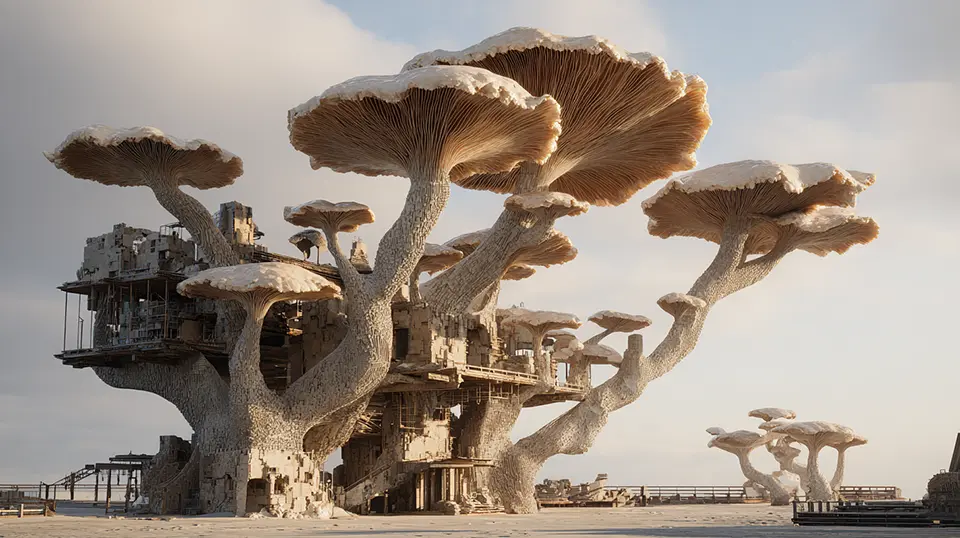
In the quiet decay of forest logs and under layers of damp soil, fungi have long played their part in the Earth’s cycles — decomposers, recyclers, silent architects of rebirth. But what if these humble organisms could be harnessed to build the cities of the future?
That’s the bold question behind a growing wave of European research projects exploring the use of mushrooms — specifically mycelium — as a building material. No longer just a culinary or ecological curiosity, fungi are now stepping into the spotlight as a living, biodegradable, and self-healing alternative to concrete, plastic, and foam.
Welcome to the world of living architecture, where biology, engineering, and environmental science meet in the service of sustainable design — and mushrooms are at the foundation, quite literally.

Source: Wikimedia Commons, CC BY-SA 4.0
What Is Mycelium?
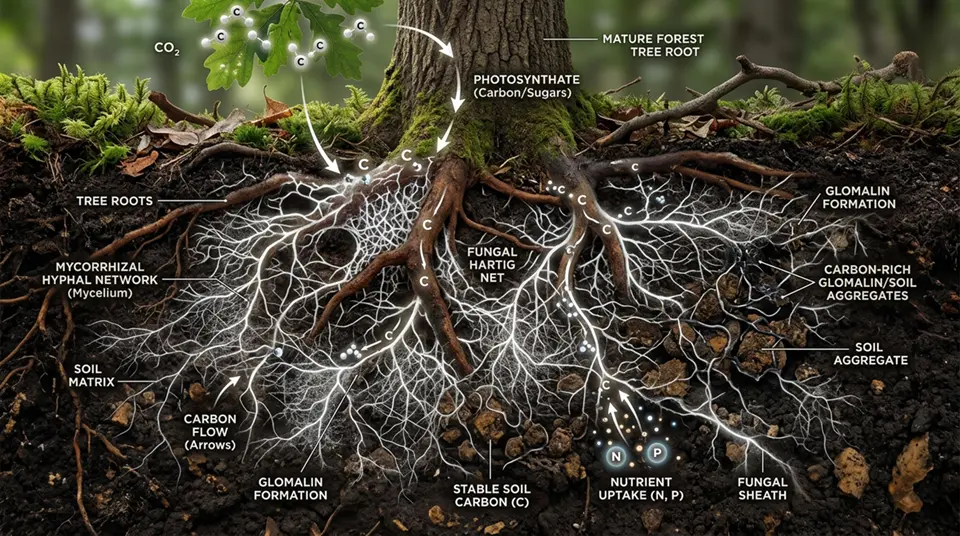
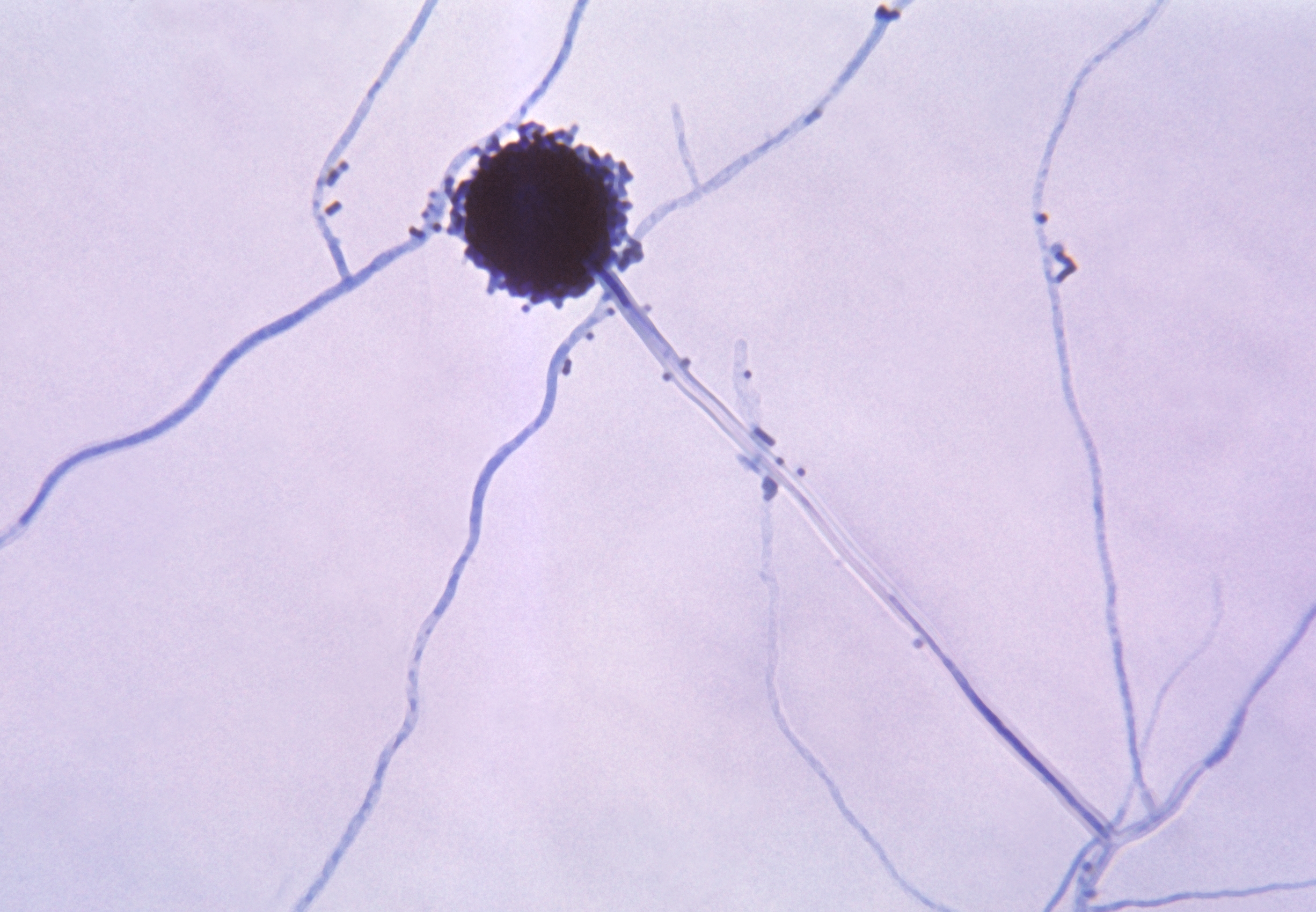
At the heart of this innovation lies mycelium, the root-like network of threadlike cells (called hyphae) that make up the vast majority of a fungus’s mass. It grows underground or within its substrate, digesting organic matter and binding particles together as it grows.
Mycelium behaves like natural glue, fusing substrates such as straw, wood chips, or agricultural waste into lightweight, durable composites. Once grown, these materials can be dried to halt further growth, shaped into bricks, panels, or insulation — or even kept alive to enable self-repair when damaged.
Species commonly used in construction research include:
Each species has different structural and biochemical properties that make them suitable for different architectural applications — from load-bearing components to soundproof insulation.
Source: Wikimedia Commons, CC BY-SA 3.0
The MycoArchitecture Movement
A number of projects across Europe — many funded by the European Union’s Horizon research programme — are now turning fungal possibilities into engineered realities.
One such initiative is exploring how mycelium-based materials could create buildings that not only biodegrade but regenerate — adapting to their environment, sealing cracks, and absorbing CO₂ from the air.
It’s not science fiction. Early-stage prototypes have already demonstrated:
- Mycelium insulation panels with superior acoustic and thermal properties
- Load-bearing bricks made from fungal composites
- Living wall systems that respond to humidity and self-repair surface damage
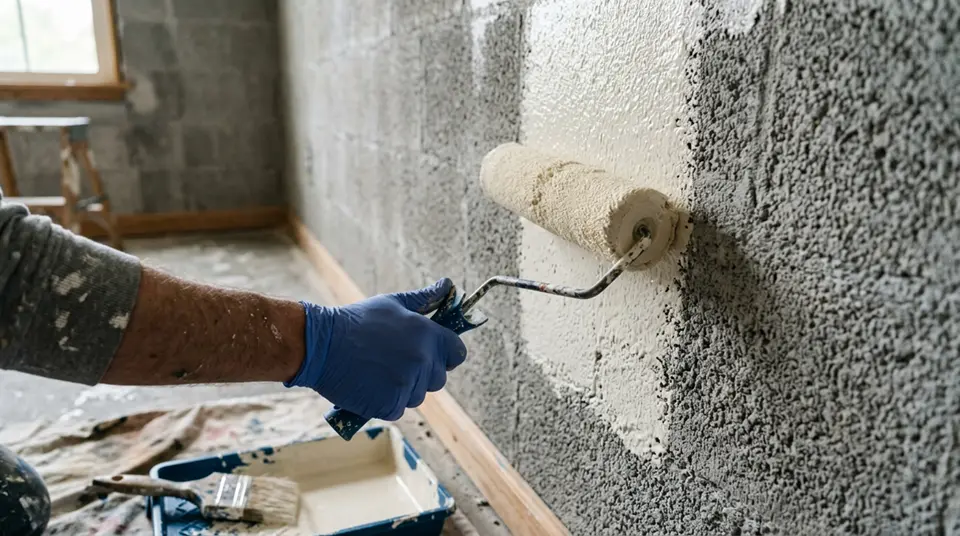
- Fire-retardant coatings derived from fungal biomass
While some of these applications are still in development, others have already made their way into architectural exhibitions and even small-scale construction.
Why Fungal Architecture Matters
The building and construction sector is responsible for nearly 39% of global CO₂ emissions (UN Environment), when accounting for both operational energy and embodied carbon in materials like steel and concrete.
Traditional materials come at a high environmental cost:
- Concrete emits around 0.9 kg of CO₂ per kilogram produced
- Steel requires vast energy inputs
- Plastic insulation contributes to microplastic pollution and resists biodegradation
Mycelium, by contrast:
- Grows from waste biomass
- Requires minimal energy input
- Is biodegradable and compostable
- Can be grown locally, reducing transportation emissions
- Acts as a carbon sink, locking carbon into its biomass
And if kept alive in controlled systems, mycelium can sense damage, redirect growth, and even repair structural weaknesses — an idea that may redefine how we think of maintenance and longevity in architecture.
Challenges and Hurdles
Still, this future faces significant challenges:
- Regulatory frameworks: Most building codes don’t account for organic, living materials. Approval processes remain slow.
- Structural limits: While strong for their weight, mycelium composites aren’t yet ready to replace steel or concrete for high-rise construction.
- Durability and weatherproofing: Fungal materials need protection from water and UV radiation in exterior applications.
- Scalability: Mass-producing living materials requires new supply chains, bioreactors, and trained labor.
- Public perception: Will people feel safe and comfortable living in mushroom-based homes?
Researchers and architects are addressing these barriers with hybrid designs, new coating technologies, and modular systems that allow fungi to thrive in protected environments.
Design Inspirations and Case Studies
Already, fungal architecture is capturing the imagination of designers around the world:
- The Hy-Fi Pavilion in New York was one of the first large-scale demonstrations of mycelium bricks.
- Grown.bio, a Dutch company, creates custom mushroom panels for interior design and packaging.
- European universities are experimenting with fungal composite domes, shelters, and mobile structures.
In each case, the aesthetic is as revolutionary as the science: curved, earthy, organic forms that defy industrial geometry and return us to the shapes of nature.
The Future: Buildings That Breathe and Grow
What if your house could grow around you? What if walls healed like skin, roofs digested pollutants, and rooms adapted to weather conditions like leaves?
This is the dream behind living architecture — not only a solution to climate change, but a philosophical evolution in how we relate to the built world.
Mycelium might be the bridge between biology and construction, between decay and creation, between sustainability and renewal.
And just like in the forest, fungi may be working quietly beneath the surface — preparing to change everything.
References
Dezeen. Fungal architecture projects.
ArchDaily. Mycelium in architecture.
According to HORIZON
Key Takeaways
- Mycelium-based building materials—composite boards, insulation panels, and structural blocks grown from agricultural waste bound together by fungal mycelium—are emerging as commercially viable sustainable alternatives to conventional materials.
- Companies like Ecovative Design have pioneered myco-composite manufacturing at commercial scale, with products already sold for packaging, building insulation, and other applications in multiple markets.
- Mycelium composites are fire-resistant, thermally insulating, acoustically dampening, and can be grown in custom mold shapes without energy-intensive manufacturing—properties that compare favourably with petrochemical-derived foam materials.
- The self-healing potential of living mycelium materials—where fungal networks can repair microscopic cracks through continued growth—represents a biomimetic property unmatched by any conventional building material.
- Regulatory pathways for mycelium-based structural building materials remain underdeveloped, as current building codes were designed for conventional materials and lack frameworks for certifying biological structural materials.
Frequently Asked Questions
What are mycelium-based building materials and how are they made?
Mycelium-based building materials are composite materials in which the root network (mycelium) of selected fungal species—typically wood-decay fungi like Ganoderma species or Trametes versicolor—grows through and binds together a substrate of agricultural waste fibers to create a solid, structured composite material. Manufacturing process: agricultural waste (corn stalks, straw, hemp hurd, rice hulls, wood chips) is pasteurised to reduce competing microbial contamination; the pasteurised substrate is inoculated with selected fungal spawn (grain or sawdust colonised with the desired fungal species); the inoculated substrate is packed into molds of the desired shape and placed in incubation conditions (20–30°C, appropriate humidity); over 5–10 days, the fungal mycelium colonises the substrate, sending hyphae through and around every fiber particle and bonding them together; when the mycelium has fully colonised the substrate and the desired density is achieved, the material is heat-treated (oven baking at 50–70°C) to deactivate the mycelium and stop growth, locking in the composite structure; the finished material is removed from the mold, trimmed, and can optionally be surface-treated or coated. The resulting material has a cellular foam-like structure with properties that can be tuned by varying the substrate composition, fungal species, incubation conditions, and processing parameters.
How strong and durable are mycelium building materials?
Mycelium building material mechanical properties have been studied extensively, with results showing they are competitive with some conventional materials but not with others, making application-matching critical. Mechanical properties of typical mycelium composites: density—typically 50–150 kg/m³ (lighter than most structural materials); tensile strength—5–30 MPa depending on formulation (comparable to low-density polyurethane foam, significantly weaker than structural timber at 10–100 MPa or concrete at 20–50 MPa); compressive strength—0.1–1.5 MPa (suitable for non-load-bearing panel applications; below the compressive strength needed for structural load-bearing applications without reinforcement); flexural strength—3–20 MPa. Comparison with conventional materials: expanded polystyrene (EPS) foam—0.1–1.5 MPa compressive strength (comparable to mycelium); polyurethane foam—0.2–2 MPa (comparable); structural timber—30–100 MPa tensile strength (much stronger than current mycelium composites); concrete—20–50 MPa compressive strength (much stronger). Current commercial applications aligned with these properties: packaging materials (protective foam replacement)—well-suited to mycelium composites; thermal and acoustic insulation panels—well-suited; non-structural interior wall panels—well-suited; structural load-bearing applications—current mycelium composites are not strong enough without significant reinforcement or hybridisation with conventional structural materials. Research frontier: hybrid mycelium-fibre composites incorporating hemp, flax, or bamboo fibres show significantly enhanced mechanical properties; some research groups have achieved composites approaching wood-equivalent strength properties.
Are mycelium building materials safe—could they release mold spores?
This is a critical safety question for mycelium building materials, and the answer depends on the lifecycle stage of the material and whether living or deactivated mycelium is incorporated. Commercial myco-composite materials (deactivated mycelium): commercially manufactured mycelium building materials (Ecovative’s MycoBoard, Mogu acoustic panels, etc.) are heat-treated during manufacturing to kill the fungal mycelium before sale; deactivated mycelium does not grow, cannot produce spores, and does not pose a biological hazard under normal conditions; these materials are essentially inert biological composites, analogous to pressed wood or natural fiber composites. Conditions under which spore risk could arise: if deactivated mycelium composite materials were exposed to persistent moisture (flooding, leak damage) without treatment, residual or environmental fungal contamination could potentially colonise the agricultural fiber substrate, which is inherently nutritious; this is a concern for any organic building material (natural fiber insulation, wood-based boards) not specific to mycelium composites; properly dried and deactivated mycelium composites require moisture exposure similar to wood products to develop secondary mold growth. Living mycelium building applications: some researchers are exploring structural applications using living mycelium that remains active; these are research-stage and not commercially deployed; the safety implications of living fungal materials in building applications—including spore production, allergenic potential, and behaviour under fire—require extensive study before regulatory approval. Comparison with conventional materials: most natural fiber insulation materials (cellulose, hemp wool, sheep’s wool) are similarly vulnerable to mold colonisation under moisture exposure, suggesting mycelium composites are not uniquely problematic.
Which companies are making mycelium building products commercially?
A small but growing number of companies have achieved commercial production of mycelium-based materials, with a few pioneering organisations leading the field and establishing proof of commercial viability. Leading companies: Ecovative Design (USA)—the most established company in the space; founded in 2007 by Eben Bayer and Gavin McIntyre; initially focused on packaging (MycoFoam replacing expanded polystyrene); has since expanded to MycoBoard (structural composite panels), Forager insulation, and AirMycelium (textile applications); holds numerous fundamental patents in the field; has licensed its technology to Sealed Air Corporation and other partners. Mogu (Italy)—produces mycelium-based acoustic panels and floor tiles for commercial interior applications; has had commercial installations in European office and retail spaces; focuses on high-design interior applications with aesthetic appeal. Grown.bio (Netherlands)—produces custom-shaped mycelium packaging and building prototypes; notable for work with furniture brand IKEA on mycelium packaging prototypes. Biohm (UK)—research and development company focused on mycelium insulation boards and structural mycelium panels for sustainable construction. Large company interest: IKEA has partnered with Ecovative to develop mycelium-based mushroom packaging as a polystyrene alternative; Biomason, while focused on bacteria rather than fungi, demonstrates the broader biotechnology construction materials ecosystem.
What is the environmental benefit of mycelium building materials over conventional materials?
Mycelium building materials offer genuine environmental benefits compared to conventional petroleum-derived materials they most directly compete with (primarily foam insulation and packaging), though their advantages are more nuanced compared to other sustainable alternatives. Life cycle assessment comparisons with EPS foam insulation: carbon footprint—mycelium composite production generates significantly lower CO₂ than expanded polystyrene, which is derived from petroleum and requires energy-intensive moulding; preliminary LCA studies suggest 50–80% lower embodied carbon compared to EPS. Energy consumption—mycelium grows using biological metabolic energy from the substrate; the process requires energy only for pasteurisation, incubation temperature control, and drying/heat-treatment; this compares favourably with the petrochemical synthesis and physical foaming required for EPS. Raw material sustainability—mycelium composites can use agricultural waste streams that would otherwise be landfilled or burned (corn stover, straw, rice hulls, spent brewery grain); these represent use of already-generated ‘waste’ carbon rather than extractive new resource consumption. End of life—heat-treated mycelium composites are biodegradable under composting conditions, though degradation rate varies; EPS is essentially non-biodegradable and persists for centuries in landfill; mycelium composites can in principle be home composted or industrially composted. Comparison with mineral wool insulation (glass fibre, stone wool): mineral wool has relatively low embodied carbon compared to plastics; it is non-biodegradable but inert; mycelium insulation has comparable thermal performance but biodegradable end-of-life; the environmental comparison is closer between mycelium and mineral wool than between mycelium and EPS.