According to MYCOSTORIES
Scientists have uncovered new insights into the natural light-producing system of bioluminescent fungi, revealing a self-sustaining biochemical cycle that may eventually support advances in medical imaging, biotechnology, and synthetic biology. The research explains how glowing fungi continuously generate light without rapidly consuming the molecules involved, providing a clearer understanding of one of nature’s most efficient bioluminescent systems. Beyond explaining a long-standing biological mystery, the discovery offers a foundation for developing sustainable biological light sources that could be adapted for future scientific and medical technologies.

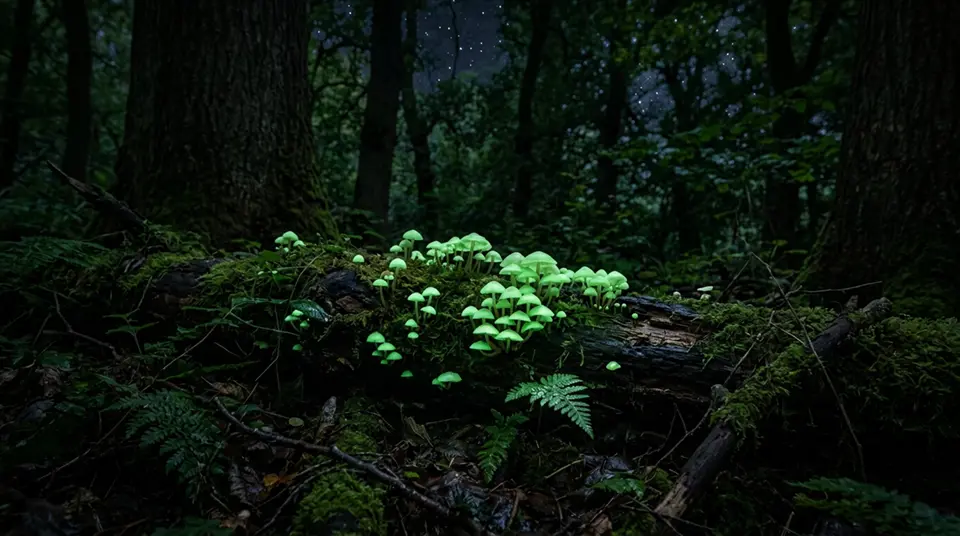
Unlike artificial fluorescent systems that require external illumination, bioluminescent fungi emit visible light through an internal chemical pathway. Researchers found that the fungal bioluminescence pathway continuously regenerates its own light-producing substrate, allowing the reaction to proceed repeatedly with minimal energy loss. The process relies on a series of enzymes that convert naturally occurring compounds — beginning with caffeic acid — into fungal luciferin (3-hydroxyhispidin), which is then oxidized by luciferase to produce green light before being recycled back into the metabolic pathway by the enzyme caffeylpyruvate hydrolase (CPH). This efficient regeneration distinguishes fungal bioluminescence from many other natural light-producing organisms and helps explain how fungi can maintain prolonged illumination in natural environments.

The study, published in The FEBS Journal by researchers including Cassius V. Stevani of the University of São Paulo, characterized CPH from Neonothopanus gardneri, one of the largest and brightest known bioluminescent fungal species, confirming that the enzyme converts oxyluciferin into caffeic acid and pyruvic acid — with the caffeic acid re-entering the pathway to sustain light emission and the pyruvic acid potentially redirected into cellular energy metabolism. The study also highlights the potential biomedical value of this self-renewing system. Because fungal bioluminescence operates independently without requiring repeated external substrate delivery, scientists believe it could become an attractive platform for long-term biological imaging. Engineered cells expressing the complete fungal pathway may eventually enable continuous monitoring of cellular activity, disease progression, gene expression, or tissue development with reduced experimental complexity. Researchers have already used the pathway to track processes such as tumor progression and inflammatory responses in engineered organisms, and to generate self-sustained luminescence in mice engineered with the fungal luciferase gene. Researchers also suggest the system could support future biosensors capable of detecting environmental changes or biological signals through persistent light emission. Although these applications remain in the research stage, the discovery broadens the possibilities for integrating fungal biochemistry into biotechnology and precision medicine.
Researchers emphasize that additional work is required before clinical or commercial applications become feasible. The efficiency, stability, and safety of transferring fungal bioluminescent pathways into mammalian cells or therapeutic systems must be carefully evaluated through further laboratory studies. Nevertheless, the discovery demonstrates how studying fungal biology can generate innovations beyond ecology, contributing to fields including synthetic biology, molecular diagnostics, environmental monitoring, and biomedical engineering. As scientists continue exploring naturally evolved biological systems, bioluminescent fungi may provide valuable inspiration for developing sustainable technologies that combine energy efficiency with continuous biological function.

References
According to MYCOSTORIES