According to MYCOSTORIES
Groundwork BioAg has announced the first Verra-verified soil carbon credits issued in the United States under the VM0042 Agricultural Land Management methodology, marking a significant milestone for both regenerative agriculture and the voluntary carbon market. The credits were generated through the company’s Rootella Carbon program, which is also recognized as the world’s first “measure-and-remeasure” project to issue verified carbon units based on direct soil measurements rather than predictive models. The announcement reflects growing interest in using naturally occurring soil fungi to support long-term carbon sequestration while improving agricultural sustainability.

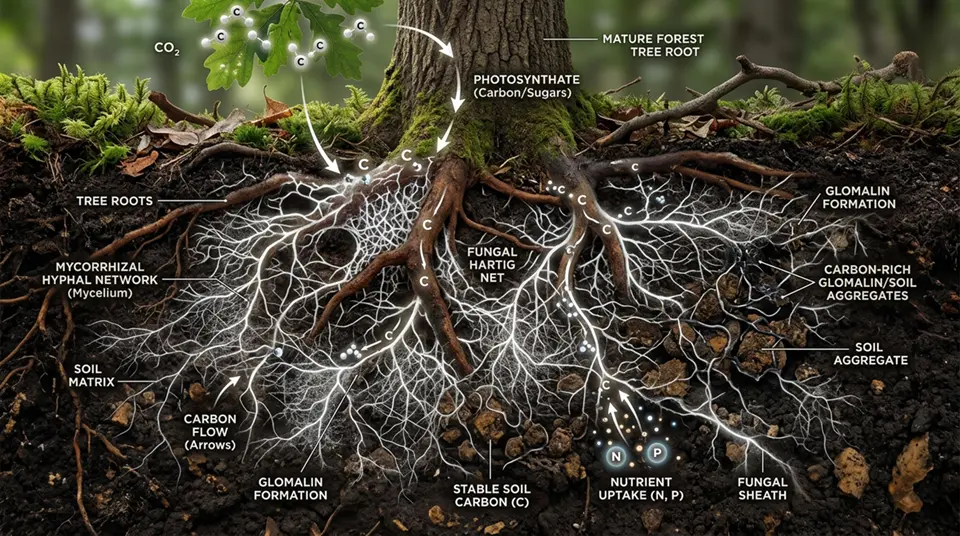
Mycorrhizal fungi form symbiotic relationships with plant roots, extending root systems and improving the uptake of water and nutrients. As these fungi grow, they help transfer atmospheric carbon into the soil, contributing to the formation of Mineral-Associated Organic Matter (MAOM), a relatively stable form of soil carbon. According to Groundwork BioAg, combining fungal inoculation with regenerative farming practices such as reduced tillage and cover cropping may increase carbon storage while improving soil health and crop resilience. The company reports that Rootella products were applied across approximately 5.5 million acres worldwide in 2025.
Unlike many existing soil carbon projects that rely heavily on satellite imagery or computer modeling, the Rootella Carbon program uses physical soil sampling and laboratory dry-combustion analysis before and after implementation. Independent verification was conducted by SCS Global Services under Verra’s Verified Carbon Standard. On June 24, 2026, the project issued 19,568 Verified Carbon Units (VCUs), becoming the first U.S. issuance under VM0042 and the first globally using the “measure-and-remeasure” approach. Participating farmers may receive up to 70% of net revenue generated from carbon credit sales, while enrollment has expanded from roughly 9,000 acres in 2023 to more than 700,000 acres across North America.

The development represents an important step for the voluntary carbon market, where confidence in soil carbon credits has often been limited by questions surrounding measurement accuracy and long-term permanence. Supporters argue that direct soil measurement improves transparency and credibility compared with purely model-based estimates. However, researchers also note that scientific debate continues regarding the long-term stability of mycorrhizal-mediated carbon storage and the varying effects fungi may have under different environmental conditions. While this verification demonstrates progress in carbon accounting methodologies, further long-term research and broader independent validation will be necessary before soil carbon credits achieve wider institutional acceptance.
References
Groundwork BioAg. Rootella Carbon Value Proposition.
According to MYCOSTORIES