According to Atmos
The Vast Hidden Infrastructure Beneath Our Feet
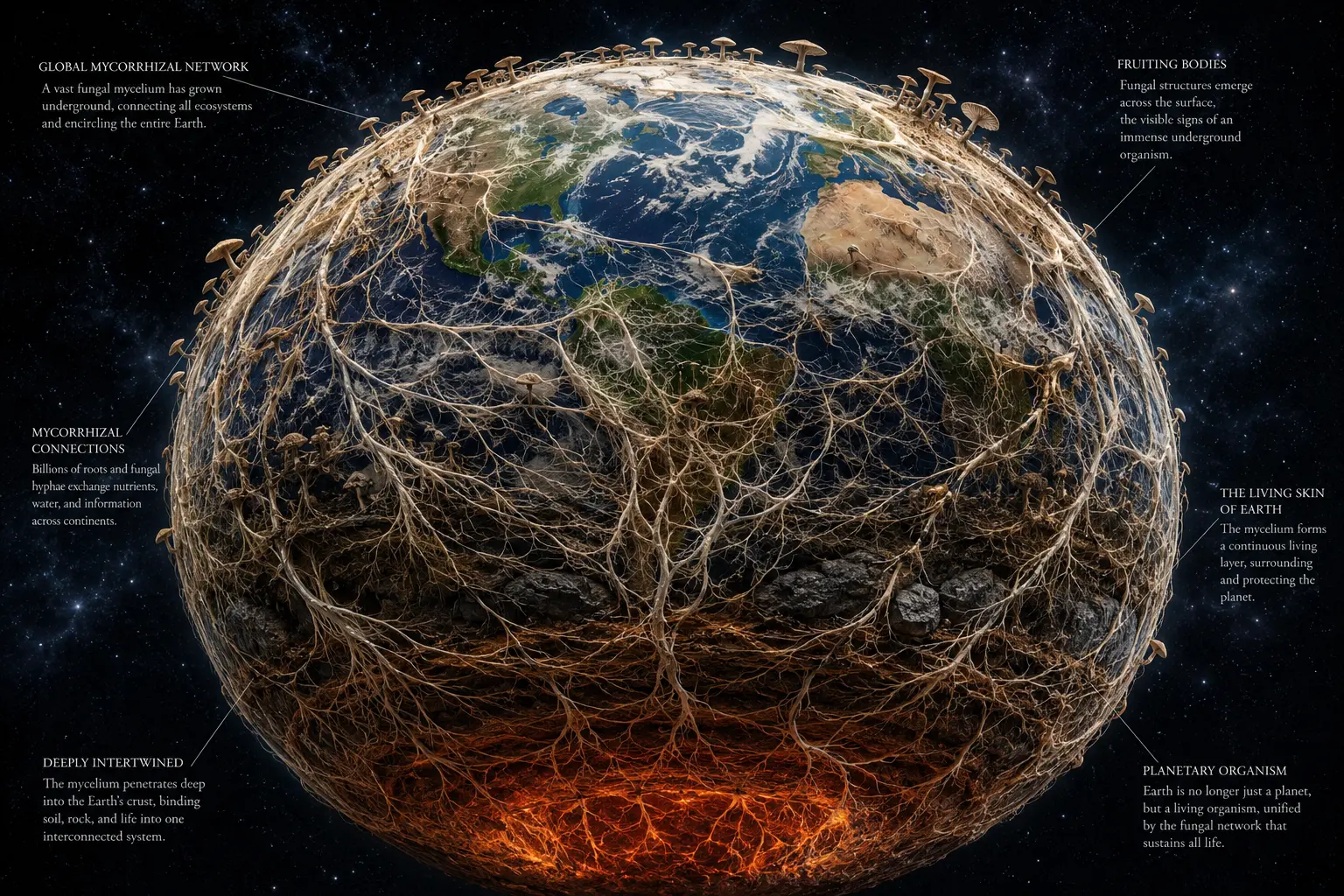
Beneath the world’s forests, grasslands, and ecosystems lies a vast biological network that may be one of the largest living structures on Earth.
Scientists are increasingly uncovering the immense scale and ecological importance of underground fungal networks, revealing that their combined length could stretch from Earth to the Sun and back nearly a billion times.
Although largely invisible to the human eye, these fungal networks form the foundation of many terrestrial ecosystems.
Composed of microscopic thread-like structures known as hyphae, fungi create extensive underground systems called mycelia that connect plants, recycle nutrients, store carbon, and help sustain life across the planet.
Recent estimates suggest that the total length of fungal mycelium in the upper layers of soil may exceed 450 quadrillion kilometers globally.
To put this into perspective, researchers estimate that if these fungal threads were laid end-to-end, they could span the distance between Earth and the Sun approximately 900 million times.
The finding highlights the extraordinary scale of an ecosystem component that remains largely hidden beneath the surface.

Fungi Are Fundamental to Life on Land
For decades, fungi were often overlooked in ecological research compared with plants and animals.
However, growing scientific evidence demonstrates that fungi are fundamental to the functioning of nearly every terrestrial ecosystem.
Far from being passive decomposers, fungi actively shape environmental processes that influence biodiversity, soil fertility, climate regulation, and plant survival.
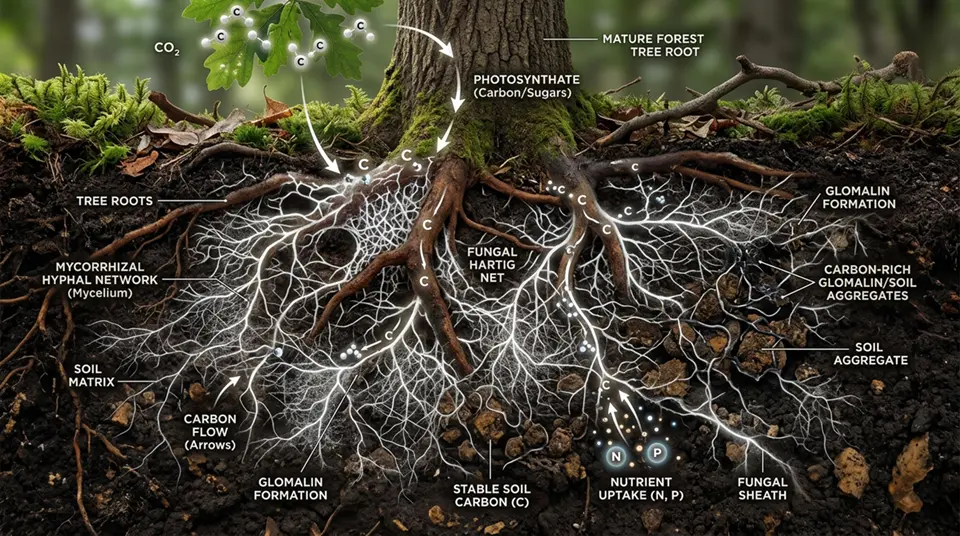
The majority of underground fungal networks are formed through symbiotic relationships known as mycorrhizae.
In these partnerships, fungi connect to plant roots and exchange resources.
Plants provide fungi with carbohydrates produced through photosynthesis, while fungi supply water and nutrients absorbed from the soil.
This mutually beneficial relationship is remarkably widespread.
Scientists estimate that approximately 90% of land plants depend on mycorrhizal fungi to some degree.
Without these partnerships, many ecosystems would struggle to maintain productivity and resilience.

Expanding the Reach of Plant Roots
The microscopic fungal threads dramatically expand the effective reach of plant root systems.
While roots can only access nutrients within a limited area, fungal hyphae extend far beyond the root zone, penetrating tiny soil spaces inaccessible to plants.
This expanded network enables more efficient acquisition of phosphorus, nitrogen, water, and essential minerals.
Researchers often describe these underground fungal systems as a “wood wide web” because they connect multiple plants within shared networks.
Through these connections, resources and chemical signals can move between different plants.
Studies have shown that fungal networks may facilitate nutrient sharing, stress signaling, and communication among plants under certain conditions.
Nature’s Largest Recycling System
The ecological significance of fungal networks extends far beyond nutrient exchange.
Fungi are among the most important decomposers on Earth, breaking down dead organic matter and returning nutrients to ecosystems.
Through decomposition, they play a crucial role in maintaining nutrient cycles that support plant growth and ecosystem productivity.
Fungal networks are also increasingly recognized as major contributors to global carbon storage.
By transferring carbon compounds into soils and stabilizing organic matter, fungi help regulate carbon cycling and influence the amount of carbon stored underground.
Some researchers estimate that mycorrhizal fungi transport billions of tons of carbon into soils annually.
This role has important implications for climate change.
Healthy fungal networks may enhance soil carbon sequestration, helping ecosystems capture and retain carbon that would otherwise enter the atmosphere.
As a result, fungi are becoming an increasingly important focus of climate and conservation research.
Growing Threats to Underground Biodiversity
Despite their ecological importance, underground fungal systems face growing threats.
Agricultural intensification, deforestation, urban development, pollution, excessive fertilizer use, and climate change can all disrupt fungal communities and reduce biodiversity.
Because these networks operate below ground, damage often occurs unnoticed until ecosystem functions begin to decline.
Scientists warn that fungal conservation has historically received far less attention than the protection of plants and animals.
While conservation efforts frequently focus on visible species, underground biodiversity remains poorly monitored and often overlooked in environmental policy.
Researchers argue that preserving fungal diversity is essential for maintaining ecosystem health.
Loss of fungal networks can affect plant communities, reduce soil fertility, alter nutrient cycling, and weaken ecosystem resilience to environmental stress.
Fungal Conservation Is Gaining Recognition
Several international initiatives have recently begun emphasizing the importance of fungal conservation.
Scientists are calling for greater recognition of fungi as a distinct component of biodiversity alongside flora and fauna.
Improved mapping, monitoring, and protection of fungal ecosystems are increasingly viewed as necessary for long-term environmental sustainability.
The challenge lies partly in the hidden nature of fungal life.
Unlike forests, wetlands, or wildlife populations, fungal networks are difficult to observe directly.
Most of their biomass exists underground, making it challenging to quantify their distribution, abundance, and ecological contributions.
Advances in DNA sequencing and soil ecology are helping researchers overcome these limitations.
New technologies allow scientists to identify fungal species, map underground communities, and investigate ecological interactions with unprecedented detail.
These tools are rapidly expanding knowledge about the complexity and scale of fungal ecosystems.
Ecosystem Engineers Beneath the Surface
The emerging picture reveals that fungi are not merely supporting actors within ecological systems.
Instead, they function as critical infrastructure that underpins many of the processes necessary for life on land.
Their networks influence nutrient availability, water movement, plant productivity, biodiversity, and carbon storage on a global scale.
Researchers increasingly view fungi as ecosystem engineers that help shape the environments in which other organisms live.
By connecting plants, cycling nutrients, and regulating soil processes, they contribute to the stability and resilience of ecosystems ranging from tropical rainforests to grasslands and agricultural landscapes.
The discovery that underground fungal networks may collectively extend hundreds of quadrillions of kilometers underscores both their immense scale and their ecological significance.
What appears to be empty soil is, in reality, a densely interconnected living system operating continuously beneath our feet.
As scientific understanding of fungi continues to expand, researchers hope that greater awareness will lead to stronger conservation efforts and improved environmental management practices.
Protecting fungal biodiversity may prove essential not only for ecosystem health but also for addressing some of the most pressing environmental challenges of the twenty-first century.
The hidden fungal universe beneath the Earth’s surface remains one of the largest and least understood biological systems on the planet.
Its extraordinary scale serves as a reminder that some of nature’s most important processes occur entirely out of sight, quietly sustaining life above ground.

References
According to Atmos