
Here is the situation most people get backwards.
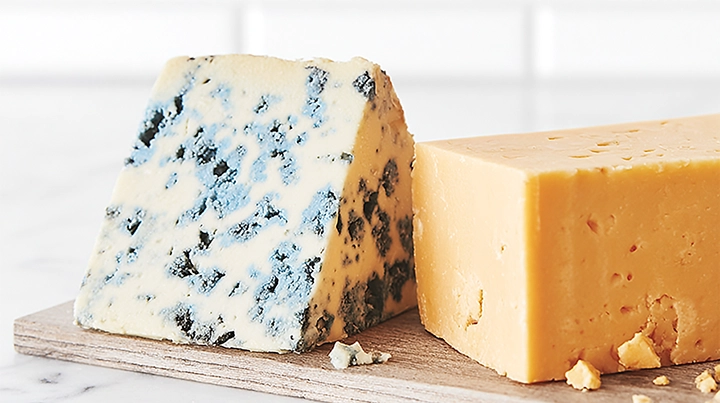
You open the fridge and find a wedge of Roquefort. The blue-green veins running through it look alarming. You wonder if it’s gone off. It hasn’t — that’s exactly what it’s supposed to look like.
The next day, you notice a small white spot on a container of fresh ricotta. It’s barely visible. You figure it’s probably fine. It isn’t.
The mold that looks dangerous is safe. The mold that looks minor is not. This is the central confusion around cheese and mold — and the reason appearance alone is a poor guide.
When Mold Is the Product
Certain cheeses are built around fungal activity. Blue cheeses — Roquefort, Gorgonzola, Stilton, Danish Blue — use Penicillium roqueforti, introduced deliberately and allowed to develop through the interior as the cheese ages. The blue-grey veining is the organism itself, and it is responsible for the characteristic sharp, complex flavor. Brie and Camembertdevelop their white bloomy rinds through Penicillium camemberti, a surface mold that shapes both texture and taste.
In each case, the mold is not contamination. It is a production input — selected, introduced under controlled conditions, and monitored through aging. The outcome is predictable because the system is designed. These cheeses are safe to eat in their entirety, mold included.

Why Appearance Cannot Tell You What You Need to Know
The practical problem is that Penicillium roqueforti and an unknown environmental mold can produce growth that looks similar to the untrained eye. Both might appear blue-green. Both might be fuzzy. The difference is not in how they look — it is in whether they were intentionally introduced under controlled conditions.
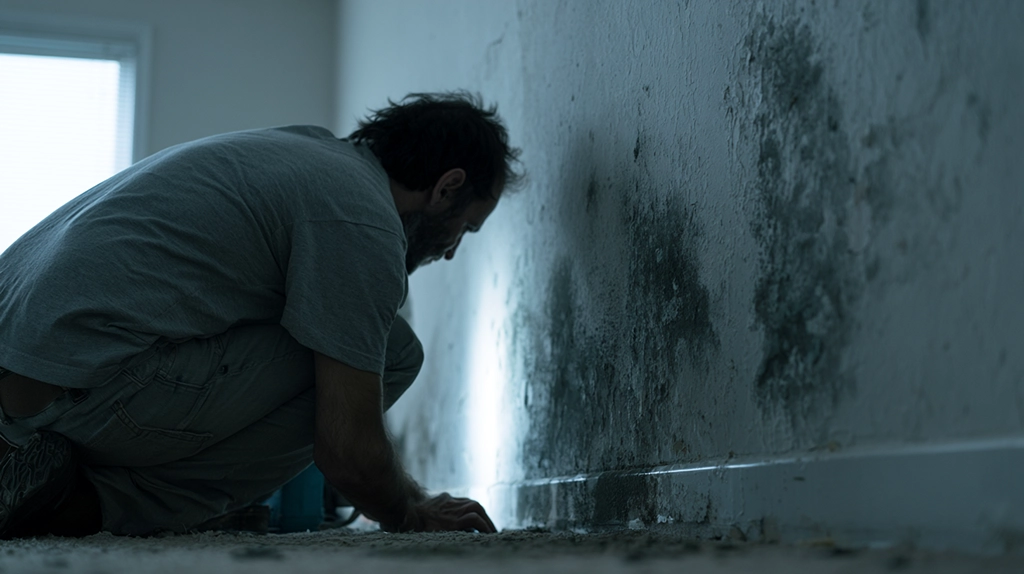
Environmental mold that develops after purchase originates from exposure during storage. Its species is unknown. Whether it produces mycotoxins under the current conditions is unknown. It may be entirely harmless, or it may not be. There is no reliable way to determine this without laboratory testing.
This is why food safety guidance consistently emphasizes origin and context over appearance. The mold on a wheel of Gorgonzola is documented and understood. The mold that appears on a piece of cheddar two weeks after opening is neither.
Structure Determines What Happens Next
When unexpected mold does appear on cheese, the cheese’s physical structure determines how to respond.
Hard cheeses — cheddar, Parmesan, aged Gouda, Gruyère — have dense, low-moisture compositions that limit how far fungal filaments can penetrate. Surface mold on a hard cheese is often genuinely localized. The USDA guidance is to cut at least 2 to 3 centimeters around and below the visible mold, using a clean knife and keeping the cut surface away from the remaining cheese. If the rest of the block is firm, smells normal, and shows no other changes, it is likely salvageable.
Soft cheeses are a different situation entirely. Cream cheese, ricotta, fresh mozzarella, cottage cheese, and similar products have high moisture content and an open structure that allows mold to spread rapidly through the interior. By the time mold becomes visible on the surface, the organism has typically already distributed through the product. Cutting away the visible spot does not remove the contamination — it removes the indicator.
For soft cheeses, any visible mold means the entire product should be discarded.

The Decision Framework
Eat normally:
- Blue-veined cheeses (Roquefort, Gorgonzola, Stilton, Danish Blue)
- Surface-ripened cheeses (Brie, Camembert) — the white rind is part of the product
- Aged natural-rind cheeses where the rind is part of normal production
May be salvageable — cut with care:
- Hard, low-moisture cheeses (cheddar, Parmesan, aged Gouda, Manchego) with small, localized surface mold
- Remove at least 2–3 cm around and below the visible mold
- Only if the rest of the cheese is firm, smells normal, and shows no texture changes
- Use a clean knife; don’t let it contact the remaining cheese
Discard entirely:
- Any soft cheese with visible mold (cream cheese, ricotta, fresh mozzarella, cottage cheese, brie if unexpected secondary mold appears)
- Shredded, sliced, or crumbled cheese — mold cannot be isolated
- Any cheese where the mold is widespread, recurring, or accompanied by odor or texture changes
The Mycotoxin Question
Some molds produce mycotoxins — chemically stable compounds that persist in food independently of the organism that made them. They are not destroyed by removing the visible mold, and they are not eliminated by cooking.
Not every environmental mold produces mycotoxins, and not every situation leads to their formation. But in a household setting, it is not possible to determine which category applies. This uncertainty is the core reason for the conservative guidance on soft cheeses: even if the mold itself is removed, compounds it may have produced could remain.
For hard cheeses, the USDA’s 2–3 centimeter margin is designed to account for this — cutting well beyond the visible boundary on the assumption that the mold’s influence may extend further than its visible presence.
What This Means in Practice
The question of whether moldy cheese is safe does not start with how the mold looks. It starts with three questions:
Was this mold introduced intentionally as part of production? If yes — it’s safe.
Is this an unexpected mold on a hard, dense cheese with localized surface growth? If yes — careful removal may work.
Is this an unexpected mold on a soft cheese, shredded cheese, or a cheese showing widespread or recurring growth? If yes — discard.
When the answer to all three is unclear, the safest position is to discard. The cost of throwing away a piece of cheese is low. The cost of consuming mycotoxins that cannot be detected by sight or smell is not.

FAQ
Is mold on cheese always dangerous? No. Cheese produced with intentional mold — blue cheeses, Brie, Camembert — is safe to eat, mold included. Unexpected mold that develops after purchase should be treated with caution.
Can I cut off mold from cheese and eat the rest? It depends on the type. Hard, dense cheeses may allow partial removal with a generous margin. Soft cheeses should be discarded entirely when any mold appears.
Why is mold safe in some cheeses? Because it is introduced under controlled conditions using known species with documented behavior. The mold in a wheel of Roquefort is a known quantity. Environmental mold is not.
Are mycotoxins a concern with cheese mold? They can be, which is why soft cheeses should be discarded rather than trimmed. For hard cheeses, the recommended 2–3 centimeter margin is designed to account for the possibility of unseen spread.
What is the safest general rule? If the mold was not intentionally introduced as part of the cheese’s production, treat it with caution. For soft cheeses, always discard. For hard cheeses, remove generously or discard if in doubt.
References
- Cheese.com — Blue-Vein Cheese Guide: https://www.cheese.com/blue-vein-cheese/
- Wisconsin Cheese — Cheese and Mold: https://www.wisconsincheese.com/the-cheese-life/article/105/cheese-and-mold
- Mayo Clinic — Moldy Cheese: Is It OK to Eat?: https://www.mayoclinic.org/healthy-lifestyle/nutrition-and-healthy-eating/expert-answers/food-and-nutrition/faq-20058492
Key Takeaways
- Please login Here is the situation most people get backwards.
- The next day, you notice a small white spot on a container of fresh ricotta.
- It is a production input — selected, introduced under controlled conditions, and monitored through aging.
- The practical problem is that Penicillium roqueforti and an unknown environmental mold can produce growth that looks similar to the untrained eye.
- Environmental mold that develops after purchase originates from exposure during storage.
Frequently Asked Questions
What should you know about please login to bookmark?
Please login Here is the situation most people get backwards.
When Mold Is the Product?
Certain cheeses are built around fungal activity. Blue cheeses — Roquefort, Gorgonzola, Stilton, Danish Blue — use Penicillium roqueforti, introduced deliberately and allowed to develop through the interior as the cheese ages. The blue-grey veining is the organism itself, and it is re
Why Appearance Cannot Tell You What You Need to Know?
The practical problem is that Penicillium roqueforti and an unknown environmental mold can produce growth that looks similar to the untrained eye. Both might appear blue-green. Both might be fuzzy. The difference is not in how they look — it is in whether they were intentionally introduced
What should you know about structure Determines What Happens Next?
When unexpected mold does appear on cheese, the cheese’s physical structure determines how to respond.
What should you know about the Mycotoxin Question?
Some molds produce mycotoxins — chemically stable compounds that persist in food independently of the organism that made them. They are not destroyed by removing the visible mold, and they are not eliminated by cooking.