
Meta Description
The green patch on your bread looks small. The instinct is to cut it off and keep the rest. But by the time mold becomes visible on bread, something much larger has already happened inside it.
The Cut That Doesn’t Help
It happens in almost every kitchen. A loaf of bread sits on the counter for a few days longer than intended. A small green or white patch appears on one corner — soft, fuzzy, unmistakably mold. The immediate instinct is practical: remove the affected slice, maybe trim a bit extra to be safe, and keep the rest.
It is a reasonable-feeling response. It is also based on a fundamental misunderstanding of how fungi grow.
Moldy bread should not be consumed, even when only a small area appears affected. The visible patch is not the organism — it is the organism’s fruiting body, the part that has grown large enough to be detected by the human eye. By the time that patch is visible, the fungus has already been growing through the bread for some time, and its microscopic root system has extended well beyond the discolored surface.
The part you can see is, in a meaningful sense, the last thing to arrive.

What Bread Looks Like to a Fungus
To understand why cutting away visible mold on bread is ineffective, it helps to understand what bread’s structure actually offers to a fungus.
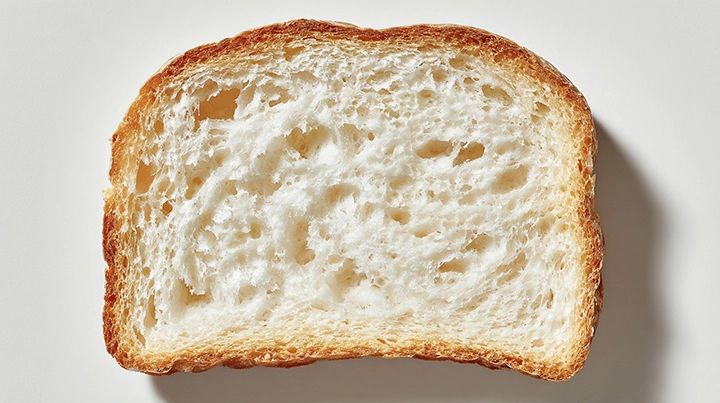
Bread is porous. The soft, light texture that makes it appealing to eat is created by countless small air pockets distributed throughout the loaf. These pockets — produced during fermentation and baking — give bread its crumb structure. They are also, from a fungal perspective, an ideal network of pathways.
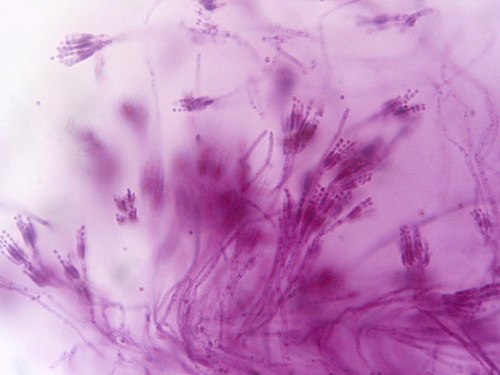
When mold spores land on the surface of bread, they begin producing filaments called hyphae. These microscopic threads grow by extending their tips, branching continuously, and penetrating the material they are growing through. In dense materials like hard cheese, this process is slow and limited — the hyphae struggle to find pathways through the compact structure. In bread, they find those pathways immediately. The soft, porous nature of bread allows mold to spread far beyond what you can see, using the air pockets as highways through the loaf.
The visible patch on the surface is the point where the colony has grown large enough to produce spores. The hyphae that produced it extend inward and outward in every direction, through the bread’s internal structure, long before any surface growth is noticeable.
The Research Behind the Rule
The question of whether cutting away the moldy portion of bread is safe has been studied directly. Research published in PMC examined five mold species growing on five types of bread — including wheat/rye sourdough, white toast, and gluten-free corn bread — to understand how mycotoxins distribute through the loaf and how far they travel from the point of visible contamination.
The findings were nuanced but the practical conclusion was consistent: given the porous structure of bread and the mobility of fungal metabolites through that structure, consuming any portion of visibly moldy bread cannot be considered safe. The USDA’s Food Safety and Inspection Service advises discarding the entire loaf when mold is present — not the affected slice, not the affected end, but the entire loaf.
This is not excessive caution. It reflects the physical reality of how mold and its chemical byproducts move through bread’s internal structure.

The Chemistry You Cannot See
Beyond the physical network of hyphae, mold on bread introduces a second category of risk: mycotoxins.
Mycotoxins are secondary metabolites — chemical compounds produced by fungi that serve various biological functions, including deterring competing organisms. Not every mold species produces them, and production varies by environmental conditions. But the common bread molds — species of Penicillium, Aspergillus, and Fusarium — include strains capable of producing compounds associated with digestive distress, liver toxicity, immune suppression, and in cases of chronic heavy exposure, increased cancer risk.
The critical property of mycotoxins in the context of moldy bread is that they may spread through bread even when visible mold growth is limited. They are not confined to the area of visible fungal growth. Like the hyphae themselves, they migrate through the bread’s porous structure — meaning that a slice of bread that appears entirely clean may carry chemical contamination from a colony growing on a different part of the same loaf.
This is why identifying mold by species before deciding whether to eat around it is not a practical safety strategy. Without laboratory testing, there is no reliable way to determine which organisms are present or what they have produced.
Why Bread Is Different From Other Foods
One of the most practically useful distinctions in food safety is the difference between how porous and dense foods respond to mold contamination.
For hard cheeses — dense, low-moisture, minimal air pockets — the USDA allows for a different approach: cutting away the moldy area with a generous margin, because the hyphae have limited ability to penetrate the compact structure. The contamination is more likely to be genuinely localized. The dense structure makes it hard for mold roots to spread, and removing a generous portion around the visible growth may genuinely eliminate the affected area.
Bread offers none of these properties. Its moisture content, carbohydrate richness, and above all its porous structure create conditions where fungal spread is rapid and extensive. The same logic that makes bread light and digestible makes it an efficient medium for mold to colonize.
Soft fruits, jams, yogurt, and cooked leftovers share a similar profile — high moisture, accessible nutrients, and structures that don’t limit hyphal spread. For all of these, the guidance mirrors what applies to bread: discard the entire item when mold appears, not just the affected portion.
Preventing Mold Before It Starts
Since bread is inherently vulnerable to mold, prevention is more effective than management. The conditions that enable mold growth are controllable:
Temperature — Mold development accelerates at room temperature, particularly above 20°C. Refrigerating bread significantly slows fungal growth, though it also affects texture. Freezing stops mold development entirely and preserves bread for weeks.
Moisture — Bread left in a closed bag while still slightly warm from baking creates condensation that accelerates mold. Ensuring bread is fully cooled before sealing, and storing it in a paper bag or bread box that allows some air circulation, reduces moisture accumulation.
Exposure time — Without chemical preservatives, bread stored at room temperature typically develops visible mold within three to four days. Buying smaller quantities and consuming bread promptly is more effective than trying to extend shelf life through storage management.
Preservative-free bread — Artisan and sourdough breads without calcium propionate or sorbic acid will mold faster than mass-produced supermarket bread. This is not a flaw — it reflects the absence of chemical inhibitors — but it requires adjusted expectations about shelf life.

FAQ: Mold on Bread
Q: Can I cut off the moldy part and eat the rest? No. The USDA advises discarding the entire loaf when mold appears on bread. The fungal network extends through the bread’s porous structure well beyond the visible growth, and mycotoxins can migrate through the loaf independently of the visible colony.
Q: Why does mold spread so quickly through bread? Bread’s porous structure — the air pockets that give it its texture — provides direct pathways for fungal hyphae to extend through the loaf. This allows mold to spread far beyond what is visible on the surface, much faster than it would through a dense food like hard cheese.
Q: Are all bread molds harmful? Not all mold species produce dangerous mycotoxins, but it is not possible to identify the species or its metabolite profile from appearance alone. Given this uncertainty, consuming any portion of bread on which mold has appeared is not considered safe.
Q: What are mycotoxins and why do they matter for bread? Mycotoxins are chemical compounds produced by certain mold species that can cause digestive upset, immune effects, or more serious harm with chronic exposure. They can spread through bread’s porous structure independently of visible fungal growth, meaning portions that appear clean may still carry chemical contamination.
Q: How long does bread last before mold develops? Without preservatives, bread stored at room temperature typically shows visible mold within three to four days. Refrigeration extends this significantly; freezing stops mold development entirely. Mass-produced bread with chemical preservatives lasts longer than artisan or preservative-free varieties.
Q: Can I give moldy bread to animals? No. Mycotoxins affect animals as well as humans — do not feed moldy bread to pets or livestock.
References
Academic & Research Sources
- PMC (2024). Mycotoxin contamination in moldy slices of bread is mostly limited to the immediate vicinity of the visible infestation. https://www.ncbi.nlm.nih.gov/pmc/articles/PMC11231700/
Official Sources
- USDA Food Safety and Inspection Service — Molds on Food: Are They Dangerous?: https://www.fsis.usda.gov/food-safety/safe-food-handling-and-preparation/food-safety-basics/molds-food-are-they-dangerous
- Healthline — Is It Safe to Eat Moldy Bread?: https://www.healthline.com/nutrition/can-you-eat-bread-mold
Article prepared by the MoldNewsHub editorial team based on peer-reviewed research and publicly available scientific literature.
Key Takeaways
- But by the time mold becomes visible on bread, something much larger has already happened inside it.
- A small green or white patch appears on one corner — soft, fuzzy, unmistakably mold.
- Moldy bread should not be consumed, even when only a small area appears affected.
- By the time that patch is visible, the fungus has already been growing through the bread for some time, and its microscopic root system has extended well beyond the discolored surface.
- The soft, light texture that makes it appealing to eat is created by countless small air pockets distributed throughout the loaf.
Frequently Asked Questions
What should you know about meta Description?
The green patch on your bread looks small. The instinct is to cut it off and keep the rest. But by the time mold becomes visible on bread, something much larger has already happened inside it.
What should you know about the Cut That Doesn’t Help?
It happens in almost every kitchen. A loaf of bread sits on the counter for a few days longer than intended. A small green or white patch appears on one corner — soft, fuzzy, unmistakably mold. The immediate instinct is practical: remove the affected slice, maybe trim a bit extra to be safe, and kee
What Bread Looks Like to a Fungus?
To understand why cutting away visible mold on bread is ineffective, it helps to understand what bread’s structure actually offers to a fungus.
What should you know about the Research Behind the Rule?
The question of whether cutting away the moldy portion of bread is safe has been studied directly. Research published in PMC examined five mold species growing on five types of bread — including wheat/rye sourdough, white toast, and gluten-free corn bread — to understand how mycotoxins dis
What should you know about the Chemistry You Cannot See?
Beyond the physical network of hyphae, mold on bread introduces a second category of risk: mycotoxins.