

1. The Fungus That Waited
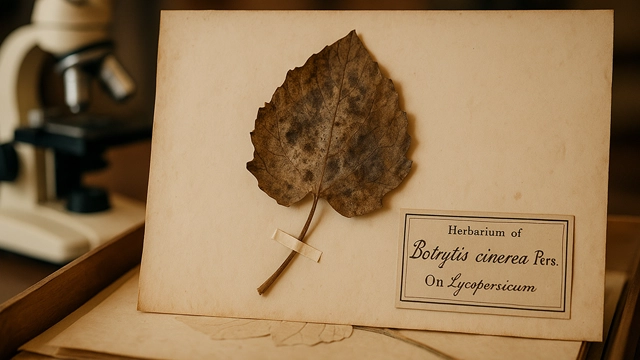
Before the chemical age dawned on agriculture—before we believed progress could be sprayed from a nozzle—there was a patch of Botrytis cinerea, the gray mold, feeding quietly on a tomato leaf. Someone pressed that leaf into a herbarium sheet sometime in the 1940s.
Eight decades later, scientists have done the unthinkable: they’ve revived that fungus.
This isn’t a ghost story. It’s a reckoning.
The resurrected mold carries molecular memories from before synthetic fungicides existed. And by comparing its DNA, metabolism, and behavior to modern descendants, scientists have found proof that we didn’t just fight fungi—we trained them.

2. A Time Capsule in a Leaf
Herbaria are not just dusty museums of plants. They are time capsules of entire ecosystems—complete with invisible passengers. Spores, hyphae, and fungal metabolites remain sealed between the pressed layers of cellulose and glue.
From two such herbarium specimens, both predating the Green Revolution, researchers coaxed life back into B. cinerea. Then they ran the full battery of modern science—phenotyping, genomics, transcriptomics, metabolomics—to decode what evolution had written in the fungal genome since the 1940s.
The result is something close to Jurassic Park, except the dinosaurs here are microscopic, and they’ve been quietly influencing global agriculture all along.

3. Then and Now: Evolution in the Petri Dish
Comparing the pre-pesticide and modern Botrytis strains revealed a chemical and genetic gulf that mirrors the rise of industrial farming.
- pH tolerance shifted. The 1940s strains faltered in buffered, slightly alkaline environments—conditions modern soil treatments have normalized. Modern B. cinerea has adapted to thrive there.
- Virulence targets changed. The ancestral fungus attacked different host plants. Today’s strains have refocused their arsenal, optimizing infection strategies for the crops that dominate post-Green Revolution landscapes.
- Genomes mutated under chemical pressure. Gene clusters linked to detoxification and fungicide resistance have expanded, while others tied to natural ecological balance have faded.
In short: when we industrialized farming, we didn’t just change crops.
We changed evolution’s syllabus.
4. Lessons Buried in Herbarium Drawers
There are over 390 million herbarium specimens in the world, and every one of them could contain traces of fungal history—Fusarium, Alternaria, Aspergillus, Cladosporium, even mildews. They are genomic black boxes, recording what pathogens looked like before human interference.
This study reframes natural history collections as living archives of microbial evolution. By reviving and sequencing fungi from these specimens, scientists can reconstruct the pre-chemical baseline of plant–pathogen relationships. It’s an archive of both what we lost and what we unleashed.
Imagine applying this to global crop protection:
- Forecasting outbreaks by modeling how ancestral traits resurface under pressure.
- Designing sustainable fungicides that account for historical resistance pathways.
- Breeding resilient crops informed by what ancient pathogens once preferred.
Every old leaf becomes a page in the evolutionary manual we never knew we had.
5. What the Past Tells the Future
Modern agriculture runs on a paradox: the more we fight pathogens, the more resilient they become.
The pre-fungicide Botrytis strains act as witnesses, reminding us that evolution isn’t a straight line—it’s a spiral of adaptation and counter-adaptation.
The implications ripple across disciplines:
- Agroecology: Baseline fungi could serve as control models for climate-induced virulence shifts.
- Evolutionary genetics: Herbarium data can reveal the pace of molecular change across decades.
- Biosecurity: Knowing ancestral resistance genes helps anticipate the next fungicide failure.
In reviving these fungal ghosts, scientists have done more than recover DNA.
They’ve recovered context—the missing control group for the Anthropocene experiment.
6. The Cost of Forgetting
We often think of innovation as forward motion. But in biology, progress and amnesia walk hand in hand. The more technology we apply, the less we remember of what came before.
The herbarium fungi tell a humbler story: the mold that we dismissed as a nuisance was evolving beside us, matching every advance molecule for molecule.
The Green Revolution didn’t end nature’s rulebook—it merely annotated it with side effects.
If those 1940s spores could speak, they might say:
“You call it progress. We call it adaptation.”

7. The Verdict from MoldNewsHub
The researchers behind this revival didn’t just extract DNA; they extracted time.
By bringing pre-pesticide Botrytis back to life, they revealed that the microbial past is not extinct—it’s archived, patient, and very much aware of us.
Herbarium cabinets are no longer just historical records. They are biological warning systems, waiting for someone to ask the right question.
This isn’t nostalgia dressed in lab coats. It’s foresight in culture medium.
Every petri dish is a mirror, and in it we see what our agriculture has become: a system that pushes life to adapt faster than we can comprehend.
“The past isn’t dead,” the old spores whisper.
“It’s sporulating.”
References
- Botrytis cinerea – NIH Fungal Pathogen Database
- Nature Microbiology: “Herbarium-Derived Fungal Revivals Reveal Evolutionary Shifts in Pathogenicity” (2024)
- Royal Botanic Gardens Kew – Global Herbarium Collections
- FAO: Historical Impact of the Green Revolution on Plant Pathogens
- Wikimedia Commons – CC Licensed Images of Botrytis and Herbaria
Key Takeaways
- Before the chemical age dawned on agriculture—before we believed progress could be sprayed from a nozzle—there was a patch of Botrytis cinerea, the gray mold, feeding quietly on a tomato leaf.
- Eight decades later, scientists have done the unthinkable: they’ve revived that fungus.
- And by comparing its DNA, metabolism, and behavior to modern descendants, scientists have found proof that we didn’t just fight fungi—we trained them.
- From two such herbarium specimens, both predating the Green Revolution, researchers coaxed life back into B.
- The result is something close to Jurassic Park, except the dinosaurs here are microscopic, and they’ve been quietly influencing global agriculture all along.
Frequently Asked Questions
What is Mold from the Past and why does it matter?
Before the chemical age dawned on agriculture—before we believed progress could be sprayed from a nozzle—there was a patch of Botrytis cinerea, the gray mold, feeding quietly on a tomato leaf. Someone pressed that leaf into a herbarium sheet sometime in the 1940s.
How does Mold from the Past affect human health and safety?
Eight decades later, scientists have done the unthinkable: they’ve revived that fungus.
What are researchers and experts doing to address Mold from the Past?
This isn’t a ghost story. It’s a reckoning.The resurrected mold carries molecular memories from before synthetic fungicides existed. And by comparing its DNA, metabolism, and behavior to modern descendants, scientists have found proof that we didn’t just fight fungi—we trained them.
What are the main risks associated with Mold from the Past?
Herbaria are not just dusty museums of plants. They are time capsules of entire ecosystems—complete with invisible passengers. Spores, hyphae, and fungal metabolites remain sealed between the pressed layers of cellulose and glue.
What actions are recommended regarding Mold from the Past?
From two such herbarium specimens, both predating the Green Revolution, researchers coaxed life back into B. cinerea. Then they ran the full battery of modern science—phenotyping, genomics, transcriptomics, metabolomics—to decode what evolution had written in the fungal genome since the 1940s.