
How scientific thinking is reshaping the way we deal with indoor mold
When people think about mold prevention, the first instinct is often elimination. Mold must be killed, removed, disinfected. Many commercial products reinforce this idea by promising fast, powerful, and complete eradication. Yet within scientific research, this approach is increasingly being questioned.
Across fields such as building science, materials research, and fungal biology, researchers have repeatedly observed that mold problems are rarely caused by insufficient cleaning alone. Instead, mold tends to return because the conditions that allow it to grow remain unchanged. As long as the environment continues to support growth, mold will reappear, regardless of how aggressively it is treated. This perspective is consistent with long-standing research on indoor mould exposure and its relationship with the built environment, which emphasizes that environmental conditions play a greater role than surface cleaning alone
(https://www.sciencedirect.com/science/article/pii/S2352710220336159).

This realization has led to a gradual shift in perspective. Rather than focusing solely on destroying mold, researchers are asking a different question: is it possible to prevent mold by making growth itself difficult?
In international fungal research, this idea is not new. Over the past decade, scientists have increasingly explored non-lethal strategies to suppress fungal growth, aiming to interfere with biological processes without directly killing the organism. These approaches often focus on disrupting metabolic balance or growth behavior, rather than relying on toxic compounds. Research into fungal-specific metabolic pathways suggests that altering how fungi allocate and use metabolic resources can significantly affect their ability to grow and spread
(https://academic.oup.com/femsre/article/doi/10.1093/femsre/fuaf028/8173761).

One reason for this shift comes from lessons learned in medicine and agriculture. Heavy reliance on antifungal agents has contributed to resistance, environmental concerns, and unintended side effects. As a result, researchers have turned toward strategies that reduce fungal competitiveness instead of applying constant selective pressure. Advances in fungal metabolomics research now allow scientists to observe how fungi respond internally to environmental stress, offering insights into how growth can be slowed without direct eradication
(https://www.mdpi.com/2309-608X/11/2/93).
This way of thinking translates naturally to buildings and indoor environments. Mold does not appear instantly. It develops gradually, starting at a microscopic level before becoming visible on walls, ceilings, or furnishings. Studies examining early-stage mold development on interior surfaces have shown that this initial growth phase is especially sensitive to environmental conditions, meaning small changes can significantly delay visible mold formation
(https://discovery.ucl.ac.uk/id/eprint/10204492/1/An%20Assessment%20of%20the%20Influencing%20Factors%20Promoting%20the%20Development%20of%20Mould%20in%20Buildings%2C%20A%20Literature%20Review.pdf).
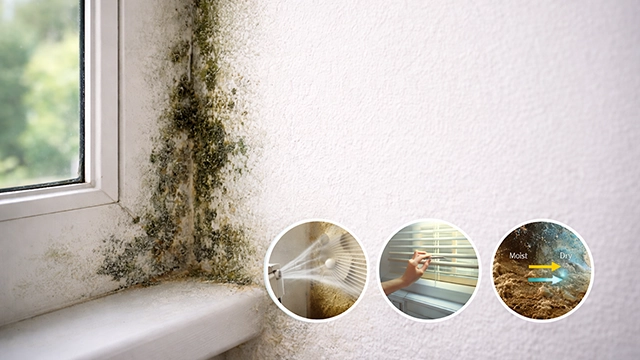
For this reason, recent research increasingly emphasizes environmental management. Factors such as surface drying, air movement, moisture persistence, and material behavior play a decisive role in whether mold can gain a foothold. From the mold’s perspective, the environment is not merely a background condition but an active driver of growth. Building science research has repeatedly demonstrated that conditions at material surfaces often determine mold outcomes more strongly than average indoor measurements.
Seen through this lens, mold prevention becomes less about one-time removal and more about long-term control. By altering the conditions that mold depends on, researchers aim to slow its development and limit its ability to establish stable colonies. The goal is not immediate elimination, but sustained disadvantage. This approach aligns with broader discussions in sustainable building and indoor environmental quality research, where mold is understood as part of a complex interaction between materials, moisture, and living conditions
(https://www.frontiersin.org/journals/built-environment/articles/10.3389/fbuil.2025.1602552/full).
This does not mean that traditional measures are obsolete. Repairing leaks, managing humidity, and using appropriate materials remain essential. What research suggests, however, is that mold control does not need to rely exclusively on harsh or highly toxic solutions. A broader toolkit, focused on making environments less favorable to mold, may prove more sustainable and effective over time.
For everyday life, the implication is straightforward. Mold problems rarely appear overnight. They are the result of conditions that persist long enough for growth to begin. When those conditions are disrupted, even subtly, mold becomes harder to sustain. Slowing growth may not sound dramatic, but it can be the difference between a recurring issue and a manageable one.
From killing mold to managing conditions, from rapid removal to growth control, scientific thinking about mold prevention is evolving. This shift may not produce instant breakthroughs, but it offers a quieter, more durable approach to living with—and limiting—one of the most persistent challenges in indoor environments.
References
Academic sources
Zhang, X., et al. (2020). Indoor mould exposure, dampness, and health outcomes in the built environment. Journal of Building Engineering, 32, 101452. https://doi.org/10.1016/j.jobe.2020.101452
Krijgsheld, P., et al. (2024). Fungal-specific metabolic pathways and adaptive growth control. FEMS Microbiology Reviews. https://doi.org/10.1093/femsre/fuaf028
Meyer, V., et al. (2025). Advances in fungal metabolomics and stress response regulation. Journal of Fungi, 11(2), 93. https://doi.org/10.3390/jof11020093
Viitanen, H., et al. (2023). Influencing factors promoting the development of mould in buildings: A literature review. University College London.
Official / institutional sources
World Health Organization (WHO). WHO guidelines for indoor air quality: dampness and mould. https://www.who.int/publications/i/item/WHO-EURO-2010-7821-41892-56883
Key Takeaways
- How scientific thinking is reshaping the way we deal with indoor mold
- Many commercial products reinforce this idea by promising fast, powerful, and complete eradication.
- Across fields such as building science, materials research, and fungal biology, researchers have repeatedly observed that mold problems are rarely caused by insufficient cleaning alone.
- This realization has led to a gradual shift in perspective.
- In international fungal research, this idea is not new.
Frequently Asked Questions
What should you know about academic sources?
Zhang, X., et al. (2020). Indoor mould exposure, dampness, and health outcomes in the built environment. Journal of Building Engineering, 32, 101452. https://doi.org/10.1016/j.jobe.2020.101452
What should you know about official / institutional sources?
World Health Organization (WHO). WHO guidelines for indoor air quality: dampness and mould. https://www.who.int/publications/i/item/WHO-EURO-2010-7821-41892-56883
What are the key findings about Mold Control?
How scientific thinking is reshaping the way we deal with indoor mold
How does Mold Control affect public health or safety?
When people think about mold prevention, the first instinct is often elimination. Mold must be killed, removed, disinfected. Many commercial products reinforce this idea by promising fast, powerful, and complete eradication. Yet within scientific research, this approach is increasingly being questio
What do researchers and experts say about Mold Control?
Across fields such as building science, materials research, and fungal biology, researchers have repeatedly observed that mold problems are rarely caused by insufficient cleaning alone. Instead, mold tends to return because the conditions that allow it to grow remain unchanged. As long as the enviro