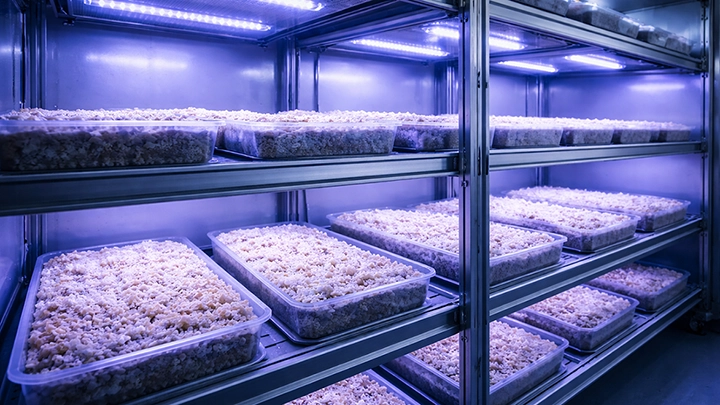

How Light Quietly Rewrites the Biology of Lion’s Mane


A New Variable Steps Into the Cultivation Room
For much of modern mushroom cultivation, Hericium erinaceus — lion’s mane — has been a creature of darkness. Growers obsess over humidity curves, substrate composition, airflow tuning, and temperature differentials, but light has always been treated as a peripheral detail, interesting yet irrelevant. The fungus was assumed to be indifferent to illumination, guided more by moisture and nutrients than by wavelength.
A 2025 study in Frontiers in Fungal Biology upends that narrative. The research demonstrates that lion’s mane mycelium is not simply tolerant of light — it interprets it. LED wavelengths, once considered ornamental or purely logistical, have measurable and sometimes dramatic effects on how this fungus spreads, metabolizes, and expresses its internal chemistry. Light, in this context, becomes less an environmental backdrop and more a biological message.
This shift reframes cultivation. Instead of asking merely how lion’s mane grows, researchers can now ask what environmental signals shape its decisions — and how those signals can be tuned to unlock new efficiencies, new compounds, and new industrial applications.
Blue Wavelengths, Faster Growth

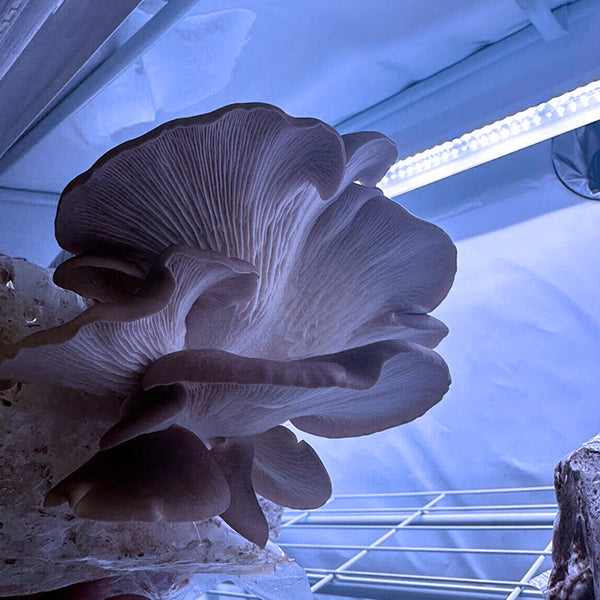

The experiment exposed lion’s mane mycelium to five lighting conditions: blue, red, green, RGB, and complete darkness. The results were stark. Under blue light, the fungus colonized substrate faster, produced more biomass, and decomposed sorghum grains more efficiently. The blue-light cultures often appeared denser, more cohesive, and more metabolically active.
Darkness — the long-trusted default — delivered the slowest colonization rates.
This suggests that fungi, though not photosynthetic, possess photoreceptors capable of translating specific wavelengths into metabolic cues. Blue light in particular may stimulate pathways associated with energy allocation, enzymatic activity, or structural expansion.
For cultivators, the implications are immediate and practical. Faster substrate colonization means shorter production cycles, reduced contamination risk, and higher yield per input. LED systems are already low-energy and programmable; spectrum optimization transforms them from mere illumination into precision tools for biological steering.
In other words, light becomes a scalable lever, capable of shaping growth kinetics without any genetic modification.
The Light That Shapes Chemistry


Yet the most intriguing findings emerged not from growth rates, but from chemistry.
When researchers extracted compounds from the mycelium and tested them against human colorectal and liver cancer cell lines, the extracts from blue-light cultures produced the strongest inhibitory effects. Importantly, toxicity toward healthy cells remained low, suggesting a selective bioactivity worth exploring further.
While these results are not clinical trials, they hint at a broader principle: environmental conditions reshape biochemical landscapes. Light exposure may shift how lion’s mane produces erinacines and hericenones — molecules associated with neuro-supportive, antioxidant, and anti-inflammatory effects.
If wavelength exposure can amplify certain metabolite families or trigger the synthesis of entirely new ones, cultivation evolves from mass production to biochemical design.
This possibility moves lion’s mane from a culinary and medicinal mushroom into the realm of programmable biotechnology. Growers become conductors; light becomes the score; the fungus responds with chemical orchestration.
Biotechnology Meets Cultivation



The industrial implications extend far beyond functional foods. Mycelium is already central to emerging markets in:
- biodegradable packaging
- alternative leather materials
- acoustic panels
- structural composites
- soil amendments
- carbon-negative manufacturing
In these applications, structure matters — density, branching, fiber orientation, and mechanical strength all determine performance.
If light can influence hyphal architecture or internal cohesion, it becomes part of the material-design toolkit. Rather than adjusting substrates or growth duration, manufacturers can refine LED recipes that encourage tighter mats, smoother textures, or stronger bonding within the mycelial matrix.
This represents a non-genetic pathway to engineered fungal materials, potentially more cost-effective and less burdened by regulatory restrictions.
Light, in this sense, is a design parameter — one that can be integrated into automated growth chambers, smart farms, or industrial bioreactors.
From Insight to Implementation
Despite the promise, scaling spectrum-tuned cultivation requires additional mapping. Light intensity, wavelength timing, substrate interactions, and temperature dependencies must be standardized across strains and industries.
Mycelium is responsive but sensitive; the same wavelength that accelerates growth under one condition might slow it under another.
Still, the direction is unmistakable: controlled-environment agriculture is evolving into programmable biology, where growers influence not just quantity, but quality and function.
This paradigm shift mirrors trends in plant factories, microalgae cultivation, and microbial fermentation — fields that increasingly rely on precise environmental signals to optimize production. Fungi, with their flexible metabolism and structural versatility, may become some of the most responsive and productive candidates in this revolution.
Conclusion: A Future Growing in Light
The study’s message is simple but transformative: fungi listen to light. Blue wavelengths accelerate growth, sharpen chemical profiles, and set the stage for a future in which cultivation is no longer passive maintenance, but active design.
As demand rises for medicinal mushrooms, functional foods, sustainable biomaterials, and biologically derived composites, spectrum-tuned cultivation offers a compelling pathway toward efficiency and innovation. Light becomes a targeted stimulus rather than a background condition. Mycelium becomes a responsive medium. Cultivation becomes a creative practice, merging biology, engineering, and design.
What once seemed like a dark, quiet corner of fungal biology is now illuminated — and full of possibility.
References
Scientific Sources
- Lyu, X. et al. (2025). Light-regulated growth and metabolite production in Hericium erinaceus. Frontiers in Fungal Biology.
- Sakamoto, Y. (2020). Influences of environmental factors on mushroom cultivation. Mycoscience.
- Wasser, S. (2017). Medicinal mushroom science: current perspectives and future directions. International Journal of Medicinal Mushrooms.
Institutional Sources
- Frontiers Media — Frontiers in Fungal Biology journal
- Food and Agriculture Organization — fungal biotechnology and food sustainability reports
Key Takeaways
- A New Variable Steps Into the Cultivation RoomFor much of modern mushroom cultivation, Hericium erinaceus — lion’s mane — has been a creature of darkness.
- The fungus was assumed to be indifferent to illumination, guided more by moisture and nutrients than by wavelength.
- LED wavelengths, once considered ornamental or purely logistical, have measurable and sometimes dramatic effects on how this fungus spreads, metabolizes, and expresses its internal chemistry.
- The experiment exposed lion’s mane mycelium to five lighting conditions: blue, red, green, RGB, and complete darkness.
- Darkness — the long-trusted default — delivered the slowest colonization rates.
Frequently Asked Questions
What should you know about the Light That Shapes Chemistry?
Yet the most intriguing findings emerged not from growth rates, but from chemistry.When researchers extracted compounds from the mycelium and tested them against human colorectal and liver cancer cell lines, the extracts from blue-light cultures produced the strongest inhibitory effects. Importantly
What should you know about biotechnology Meets Cultivation?
The industrial implications extend far beyond functional foods. Mycelium is already central to emerging markets in:
What should you know about from Insight to Implementation?
Despite the promise, scaling spectrum-tuned cultivation requires additional mapping. Light intensity, wavelength timing, substrate interactions, and temperature dependencies must be standardized across strains and industries.
What are the key findings about Illuminated Mycelium?
A New Variable Steps Into the Cultivation RoomFor much of modern mushroom cultivation, Hericium erinaceus — lion’s mane — has been a creature of darkness. Growers obsess over humidity curves, substrate composition, airflow tuning, and temperature differentials, but light has always been treated as a
How does Illuminated Mycelium affect public health or safety?
A 2025 study in Frontiers in Fungal Biology upends that narrative. The research demonstrates that lion’s mane mycelium is not simply tolerant of light — it interprets it. LED wavelengths, once considered ornamental or purely logistical, have measurable and sometimes dramatic effects o