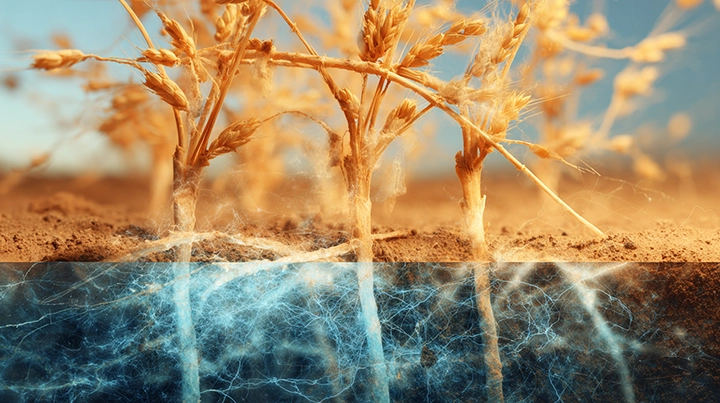
Ocean health is most often discussed in terms of visible actors — fish stocks, coral reefs, phytoplankton blooms, sea surface temperatures. The biochemical processes sustaining these systems operate at a level far less visible. Marine fungi are among the least-studied contributors to ocean function, yet they participate in decomposing organic matter and recycling nutrients throughout the water column.
A new study published in Communications Earth & Environment examines a specific mechanism regulating that fungal contribution: iron availability. In ocean environments, dissolved iron is among the most constrained micronutrients despite its abundance in the earth’s crust. The study demonstrates that iron concentration exerts meaningful control over how efficiently marine fungi process organic carbon — and that the relationship between iron supply and fungal metabolic performance is more complex than a simple dose-response model.

A phytoplankton bloom stretching from the tip of South America toward Antarctica, captured by NASA's Suomi NPP satellite in January 2016. Ocean biological productivity — driven by nutrients including iron — shapes the environment in which marine fungi operate as decomposers and carbon processors.Credit:
NASA Earth Observatory, via Wikimedia Commons, Public DomainIron as a Regulatory Factor in Marine Metabolism
Iron participates in core cellular processes across most living organisms. In fungal metabolism, iron-dependent proteins support respiration, electron transport chains, and the enzymatic breakdown of organic compounds — the functions that allow fungi to decompose organic material and contribute to nutrient cycling.
In open ocean conditions, dissolved iron is scarce across wide areas. River input, atmospheric dust deposition, hydrothermal vents, and ocean circulation patterns each contribute to local iron availability, but large regions — the Southern Ocean, equatorial Pacific, and sub-Arctic Pacific among them — maintain chronically low concentrations.
This scarcity makes iron a physiological bottleneck. Not merely a nutrient the cell requires, but a regulatory constraint that determines how much metabolic activity the organism can sustain. The study establishes that in marine fungal systems, this constraint is not passive — it actively shapes how much organic carbon fungi can process under real environmental conditions.

Morphology of *Aspergillus* — a genus found in both terrestrial and marine environments. In marine fungi, the iron-dependent proteins supporting respiration and enzyme activity are embedded in the same cellular architecture illustrated here.Credit:
M. Piepenbring, corrected by Jerzy Opioła, via Wikimedia Commons, CC BY-SA 4.0A Biphasic Response: Why Balance Matters More Than Abundance
The study’s central finding is that marine fungal glucose biodegradation does not increase linearly with iron concentration. It follows a biphasic pattern.
At low iron concentrations, fungal metabolic activity improves as availability rises — consistent with the established prediction that iron limitation constrains enzyme function and slows decomposition rates. Supply more of what the cell requires, and performance improves. This phase conforms to standard nutrient limitation models.
Beyond a specific threshold, additional iron no longer produces additional metabolic benefit. Efficiency plateaus or declines. This second phase is where the study makes its most important contribution: it demonstrates that biological performance in marine fungal systems has an optimum range, not an indefinitely rising response to nutrient enrichment.
Why Excess Iron Reduces Efficiency
The precise mechanisms underlying performance decline at high iron concentrations remain under active investigation. Candidate explanations include oxidative stress generated by iron-catalyzed free radical reactions, disruption of the regulatory proteins that maintain iron homeostasis within the cell, and interference with uptake pathways for other essential metals.
Whatever the mechanism, the functional outcome reflects a principle operating across biological systems: cellular processes are calibrated for ranges, not extremes. A micronutrient that supports function at optimal concentration can disrupt the same processes when present in excess.
Implications for Ocean Carbon Cycling

The ocean carbon cycle, showing how the biological carbon pump transfers surface carbon to the deep ocean. Marine fungi contribute to this cycle as decomposers of organic matter — and their efficiency is regulated by micronutrients including iron.Credit:
Juan José Pierella Karlusich, Chris Bowler and Haimanti Biswas, via Wikimedia Commons, CC BY-SA 4.0Marine fungi contribute to the microbial loop — the network of microbial processes converting dissolved and particulate organic matter into forms that re-enter marine food webs or sink to deeper layers for longer-term carbon storage. Their position in this network has historically received less research attention than bacterial or archaeal contributions, but that is changing as marine microbiology expands its scope.
The iron–fungal activity relationship identified in this study introduces a regulatory variable into that network. If iron concentrations in a given ocean region shift — through changes in atmospheric dust deposition, altered circulation patterns, or climate-driven modifications to upwelling dynamics — fungal metabolic performance may shift accordingly.
The consequences for carbon processing are potentially significant. Changes in fungal decomposition efficiency could alter how much organic carbon is broken down in the surface water column, how much reaches deeper layers for sequestration, and how nutrients are redistributed through the broader microbial community. The study does not directly quantify large-scale carbon flux impacts, but the regulatory mechanism it identifies provides a foundation for more complex models of marine carbon dynamics that account for fungal activity as a variable rather than a fixed parameter.
Iron Distribution Under Climate Pressure
Iron distribution in marine systems is not static. Atmospheric dust — a primary iron source for surface waters in remote ocean regions — is sensitive to land-use change, desertification, and climate-driven shifts in wind patterns. Upwelling, which transports iron-rich deep water toward the surface, responds to sea surface temperature gradients and large-scale atmospheric circulation.
These dependencies mean that climate change may alter iron availability in marine systems through multiple simultaneous pathways. In iron-limited regions, changes in dust input or upwelling intensity could shift iron concentrations toward or away from the optimal range for fungal metabolic activity. That response is unlikely to be uniform across ocean basins or microbial communities.
For marine fungi, this introduces climate sensitivity beyond direct temperature effects on growth. Iron availability functions as a control point within the metabolic system, and that control point sits at the intersection of cellular biology and large-scale oceanographic dynamics.
Rethinking the Role of Marine Fungi in Biogeochemical Models

Pelagic fungi as active contributors to the microbial loop and mycoloop — both parasitic and saprotrophic fungi influence how carbon flows through ocean food webs and how much is ultimately sequestered or respired back to CO₂.Credit:
Eva Breyer and Federico Baltar, via Wikimedia Commons, CC BY 4.0The conventional model of marine decomposition centers on bacterial activity, with fungi occupying a secondary or loosely defined role. This study joins a growing body of evidence repositioning marine fungi as regulated participants in biogeochemical cycling — organisms whose activity responds to the same environmental variables that govern the broader system.
Iron functions as a key regulator of that participation. At limiting concentrations, it constrains how much organic carbon marine fungi can process. At excessive concentrations, it interferes with metabolic performance. The effective operating range sits between these extremes, and the position of any given marine environment within that range determines how much fungal activity contributes to local carbon dynamics.
Marine ecosystem models that aim to represent carbon flux with precision have an emerging reason to treat fungal metabolic activity as a responsive variable — one whose performance is shaped by the micronutrient conditions that also govern phytoplankton growth, bacterial respiration, and the movement of organic matter through the water column. The iron–fungi relationship identified here is one mechanism through which those connections operate.
FAQ: Iron, Marine Fungi, and Ocean Carbon
What do marine fungi do in ocean ecosystems?
Marine fungi contribute to decomposing organic matter, converting dissolved and particulate carbon into forms that can re-enter marine food webs or sink to deeper layers. They are part of the microbial loop that processes and redistributes nutrients throughout ocean environments.
Why is iron a limiting factor in the ocean?
Despite being abundant in the earth’s crust, dissolved iron is scarce across large areas of the open ocean. This makes it one of the primary micronutrient constraints on biological activity in marine systems — affecting bacteria, phytoplankton, and fungi alike.
What does a biphasic response to iron mean?
A biphasic response means that biological activity increases with iron up to an optimal point, then plateaus or declines as iron concentration continues to rise. It indicates that the cell is calibrated for a specific range — not that more iron always means more activity.
How does climate change affect iron availability in the ocean?
Iron distribution in ocean surface water depends on atmospheric dust deposition, upwelling intensity, and ocean circulation patterns — all of which are sensitive to climate conditions. Climate-driven shifts in these processes could move iron concentrations toward or away from the optimal range for fungal metabolism in different ocean regions.
Are marine fungi significant enough to affect global carbon cycling?
Research is still characterizing the scale of marine fungal contributions. This study demonstrates a regulatory mechanism — iron controlling metabolic efficiency — but does not directly quantify global carbon flux impacts. The significance of marine fungi in biogeochemical cycling is an active area of investigation.
References
- Iron availability regulates marine fungal glucose biodegradation and carbon cycling — Communications Earth & Environment, 2026