

In the Heart of the Cheese Cave, a New Story Begins
Some foods speak of invention. Others, memory. But the rare ones—the truly remarkable—carry both in every bite.
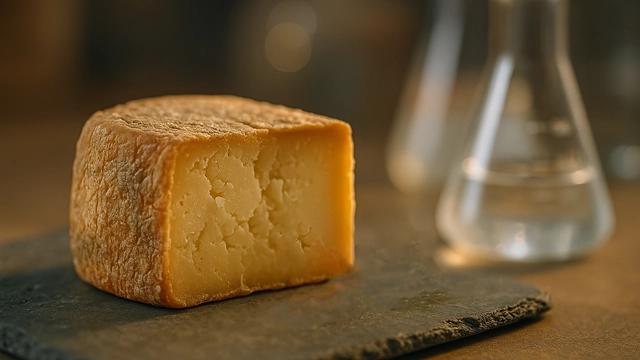
In the dairy-rich regions of northern Iran, there’s a cheese that does just that: Siahmazgi. Crafted from ewe’s milk, sometimes blended with goat, it’s a cheese rich in history, steeped in place, and brimming with character. Its flavor is a conversation between land, animal, and time. But like many artisanal treasures, its life is delicate. Moisture and microbes don’t just threaten shelf life—they threaten legacy.
And yet, this vulnerability is where a new chapter begins.
Researchers, drawing from both tradition and technology, introduced a quiet intervention: a native herb, Echinophora platyloba, already known in Persian kitchens and medicine cabinets, infused into the cheese. Not just dropped in. Wrapped—at the microscopic level—in protective nanospheres. A modern method for an ancient ally.
This isn’t a story about replacement. It’s a lesson in refinement—about extending shelf life without compromising soul, and about letting science preserve what culture created.
The Unsuspecting Hero: Echinophora platyloba
To locals, Echinophora is no stranger. It’s fragrant, antimicrobial, and woven into generations of recipes and remedies. Its essential oil—EPEO (Echinophora platyloba essential oil)—is both healing and harsh, rich in potential yet difficult to control.
Essential oils are like that. Beautiful, volatile, unstable. Especially in food.
But science didn’t discard it. Instead, it studied its behavior—and offered a steadier hand. Using nanoencapsulation, researchers encased the oil in tiny lipid-based spheres, invisible to the eye but precise in function.
These nanocapsules don’t suppress the herb. They protect its power, releasing it gradually, where and when it matters most—inside the cheese matrix.
What was once a raw aromatic is now a calibrated tool. Still natural. Still recognizable. Just… smarter.
Taste, Time, and Trust

To test the idea, batches of Siahmazgi cheese were infused with EPEO—both free-form and nanoencapsulated—at three concentrations: 0.1%, 0.3%, and 0.5%.
Over a 90-day period, each sample was monitored with the kind of care you’d give to a family recipe. Researchers weren’t just measuring microbial counts—they were asking bigger questions: Would the herb hold up? Would the cheese hold its form? Would flavor deepen, or disappear?
The results weren’t merely data points. They were revelations.
Microbial invaders—yeasts, molds, even stubborn pathogens like Escherichia coli and Salmonella—were markedly reduced.
Not through aggressive sterilization, but through presence. EPEO didn’t act like a hammer. It acted like a barrier. Especially in nano-form, it made the cheese inhospitable to decay, without altering what made it delicious in the first place.
But safety isn’t enough in cheese. If flavor falters, the entire experiment fails. Fortunately, it didn’t.
In fact, the version infused with 0.3% nanoencapsulated EPEO scored highest in taste, smell, and overall enjoyment—especially as it aged.
That’s rare. Most preservatives flatten nuance. This one seemed to preserve complexity.
It Still Felt Like Cheese
Texture often pays the price for preservation. Yet here, the cheese held its form. Hardness remained intact. Adhesiveness increased slightly—enough to make it more spreadable, more appealing. Cohesiveness dipped a touch, but not destructively. Salt levels stayed right where tradition left them.
In short: it still felt like cheese. Familiar, rustic, proudly itself. Only now, it lasted longer, tasted cleaner, and resisted the very forces that usually shorten its life.
And of all the samples, one stood out. Not the one with the highest concentration of EPEO. Not the one trying to be the strongest.
The sweet spot—0.3% nano-EPEO—achieved balance. Just enough to protect. Just enough to enhance. Never enough to steal the spotlight.
Moderation, it turns out, is precision.
Not Nature or Technology. Both.
Too often we frame these stories as a battle: old versus new, natural versus engineered, ancestral wisdom versus scientific method. But that’s a false binary.
This isn’t a case of technology overwriting culture. It’s one of technology respecting it.
The herb was always part of the tradition. The cheese was always part of the place. All nanoencapsulation did was offer a better way to deliver the wisdom without distortion.
The result? A product that could someday sit proudly on an international shelf—not as an exotic import, but as a proof point that local foods don’t need to be industrialized to scale. They need to be understood.
Global potential doesn’t require uniformity. It requires preserved identity.
Rethinking What Preservation Can Mean
We often accept trade-offs in food preservation. Safety at the cost of flavor. Longevity at the cost of texture. But this cheese rewrites that assumption.
Preservation doesn’t have to taste like chemicals.
Technology doesn’t have to strip away emotion.
And protection doesn’t have to be loud. It can be internal. Invisible. Confident.
The EPEO didn’t dominate the cheese. It joined it. Supported it. And like any strong partner, it knew when to step in—and when to step back.
A Final Slice of Perspective
What excites me most about this work isn’t the innovation. It’s the restraint. The humility to let tradition lead. The discipline to protect rather than remake.
The foresight to recognize that real quality doesn’t shout.
Siahmazgi cheese didn’t need to be reinvented. It just needed to be understood, protected, and extended.
And in that protection, there’s a lesson for every brand, every product, every maker:
The future of food isn’t synthetic. It’s symbiotic.
It isn’t flashy. It’s quiet.
It isn’t about changing everything. It’s about preserving the right things—beautifully, precisely, and with purpose.
So the next time you taste something that lingers—something herbal, haunting, and aged in both time and thought—ask yourself:
Is this just cheese? Or is it a smarter memory of how good food used to be—and still can be?
References
- Niazmand, R. et al. (2024). Nanoencapsulation of Echinophora platyloba essential oil in traditional Iranian cheese: physicochemical and microbiological effects. Food Chemistry, 440, 138215. DOI: 10.1016/j.foodchem.2024.138215
- World Health Organization (WHO). Food Safety and Traditional Fermented Foods.
- Gahruie, H. H. et al. (2023). Essential oils in nanoemulsions for food preservation. Trends in Food Science & Technology, 132, 75–88.
- Wikipedia: Echinophora platyloba, Nanoencapsulation.
Key Takeaways
- But the rare ones—the truly remarkable—carry both in every bite.
- Crafted from ewe’s milk, sometimes blended with goat, it’s a cheese rich in history, steeped in place, and brimming with character.
- Moisture and microbes don’t just threaten shelf life—they threaten legacy.
- Wrapped—at the microscopic level—in protective nanospheres.
- Its essential oil—EPEO (Echinophora platyloba essential oil)—is both healing and harsh, rich in potential yet difficult to control.
Frequently Asked Questions
What should you know about in the Heart of the Cheese Cave, a New Story Begins?
Some foods speak of invention. Others, memory. But the rare ones—the truly remarkable—carry both in every bite.
What should you know about the Unsuspecting Hero: Echinophora platyloba?
To locals, Echinophora is no stranger. It’s fragrant, antimicrobial, and woven into generations of recipes and remedies. Its essential oil—EPEO (Echinophora platyloba essential oil)—is both healing and harsh, rich in potential yet difficult to control.
What should you know about taste, Time, and Trust?
To test the idea, batches of Siahmazgi cheese were infused with EPEO—both free-form and nanoencapsulated—at three concentrations: 0.1%, 0.3%, and 0.5%.
What should you know about it Still Felt Like Cheese?
Texture often pays the price for preservation. Yet here, the cheese held its form. Hardness remained intact. Adhesiveness increased slightly—enough to make it more spreadable, more appealing. Cohesiveness dipped a touch, but not destructively. Salt levels stayed right where tradition left them.
What should you know about not Nature or Technology. Both.?
Too often we frame these stories as a battle: old versus new, natural versus engineered, ancestral wisdom versus scientific method. But that’s a false binary.