
The newly discovered proteins that may help freeze clouds and shape the planet’s water cycle
For most of us, freezing seems simple: lower the temperature enough and water turns to ice. But in reality, water can resist freezing for surprisingly long periods unless something triggers the transition.
In nature, that trigger often comes from microscopic particles drifting in the atmosphere.
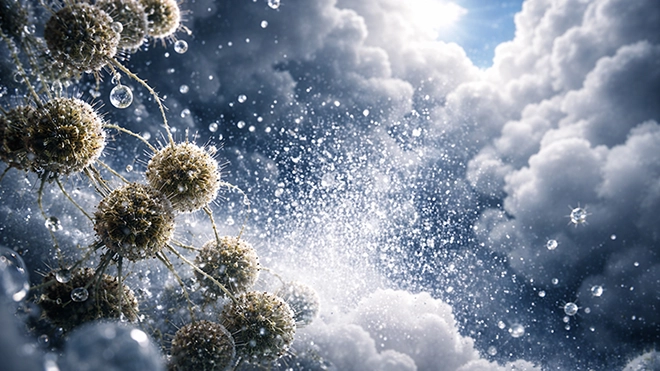
Recent research has revealed that fungi may play an unexpected role in this process. Scientists have discovered that certain fungi produce ice-nucleating proteins, specialized molecules capable of organizing water molecules into patterns that initiate freezing.
Even more surprising, these proteins appear to have originated from bacterial genes that jumped into fungi millions of years ago. The discovery suggests that fungal spores may influence cloud formation, precipitation, and possibly even climate systems.
In other words, tiny fungal molecules may help determine when clouds turn into snow or rain.
Global Context
Why freezing in the sky matters
Clouds are not simply floating water droplets. They are complex physical systems where temperature, chemistry, and microscopic particles interact.
Under pure conditions, water droplets can remain liquid down to around −40 °C. But if an ice-nucleating particle is present, freezing can occur much earlier, sometimes around −5 °C.
That difference dramatically affects how clouds behave.
Ice formation inside clouds influences their structure, lifetime, and ability to produce precipitation. Snowflakes and raindrops often begin when microscopic particles trigger freezing in supercooled droplets.
For decades scientists believed that most biological ice-nucleating particles came from bacteria such as Pseudomonas. The new discovery suggests fungi may also play an important role in these atmospheric processes.
Considering the enormous number of fungal spores circulating in the air, their influence on weather systems could be significant.

Emerging Science
A newly recognized class of fungal ice-nucleating proteins
The research team examined fungal proteins suspected of contributing to ice nucleation and discovered a previously unknown structural class of ice-nucleating proteins (INPs).
These proteins contain repeating molecular structures that align nearby water molecules into a configuration that resembles the lattice structure of ice. Once enough water molecules organize into this pattern, freezing begins.
Unlike bacterial INPs, which often remain attached to cell membranes, the fungal versions can assemble outside the cell into large extracellular complexes. These complexes behave like microscopic ice-forming particles interacting directly with surrounding water droplets.
Laboratory experiments showed that these fungal protein complexes can trigger freezing at temperatures far warmer than spontaneous ice formation would normally occur.
This makes them potentially powerful contributors to environmental ice nucleation.

An Evolutionary Surprise
When bacteria share genes with fungi
Genetic analysis revealed an unexpected evolutionary twist.
The fungal genes responsible for the newly discovered proteins closely resemble InaZ, a well-known bacterial ice-nucleating protein gene. This similarity suggests that the fungal version originated through horizontal gene transfer, a process in which genes move between unrelated organisms.
Rather than inheriting traits only from ancestors, microorganisms sometimes acquire useful genes directly from other species. In this case, bacteria likely transferred an ice-nucleation gene into fungal genomes long ago.
Over time, fungi adapted and modified the gene, producing proteins suited to their ecological environments.
This example highlights how microbial evolution often involves cooperation and exchange rather than isolated development.

Opportunities and Implications
Microbes as actors in the water cycle
Fungal spores are among the most abundant biological particles in the atmosphere. Carried by wind currents, they can travel across continents and oceans.
If many of these spores contain ice-nucleating proteins, they may influence several atmospheric processes:
- cloud ice formation
- snowfall initiation
- rainfall development
- regional hydrological cycles
Scientists increasingly suspect that biological particles contribute significantly to atmospheric ice nucleation. The discovery of fungal INPs strengthens this idea and suggests fungi may be key participants in Earth’s water cycle.
Beyond climate science, these proteins may also have technological applications.
Industries that rely on controlled freezing — such as frozen food manufacturing, cryopreservation, and artificial snow production — already use bacterial ice-nucleating proteins. Fungal versions could expand these possibilities, especially because their extracellular complexes appear stable and efficient.

Outlook
The growing field of atmospheric microbiology
The discovery of fungal ice-nucleating proteins reinforces a broader scientific realization: microorganisms are deeply integrated into planetary systems.
Fungi are often studied in soil ecosystems, forests, or indoor environments. Yet they also exist in the aerial biosphere, a vast microbial community circulating through the atmosphere.
During their journey through the sky, fungal spores may influence weather patterns, plant disease spread, and atmospheric chemistry.
Understanding these processes is part of an emerging field known as atmospheric microbiology, which explores how microscopic life interacts with climate systems.
The more scientists study these interactions, the clearer it becomes that microbial life participates in Earth’s physical processes in ways we are only beginning to understand.
The discovery of fungal ice-nucleating proteins reminds us that the smallest biological mechanisms can influence the largest environmental systems.
A microscopic protein aligning a few water molecules might seem insignificant. Yet that molecular event could initiate the formation of an ice crystal inside a cloud — a step that may eventually lead to snowfall over mountains or rainfall across farmland.
Fungi are often seen as quiet recyclers of ecosystems. But research increasingly shows that their influence extends far beyond soil and forests.
Sometimes, the forces shaping the weather begin with molecules smaller than a grain of dust.

FAQ
❓ Do fungi really influence weather?
Yes. Fungal spores can act as atmospheric particles that trigger ice formation in clouds. This process can influence precipitation, snowfall, and cloud dynamics.
❓ What are ice-nucleating proteins?
Ice-nucleating proteins organize water molecules into a structure that promotes ice crystal formation, allowing freezing to occur at relatively warm sub-zero temperatures.
❓ Did fungi evolve these proteins themselves?
Evidence suggests the genes originated in bacteria and later transferred into fungi through horizontal gene transfer.
❓ Why is this discovery important?
It shows that fungi may play a larger role in atmospheric processes and climate systems than previously understood.
❓ Could these proteins be used in technology?
Yes. Ice-nucleating proteins are already used in artificial snow production, food freezing, and cryopreservation. Fungal versions may expand these applications.
References
Morris, C. E., Sands, D. C., Bardin, M., et al. (2014). Microbiology and atmospheric processes: Research challenges concerning the impact of airborne microorganisms on the atmosphere and climate. Biogeosciences.
Pummer, B. G., et al. (2015). Ice nucleation by atmospheric biological particles. Nature Geoscience.
Möhler, O., et al. (2007). Microbiology and atmospheric processes: the role of biological particles in cloud physics. Biogeosciences.
CDC – Environmental microbiology resources.
https://www.cdc.gov
Key Takeaways
- Please login The newly discovered proteins that may help freeze clouds and shape the planet’s water cycle
- But in reality, water can resist freezing for surprisingly long periods unless something triggers the transition.In nature, that trigger often comes from microscopic particles drifting in the atmosphere.
- Even more surprising, these proteins appear to have originated from bacterial genes that jumped into fungi millions of years ago.
- In other words, tiny fungal molecules may help determine when clouds turn into snow or rain.
- But if an ice-nucleating particle is present, freezing can occur much earlier, sometimes around −5 °C.
Frequently Asked Questions
What should you know about please login to bookmark?
Please login The newly discovered proteins that may help freeze clouds and shape the planet’s water cycle
What should you know about global Context?
Clouds are not simply floating water droplets. They are complex physical systems where temperature, chemistry, and microscopic particles interact.
Why freezing in the sky matters?
Clouds are not simply floating water droplets. They are complex physical systems where temperature, chemistry, and microscopic particles interact.
What should you know about emerging Science?
The research team examined fungal proteins suspected of contributing to ice nucleation and discovered a previously unknown structural class of ice-nucleating proteins (INPs).
What should you know about a newly recognized class of fungal ice-nucleating proteins?
The research team examined fungal proteins suspected of contributing to ice nucleation and discovered a previously unknown structural class of ice-nucleating proteins (INPs).