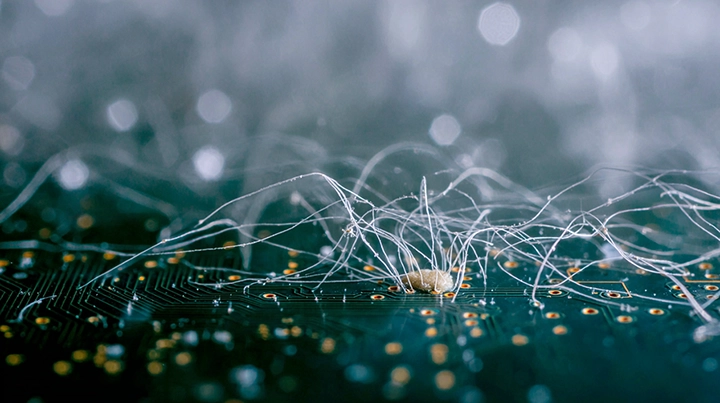

When Biology Becomes Hardware
Fungi have long lived at the edge of the visible world — breaking down fallen wood, cycling nutrients through soil, appearing on surfaces where moisture gathers. That story is familiar. What is less familiar is where fungi are showing up now: inside robotics labs, connected to electrodes, generating signals that influence how machines move.
In emerging biohybrid systems, fungal networks are being explored as functional components — not as decorative biology, but as active parts of engineered systems capable of sensing environmental changes and feeding that information into mechanical behavior. The organism is no longer just something to study or remove. It is becoming something to build with.
This shift reflects a deeper change in how engineers think about materials. Systems built entirely from inert, predictable components have defined technology for centuries. What is emerging now is different: architectures that incorporate living structures — ones that respond, adapt, and interact with their surroundings in ways no synthetic material currently can.
The Core Concept: Fungi as Biological Sensors
At the center of this research is mycelium — the dense network of microscopic filaments that forms the main body of a fungus. Most of it is hidden: threading through soil, wood, or growth substrate, extending across distances that the fruiting body above never hints at.
Mycelium is not only structural. It is electrically active. As it grows and responds to environmental stimuli — light, humidity, temperature, chemical exposure — it produces measurable electrical signals. These are not signs of thought or awareness. They are physiological responses: shifts in electrical activity that reflect how the organism is interacting with its immediate environment, in the same way that a plant wilts under drought or a muscle contracts under tension.
By capturing and interpreting these signals, engineers have found a new category of sensor — one that is alive, distributed, and continuously responsive.

From Signal to Movement: Building Biohybrid Systems
The experimental architecture is straightforward in concept, if complex in practice. Fungal networks are grown into or alongside robotic platforms. Electrodes make contact with the mycelium and detect its electrical activity. That signal passes through an electronic interface, where it is interpreted and translated into commands that influence how the mechanical system behaves.
The chain runs: environmental stimulus → fungal response → electrical signal → programmed interpretation → mechanical action.
Fungi are not controlling anything. They are providing biological input — raw signal — and the engineering system determines what to do with it. The distinction matters. What makes this a biohybrid system is precisely that both components are doing real work: the fungus senses, the machine acts, and neither could do the other’s job alone.
Why Use Fungi Instead of Traditional Sensors
A conventional sensor does one thing well. It measures a specific variable — temperature, pressure, light — with precision and consistency. That reliability is valuable. But it comes with limits: fixed geometry, narrow sensitivity, and no ability to adapt as conditions change.
A single fungal network can respond to multiple environmental variables at once. It can grow across irregular surfaces. It continues functioning — and changing — as the system around it evolves. In environments that are complex, unpredictable, or physically irregular, that flexibility opens possibilities that conventional sensors cannot reach.
The tradeoff is variability. Biological signals are less consistent than electronic ones. They require calibration, modeling, and ongoing interpretation. Fungi do not replace traditional sensors. They extend the range of what sensing systems can become.
Distributed Intelligence Without a Brain
One of the more counterintuitive features of fungal networks is how they process information. There is no center. No single point through which all signals pass. Activity moves through the mycelium in a decentralized manner, allowing the system to respond to local conditions across multiple points simultaneously.
This has drawn comparisons to neural networks — and the parallel is worth examining carefully. Fungi do not think. They do not make decisions in any meaningful sense. But they do process environmental information in a way that is spatially distributed and dynamically responsive, which is functionally similar to how distributed computing architectures handle complex, parallel inputs.
For engineering, this suggests something worth paying attention to: system designs that are resilient by structure rather than by redundancy — capable of functioning even when individual components fail, because there is no single point of failure to begin with.

Implications for Materials and Built Environments
The application space extends beyond robotics. Mycelium-based materials are already being developed as lightweight, biodegradable structural components — packaging, insulation, architectural panels. What the biohybrid research adds is a sensing dimension. Materials that were previously passive could, in principle, become responsive.
A wall panel that detects moisture accumulation. A structural element that signals stress before visible damage appears. A building material that provides real-time feedback on the conditions it is embedded in. Each of these remains speculative. But the underlying mechanism — mycelium as a distributed sensor within a solid material — is being actively investigated.
The trajectory points toward built environments where the boundary between structure and sensor dissolves.
Limits and Reality Check
Fungal biohybrid technology is early-stage research. The gap between laboratory demonstration and deployable system remains significant, and it is worth being precise about what that gap contains.
Signal variability is a genuine challenge. Biological systems do not behave with the consistency of engineered components, and that inconsistency compounds across environmental fluctuations, growth stages, and organism-to-organism differences. Standardization — a basic requirement for any technology that moves from lab to product — is difficult when the core component is alive and responsive to its surroundings.
Long-term stability presents a separate problem. Living systems age, respond to stress, and eventually die. Engineering around that lifecycle requires approaches that have no direct precedent in conventional materials science.
These are not reasons to dismiss the field. They are the actual problems the field is working on.
Rethinking What Materials Can Be
There is a deeper implication running through this research — one that extends beyond any specific application. For most of technological history, materials have been chosen for their inertness: their ability to hold a fixed form, resist change, and perform predictably over time. Fungal systems invert that logic. Their value comes precisely from their responsiveness — from the fact that they change.
That reframing changes what questions engineers should be asking. Not just: how stable is this material? But: what can this material detect? What can it do as conditions shift?
The boundary between living and engineered systems is not fixed. It is becoming a space where new kinds of functionality are being worked out — one electrode, one signal, one carefully grown mycelial thread at a time.
FAQ
Can fungi actually control robots? No. Fungi generate electrical signals that engineered systems interpret and act on. The control logic remains entirely within the human-designed framework.
What is mycelium? Mycelium is the network of filament-like structures that forms the main body of a fungus — typically hidden within soil, wood, or other substrates, and often far more extensive than the visible fruiting body above.
Why are fungi used in these systems? Because they respond to multiple environmental variables simultaneously and generate measurable electrical signals — capabilities that make them useful as biological sensors in ways conventional materials cannot replicate.
Are fungal robots available now? They exist as experimental research platforms. Commercial or industrial deployment is not yet practical.
Could fungi be used in buildings in the future? Research is actively exploring mycelium-based materials as both structural elements and environmental sensors. Practical applications remain in development.
References
- Science Robotics — Fungal Networks in Biohybrid Robotic Systems: https://www.science.org/doi/10.1126/scirobotics.adk8019
- Royal Botanic Gardens Kew — Fungi: The Hidden Dimension: https://www.kew.org/read-and-watch/fungi-hidden-dimension
Key Takeaways
- Please login When Biology Becomes Hardware Fungi have long lived at the edge of the visible world — breaking down fallen wood, cycling nutrients through soil, appearing on surfaces where moisture gathers.
- The organism is no longer just something to study or remove.
- What is emerging now is different: architectures that incorporate living structures — ones that respond, adapt, and interact with their surroundings in ways no synthetic material currently can.
- As it grows and responds to environmental stimuli — light, humidity, temperature, chemical exposure — it produces measurable electrical signals.
- Fungal networks are grown into or alongside robotic platforms.
Frequently Asked Questions
What should you know about please login to bookmark?
Please login When Biology Becomes Hardware Fungi have long lived at the edge of the visible world — breaking down fallen wood, cycling nutrients through soil, appearing on surfaces where moisture gathers. That story is familiar. What is less familiar is where fungi are showing up now: inside robotic
When Biology Becomes Hardware?
Fungi have long lived at the edge of the visible world — breaking down fallen wood, cycling nutrients through soil, appearing on surfaces where moisture gathers. That story is familiar. What is less familiar is where fungi are showing up now: inside robotics labs, connected to electrodes, generating
What should you know about the Core Concept: Fungi as Biological Sensors?
At the center of this research is mycelium — the dense network of microscopic filaments that forms the main body of a fungus. Most of it is hidden: threading through soil, wood, or growth substrate, extending across distances that the fruiting body above never hints at.
What should you know about from Signal to Movement: Building Biohybrid Systems?
The experimental architecture is straightforward in concept, if complex in practice. Fungal networks are grown into or alongside robotic platforms. Electrodes make contact with the mycelium and detect its electrical activity. That signal passes through an electronic interface, where it is interprete
Why Use Fungi Instead of Traditional Sensors?
A conventional sensor does one thing well. It measures a specific variable — temperature, pressure, light — with precision and consistency. That reliability is valuable. But it comes with limits: fixed geometry, narrow sensitivity, and no ability to adapt as conditions change.