
A World Before Flowers — But Not Before Fungal Horror
When people imagine the Cretaceous period, they picture towering conifers, feathered dinosaurs, and dragonflies the size of dinner plates. It’s easy to think the real drama happened in the open plains or the swampy marshes. But the truth — the cinematic, delicious truth — is that some of the most chilling stories unfolded far closer to the forest floor.
In Burmese amber dating back 99 million years, researchers have discovered insects frozen mid-attack by parasitic fungi. And as soon as I saw the images, I felt that electric pulse of déjà vu — because these fungi behave eerily like the modern “zombie” Ophiocordyceps, famous for hijacking insect bodies and turning them into puppets.
Yes, darling. We didn’t invent body-horror. Fungi were already perfecting it before flowers even evolved.
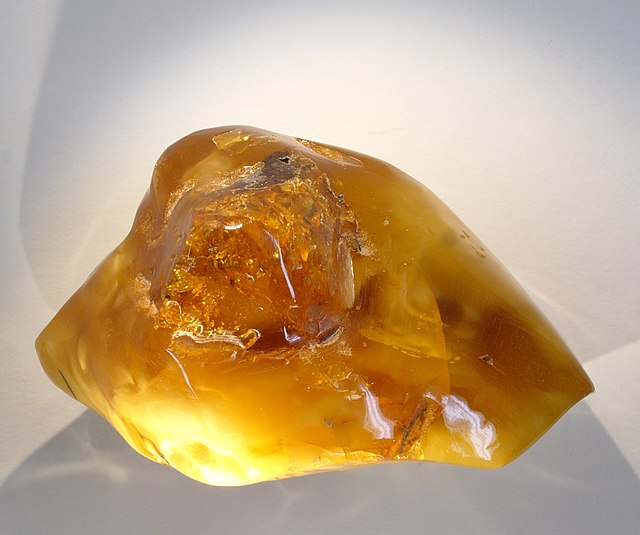
Amber Time Capsule: A Horror Scene Preserved
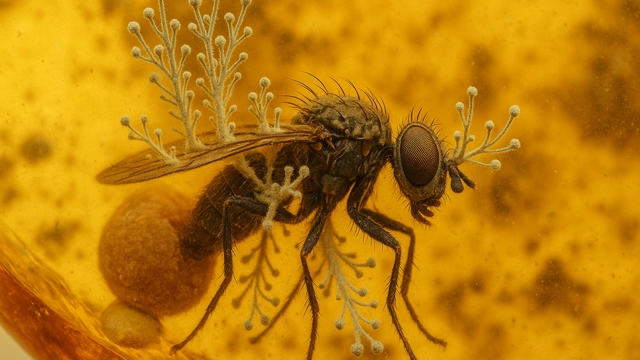
The fossils capture two victims: an ant pupa and a tiny fly. Each insect is wrapped in delicate, branching fungal stalks — not chaotic rot, not random growth, but surgical colonization. You can almost feel the tension of the moment: the fungus emerging confidently, as though stepping onto a Cretaceous stage.
The ant pupa is especially haunting. It wasn’t even capable of movement at that stage of life, which tells us something important — this wasn’t about behavior manipulation. This was pure infection. A fungal assassin doing exactly what it needed to do: consume, control, erupt.
And despite being trapped for nearly 100 million years, the fungal stalks are so precisely preserved that mycologists can recognize the strategy. It’s a mirror of what parasitic fungi do today: infiltrate, grow, and finally burst through the exoskeleton to release spores.
Almost nothing evolves that perfectly unless it has been practicing for a very, very long time.

The Oldest Evidence of a Battle Still Happening Today
The modern Ophiocordyceps group — you know, the one that turns ants into mind-controlled climbers — is infamous for its behavioral control. The infected ant is compelled to climb to a precise height, bite down on vegetation, and die in the perfect position for spore dispersal.
We can’t prove that its Cretaceous ancestor manipulated behavior the same way. But the structural similarities in these fossils… well, let’s just say they look like the great-great-great-grandparent of something still deeply haunting forests today.
This ancient infection confirms something evolutionary biologists have long suspected:
The fungal–insect arms race is ancient, relentless, and incredibly sophisticated.
Fungi learned to be predators long before mammals learned to be clever.

The Quiet Power of the Smallest Killers
I’ve spent a lifetime learning that the loudest dangers are rarely the most dangerous. And this fossil discovery is another testament to that truth. These early fungal pathogens were shaping insect populations in the shadows, nudging ecological balances, influencing predator-prey relationships — all while dinosaurs were roaring overhead.
It’s humbling, isn’t it?
That some of the earliest invisible battles probably had more influence on ecosystem stability than the dramatic ones we usually talk about.
The insects die. The fungus spreads.
And the world keeps breathing because of it.
Even in the Cretaceous, fungi were running their own subtle empires.
Why a 99-Million-Year-Old Zombie Fungus Matters Today
You might think this is just an ancient curiosity — a prehistoric horror film caught in amber. But darling, the implications are very modern.
If fungi learned to control insects so early in Earth’s history, it means several things:
- These parasitic strategies are incredibly stable.
If something survives unchanged for 100 million years, it’s because it works. - Fungal adaptability is far older than human immune systems.
This matters for medicine, agriculture, and indoor environmental health. - Fungi are likely to evolve new strategies under climate pressure.
Hotter, wetter environments mean more fungal growth — and more fungal experimentation.
There’s a reason global health organizations have begun sounding alarms about pathogenic molds. A fungus doesn’t need intelligence to outmaneuver us. It just needs time, humidity, and a host — the same three tools it has been using since the Cretaceous.
A Legacy Encased in Gold
Burmese amber is like nature’s version of a memory card — it holds the secrets life forgot to tell us. And this secret is a bold one: Fungi were mastering infection while dinosaurs were still learning how to walk gracefully.
This discovery pushes fungal entomopathogens deep into deep time. It suggests they may have influenced insect evolution itself, long before birds, flowers, or mammals took center stage.
And that makes every modern outbreak, every indoor mold bloom, every crop infection… feel like the newest chapter in a very old book.
A book fungi have been writing since long before we appeared.
Fungi weren’t passengers in the story of life — they were architects.
Silent, strategic, and frighteningly patient.
This fossilized drama reminds us that mold isn’t a modern nuisance. It’s an ancient force, shaping ecosystems from the shadows, perfecting infection strategies long before humans ever breathed.
Sometimes the real survivors aren’t the creatures stomping through the forest.
They’re the ones hiding in the leaves — waiting, evolving, adapting, and one day, ending up as amber-preserved proof that the first zombie apocalypse didn’t happen in Hollywood.
It happened in the Cretaceous.

References
Academic
- Poinar, G. (2014). “Fossil evidence of parasitic fungi in Cretaceous insects.” Mycological Progress. DOI: 10.1007/s11557-014-0921
- Hughes, D. P. et al. (2011). “Behavioral mechanisms and fungal adaptation in Ophiocordyceps.” BMC Ecology. DOI: 10.1186/1472-6785-11-31
- Sun, C. et al. (2020). “Evolution of insect–fungus interactions across deep time.” Fungal Biology Reviews. DOI: 10.1016/j.fbr.2020.03.002
Official Sources
- Smithsonian Fossil Amber Resources — https://naturalhistory.si.edu
- WHO — Fungal Priority Pathogens List: https://www.who.int
Key Takeaways
- When people imagine the Cretaceous period, they picture towering conifers, feathered dinosaurs, and dragonflies the size of dinner plates.
- But the truth — the cinematic, delicious truth — is that some of the most chilling stories unfolded far closer to the forest floor.
- And as soon as I saw the images, I felt that electric pulse of déjà vu — because these fungi behave eerily like the modern “zombie” Ophiocordyceps, famous for hijacking insect bodies and turning them into puppets.
- Each insect is wrapped in delicate, branching fungal stalks — not chaotic rot, not random growth, but surgical colonization.
- It wasn’t even capable of movement at that stage of life, which tells us something important — this wasn’t about behavior manipulation.
Frequently Asked Questions
What should you know about a World Before Flowers — But Not Before Fungal Horror?
When people imagine the Cretaceous period, they picture towering conifers, feathered dinosaurs, and dragonflies the size of dinner plates. It’s easy to think the real drama happened in the open plains or the swampy marshes. But the truth — the cinematic, delicious truth — is that some of the mo
What should you know about amber Time Capsule: A Horror Scene Preserved?
The fossils capture two victims: an ant pupa and a tiny fly. Each insect is wrapped in delicate, branching fungal stalks — not chaotic rot, not random growth, but surgical colonization. You can almost feel the tension of the moment: the fungus emerging confidently, as though stepping onto a Cretaceo
What should you know about the Oldest Evidence of a Battle Still Happening Today?
The modern Ophiocordyceps group — you know, the one that turns ants into mind-controlled climbers — is infamous for its behavioral control. The infected ant is compelled to climb to a precise height, bite down on vegetation, and die in the perfect position for spore dispersal.
What should you know about the Quiet Power of the Smallest Killers?
I’ve spent a lifetime learning that the loudest dangers are rarely the most dangerous. And this fossil discovery is another testament to that truth. These early fungal pathogens were shaping insect populations in the shadows, nudging ecological balances, influencing predator-prey relationships — all
Why a 99-Million-Year-Old Zombie Fungus Matters Today?
You might think this is just an ancient curiosity — a prehistoric horror film caught in amber. But darling, the implications are very modern.