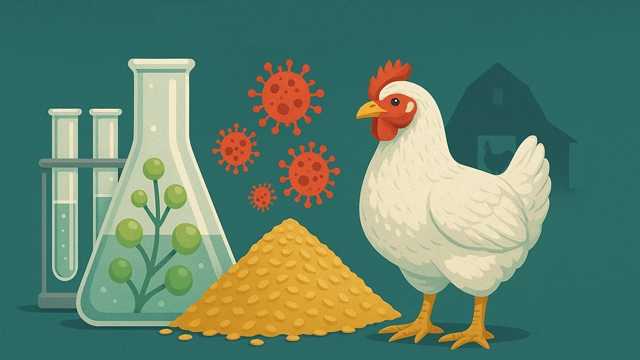

A New Frontline in the Invisible War
Across global grain supply chains, a quiet biochemical menace moves largely undetected. The culprits—Aflatoxin B1, deoxynivalenol (DON), and zearalenone (ZEN)—are fungal metabolites with a gift for subtlety. They do not act like conventional poisons with immediate, dramatic symptoms. Instead, they work slowly, eroding internal systems one pathway at a time. Poultry producers know their effects well: diminished growth, impaired immunity, organ stress, hormonal imbalance, and sometimes mortality. Yet these toxins continue to slip into feed because they originate long before grain enters a mill—often forming during crop growth or storage.
Traditional countermeasures have attempted to catch these toxins after the fact, relying mostly on binders that trap them loosely and temporarily. But this approach does not eliminate the threat; it simply delays it. A toxin captured in one part of the gut may be released farther along, where absorption is even more efficient. What the industry has lacked is a method not of hiding the toxins, but ending them.
A new study introduces something that may offer that possibility: a microencapsulated enzyme complex capable of degrading all three major mycotoxins. It represents a shift not merely in technique but in philosophy. Instead of treating mycotoxins as contaminants to be blocked, researchers are treating them as molecular structures to be dismantled.
The Engineering of a Biological Countermeasure
The heart of this innovation is the mycotoxin-degrading enzyme complex, or MDE. Unlike binders, which operate by adsorption, this system uses biochemistry as a tool for structural deconstruction. Through microencapsulation, researchers protect each enzyme from heat, pressure, and chemical changes during feed processing. Only when the enzymes enter the digestive tract—where the mycotoxins themselves become active—does the protective coating dissolve, releasing a team of molecular specialists designed to attack the toxins directly.
In laboratory simulations of digestive conditions, the MDE displayed a remarkable ability to break down mycotoxins. Aflatoxin B1, one of the most carcinogenic natural substances known, was degraded at levels exceeding seventy percent. DON, notorious for damaging the gastrointestinal lining and suppressing immunity, experienced a similar reduction. Even zearalenone, an estrogenic toxin that disrupts hormonal systems, showed significant breakdown. These results demonstrate not just chemical reactivity but biochemical targeting. The enzymes behave like craftsmen working with precision rather than blunt instruments used to hide a hazard.
Yet laboratory simulations, no matter how promising, must always face the test of real biological complexity. To understand whether the enzymes could function inside living organisms, researchers turned to broiler trials—the closest approximation to the conditions under which feed additives must operate.

Inside the Broiler Trial: Biology Under Challenge
The study followed a simple yet powerful design. One group of chicks received a clean, uncontaminated diet. Another group consumed feed contaminated with AFB1, DON, and ZEN at levels known to cause physiological stress. The third group received this same toxin-laced feed, but with the addition of the MDE complex. Over the course of only fourteen days, the consequences became clear.
Chicks exposed solely to the toxins suffered measurable physiological decline. Markers of liver distress, such as ALT and AST, rose sharply, indicating damage at the cellular level. Blood urea nitrogen increased, suggesting impaired kidney function or protein metabolism. The lining of the stomach thickened and inflamed, evidence of DON’s well-documented corrosive influence on the digestive tract. These symptoms were not surprising; they were confirmations of what mycotoxin researchers have known for decades.
What was surprising was the effect of the enzyme complex. In the MDE group, the biochemical markers moved toward normal ranges. Liver distress signals decreased. The epithelial damage observed in stomach tissue was reduced. Residues of toxins in the gastrointestinal tract dropped significantly. Even the chicks’ body weight began trending upward compared with the toxin-only group, suggesting that the mitigation of internal stress allowed normal metabolic processes to resume.
What this demonstrates is not a marginal improvement, but a functional reversal of early-stage toxin damage. The enzymes did not merely interfere with toxin activity—they reduced the presence of the toxins themselves. In doing so, they allowed the birds’ own physiology to recover its balance.
Why This Approach Matters
To understand the significance of enzymatic detoxification, one must consider the limitations of traditional binders. Binders do not eliminate toxins; they merely immobilize them. Their performance depends heavily on pH, digestive speed, moisture, and competition from other molecules. Some binders display strong affinity for one toxin but weak affinity for another. Many cannot function effectively when multiple toxins are present, which is the rule rather than the exception in contaminated grain.
Enzymatic degradation, however, bypasses these limitations. It treats mycotoxins not as particles to be stored away but as chemical puzzles that can be dismantled into harmless fragments. It is a fundamentally problem-solving approach—akin to resolving electrical interference not by shielding a wire, but by eliminating the source of the interference itself.
Microencapsulation adds another layer of elegance. Without it, the enzymes would be destroyed during feed processing or rendered inactive by gastric acidity. With it, they become a timed-release intervention, active precisely where the toxins inflict their harm.

A Glimpse Into the Future of Feed Safety
If this technology continues to show promise in larger and longer trials, it could transform how the poultry sector addresses mycotoxins. The implications are broad: cleaner feed, healthier birds, reduced reliance on antibiotics, improved growth performance, and potentially even lower production costs. Since mycotoxins weaken immunity, neutralizing them may also decrease the likelihood of secondary infections.
There are broader implications still. Other sectors—swine, dairy, aquaculture—face similar multi-toxin challenges. A flexible enzymatic system capable of working across species and feed types could dramatically increase resilience in global food production.
In many ways, this represents a turning point. For the first time, we are not responding to mycotoxins with blunt chemical defenses but with engineered biological intelligence. Fungi created these molecules through millions of years of evolutionary innovation. Now, biotechnology is beginning to craft equally sophisticated responses.
Teslo’s Final Reflection
This research feels like a quiet revolution. It does not announce itself with drama, but with precision. It recognizes that the best way to counter a fungal toxin is not to bury it, disguise it, or ignore it—but to understand it at the molecular level and undo its structure. It is science meeting nature not with resistance, but with ingenuity.
If fungi have learned to produce molecules that disrupt life, then biotechnology must learn to unmake them.
This enzyme complex is one step in that direction—a promising one.
Key Takeaways
- Please login A New Frontline in the Invisible War Across global grain supply chains, a quiet biochemical menace moves largely undetected.
- They do not act like conventional poisons with immediate, dramatic symptoms.
- Yet these toxins continue to slip into feed because they originate long before grain enters a mill—often forming during crop growth or storage.
- But this approach does not eliminate the threat; it simply delays it.
- A new study introduces something that may offer that possibility: a microencapsulated enzyme complex capable of degrading all three major mycotoxins.
Frequently Asked Questions
What should you know about please login to bookmark?
Please login A New Frontline in the Invisible War Across global grain supply chains, a quiet biochemical menace moves largely undetected. The culprits—Aflatoxin B1, deoxynivalenol (DON), and zearalenone (ZEN)—are fungal metabolites with a gift for subtlety. They do not act like conventiona
What should you know about a New Frontline in the Invisible War?
Across global grain supply chains, a quiet biochemical menace moves largely undetected. The culprits—Aflatoxin B1, deoxynivalenol (DON), and zearalenone (ZEN)—are fungal metabolites with a gift for subtlety. They do not act like conventional poisons with immediate, dramatic symptoms. Inste
What should you know about the Engineering of a Biological Countermeasure?
The heart of this innovation is the mycotoxin-degrading enzyme complex, or MDE. Unlike binders, which operate by adsorption, this system uses biochemistry as a tool for structural deconstruction. Through microencapsulation, researchers protect each enzyme from heat, pressure, and chemical changes du
What should you know about inside the Broiler Trial: Biology Under Challenge?
The study followed a simple yet powerful design. One group of chicks received a clean, uncontaminated diet. Another group consumed feed contaminated with AFB1, DON, and ZEN at levels known to cause physiological stress. The third group received this same toxin-laced feed, but with the addition of th
Why This Approach Matters?
To understand the significance of enzymatic detoxification, one must consider the limitations of traditional binders. Binders do not eliminate toxins; they merely immobilize them. Their performance depends heavily on pH, digestive speed, moisture, and competition from other molecules. Some binders d