
When a Morning Drink Becomes a Fungal Evolution Story
Coffee occupies an unusual position in global agriculture. It is simultaneously one of the most traded commodities on earth and one of the most biologically fragile — a crop grown across a narrow band of tropical and subtropical latitudes, dependent on specific temperature and rainfall conditions, and cultivated predominantly in monoculture systems that offer pathogens a vast, genetically uniform target.
Beneath every cup is an ecosystem under pressure.
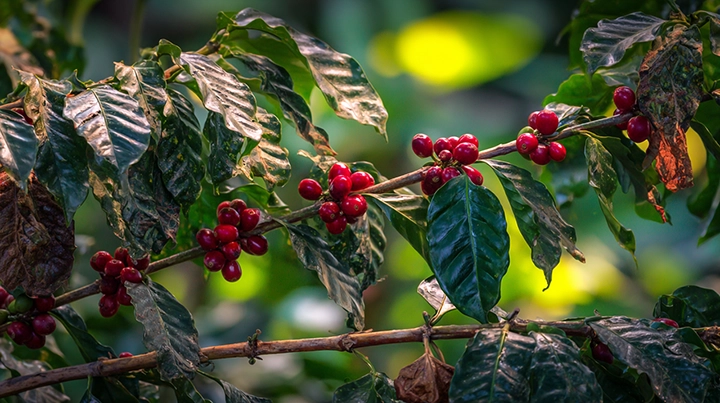
One of the most destructive forces in that ecosystem is coffee wilt disease, caused by the fungus Fusarium xylarioides. The pathogen disrupts the vascular system that allows coffee plants to move water from roots to leaves. What follows is a slow collapse: progressive wilting, declining yield, and eventually plant death. Since the 1990s, outbreaks of coffee wilt disease have caused more than US$1 billion in losses across Africa, forced farms to close, and disrupted supply chains that millions of smallholder farmers depend on for their livelihoods.
The newest genomic research suggests the threat is more complex than a straightforward host-pathogen relationship. Coffee wilt disease is not simply a fungus attacking a crop. It is an evolutionary system — one shaped by genetic exchange between organisms, by the structure of the agricultural landscapes surrounding coffee farms, and by environmental pressures that are intensifying as climates become less stable.
Why Coffee Wilt Is a Global Food Security Issue
Coffee’s economic footprint extends far beyond the farmers who grow it. The crop supports exporters, processors, roasters, retailers, and the logistics infrastructure connecting them — a supply chain spanning dozens of countries and billions of dollars in annual trade.
When fungal disease moves through a coffee-growing region, the disruption propagates outward. Crop losses reduce farmer income. Export volumes fall. Prices shift in importing markets. Infrastructure built around coffee production sits idle. Recovery can take years, particularly for smallholder farmers in regions with limited access to replacement planting material, crop insurance, or alternative income sources.
The research also notes that coffee wilt disease has not disappeared. It remains endemic at manageable levels across parts of Africa, with evidence of recent reappearance in Ivory Coast. Producers in Asia and the Americas may face future exposure as the pathogen and the conditions that favor it continue to evolve.
Coffee wilt disease is one instance of a broader pattern: the growing vulnerability of globally important crops to fungal pathogens that are themselves changing in ways that outpace the agricultural systems designed to contain them.
Why Fungal Diseases Keep Returning
Understanding why coffee wilt disease resurfaces requires understanding the evolutionary dynamics that govern plant disease more broadly.
Plants develop resistance mechanisms. Fungi evolve capacity to overcome them. Breeders introduce resistant varieties. Pathogens adapt. Fungicides reduce populations. Resistant strains persist and proliferate. The cycle continues — not because any single actor is failing, but because the system operates as a continuous evolutionary arms race between organisms with very different timescales and population sizes.
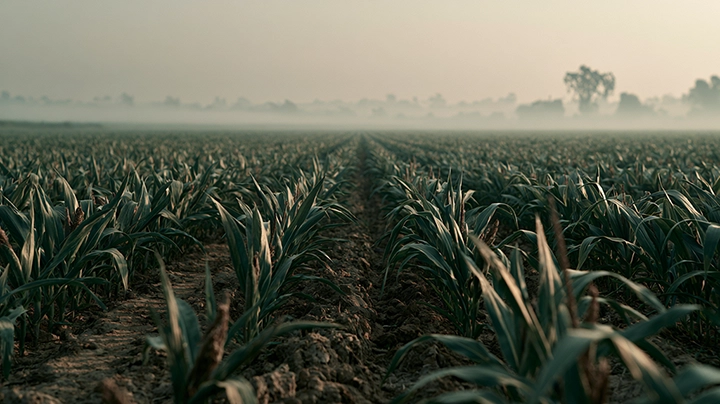
Modern agriculture intensifies this cycle in a specific and important way. Monoculture farming — large areas planted with genetically similar or identical varieties — creates the most efficient production systems known for many crops. It also creates the most uniform biological targets.
When a fungal pathogen evolves the ability to infect one plant in a monoculture field, it has effectively evolved the ability to infect every plant in that field. The genetic similarity that makes monocultures productive is the same characteristic that makes them vulnerable. Fungal outbreaks in these systems are not simply microbiological events. They are, in part, consequences of agricultural design.

Credit: The Mediae Company, via Wikimedia Commons, CC BY-SA 4.0
Resurrecting Historical Fungal Genomes
One of the more remarkable aspects of the research is its use of historical fungal collections as a scientific resource.
Fungal libraries — archives of preserved strains collected from past outbreaks — function as biological time capsules. The organisms they contain carry the genomic record of how pathogens were constituted at specific points in time, in specific agricultural contexts, against specific host populations. By sequencing these historical strains and comparing them with contemporary isolates, researchers can reconstruct the evolutionary trajectory of a pathogen across decades.
For Fusarium xylarioides, this approach revealed clear genetic differences between strains associated with pre-1970s outbreaks and those infecting arabica and robusta coffee in more recent decades. Many of these differences followed the expected pattern of vertical evolution — genetic changes accumulated through normal mutation and inheritance as the pathogen reproduced over generations.
But some of the most important genes associated with disease — genes involved in virulence, host interaction, and environmental adaptation — appeared to have arrived from somewhere else entirely.
Neighboring Plants as Genetic Meeting Grounds
The finding that points toward the most significant implications for agricultural management involves horizontal gene transfer — the movement of genetic material between organisms that are not in a direct parent-offspring relationship.
Fungi are capable of exchanging genetic material with other fungal species they encounter in the same environment. When two fungal species occupy the same host plant, or the same soil, or the same leaf surface, the conditions for genetic exchange can exist. The genes that transfer are not random. The elements most commonly involved — including large mobile genetic structures — tend to carry functional genes: sequences associated with environmental persistence, adaptation to new hosts, or the production of compounds that overcome plant defenses.
The research raises a specific ecological concern for coffee-growing systems. Plants growing near coffee farms — banana trees, Solanum weeds, and other cultivated or wild species — may host related Fusarium species that interact with coffee pathogens in the shared landscape. These neighboring plants can function as reservoirs where different fungal populations survive, encounter one another, and exchange genetic material.
This does not implicate intercropping or agricultural biodiversity as inherently dangerous. Mixed farming systems provide genuine ecological benefits, and the research does not argue for eliminating them. What it does establish is that the biological environment surrounding a coffee farm is not neutral. The fungi living on neighboring plants are part of the evolutionary context in which coffee pathogens develop — and the genetic exchanges that happen there can influence what the pathogen becomes.

Credit: Derio.brioschi, via Wikimedia Commons, CC BY-SA 4.0
Climate Stress and the Future of Crop Vulnerability
The evolutionary dynamics described above do not operate in a stable environment. They operate within agricultural and ecological systems that are themselves changing under climate pressure.
Heat stress, shifting rainfall patterns, drought, and temperature instability weaken coffee plants in ways that increase their vulnerability to fungal attack. The same conditions alter fungal ecology — affecting spore production, dispersal, germination, and the competitive dynamics between fungal species sharing the same environment. Under sustained environmental stress, the opportunities for fungal adaptation and genetic exchange may increase as pathogens encounter new hosts, new landscapes, and new selection pressures.
Combined with the monoculture structure of many coffee-growing systems and the expanding reach of global agricultural trade, this creates conditions in which fungal pathogens can evolve more rapidly and spread more efficiently than historical patterns would suggest. The next outbreak may not resemble previous ones — not because the pathogen is entirely different, but because the genes it carries, and the agricultural context it operates in, have changed.
From Outbreak Response to Evolutionary Surveillance
The research points toward a fundamental shift in how crop disease management needs to be understood — away from reactive containment and toward what might be called evolutionary surveillance.
The traditional model of disease management responds to visible symptoms: a pathogen is identified, a fungicide is applied or a resistant variety is deployed, and the outbreak is contained. This approach remains necessary. It is not, on its own, sufficient.
Genomic surveillance — tracking how pathogen populations are changing at the molecular level, including what genes they are acquiring and from where — provides a different kind of information. It can reveal whether a pathogen is accumulating genetic changes that suggest new host-range expansion or resistance to existing treatments before those changes become clinically or agriculturally visible. Historical fungal archives make this kind of longitudinal analysis possible. Ecological mapping of the fungal communities surrounding agricultural systems identifies the reservoirs and transfer points where genetic exchange is happening.
The strongest defense against a pathogen that evolves is a monitoring system that tracks evolution in progress — not one that responds only after adaptation has already occurred.
The Next Outbreak May Not Resemble the Last
Coffee wilt disease has resurfaced multiple times across the history of African coffee agriculture. Each reappearance has carried the genomic signature of what came before — but also the influence of what the pathogen encountered along the way.
The newest genomic evidence suggests that future outbreaks may emerge not only through mutation within a single lineage, but through the acquisition of genes from other fungal species sharing the same agricultural landscapes. The capacity for genetic exchange means that the evolutionary trajectory of coffee wilt disease is not determined solely by the relationship between Fusarium xylarioides and coffee plants. It is also shaped by the fungi living on banana trees at the field edge, on weeds between rows, on other crops in neighboring farms.
For coffee agriculture, and potentially for the many other crops grown in similarly structured systems, this reframes the problem of fungal disease in a fundamental way. Prevention is no longer only about eliminating a known pathogen. It is about understanding the evolutionary systems that allow pathogens to change — and monitoring those systems closely enough to respond before the next outbreak takes a form that existing tools were not designed to address.
FAQ
What causes coffee wilt disease? Fusarium xylarioides, a fungal pathogen that disrupts the vascular system allowing coffee plants to transport water, leading to progressive wilting and plant death.
Why is coffee wilt disease economically important? Coffee supports millions of farmers and major global supply chains. Large outbreaks reduce crop yields, destabilize markets, and can close farms for extended periods — with impacts that extend through the entire supply chain.
What is horizontal gene transfer in fungi? The movement of genetic material between fungal organisms that are not in a parent-offspring relationship — allowing one species to acquire functional genes from another it encounters in the same environment.
How can neighboring plants increase disease risk? Plants near coffee farms may host related fungal species, creating ecological environments where pathogens from different hosts can survive, interact, and exchange genetic material — potentially producing strains with new capabilities.
What is genomic surveillance for crop disease? Tracking changes in pathogen genomes over time to identify evolving threats — including new gene acquisitions or resistance patterns — before they manifest as visible outbreaks.
References
- Phys.org — Fungus Species Genes Threaten Coffee: https://phys.org/news/2026-02-fungus-species-genes-threatens-coffee.html
Key Takeaways
- Please login When a Morning Drink Becomes a Fungal Evolution Story Coffee occupies an unusual position in global agriculture.
- The pathogen disrupts the vascular system that allows coffee plants to move water from roots to leaves.
- Coffee wilt disease is not simply a fungus attacking a crop.
- When fungal disease moves through a coffee-growing region, the disruption propagates outward.
- The research also notes that coffee wilt disease has not disappeared.
Frequently Asked Questions
What should you know about please login to bookmark?
Please login When a Morning Drink Becomes a Fungal Evolution Story Coffee occupies an unusual position in global agriculture. It is simultaneously one of the most traded commodities on earth and one of the most biologically fragile — a crop grown across a narrow band of tropical and subtropical
When a Morning Drink Becomes a Fungal Evolution Story?
Coffee occupies an unusual position in global agriculture. It is simultaneously one of the most traded commodities on earth and one of the most biologically fragile — a crop grown across a narrow band of tropical and subtropical latitudes, dependent on specific temperature and rainfall conditio
Why Coffee Wilt Is a Global Food Security Issue?
Coffee’s economic footprint extends far beyond the farmers who grow it. The crop supports exporters, processors, roasters, retailers, and the logistics infrastructure connecting them — a supply chain spanning dozens of countries and billions of dollars in annual trade.
Why Fungal Diseases Keep Returning?
Understanding why coffee wilt disease resurfaces requires understanding the evolutionary dynamics that govern plant disease more broadly.
What should you know about resurrecting Historical Fungal Genomes?
One of the more remarkable aspects of the research is its use of historical fungal collections as a scientific resource.