According to THE GUARDIAN
At Dawn, the Search Begins
At dawn, in lawns, sheep pastures, and churchyards across Britain, a delicate army of citizen scientists is on the hunt—not for birds or butterflies, but for elusive mushrooms of candy-pink and violet hue. Their prize: rare waxcap fungi, previously known in only a limited number of locations.
In 2024, the UK conservation charity Plantlife called on volunteers for its annual “Waxcap Watch” survey, delegating fungal exploration to 850 local volunteers. By the close of the season, the result was stunning: 300 new sites for Pink Waxcap (Porpolomopsis calyptriformis) and 18 new sites for Violet Coral (Clavaria zollingeri). These fungi are internationally vulnerable, yet their discovery in so many new locales underscores both the hidden richness of ordinary landscapes and the urgency of conserving ancient grasslands.
The Pink Waxcap: A Ballet of Roses
Porpolomopsis calyptriformis, commonly called the Pink Waxcap or Ballerina Waxcap, is among the more visually arresting grassland fungi. It sports a pale rose-pink conical cap, often splitting and flaring outward with age, over a slender white stem. Its gills are pink to pale, and its spores are white.

Source: Wikimedia Commons, CC BY-SA 4.0
This species favors unimproved, nutrient-poor grasslands—settings that avoid fertilizer, heavy plowing, and fungicide use. In the UK, it’s often found in churchyards, old lawns, upland pastures, and sheep-grazed commons.
Though once included in UK biodiversity plans, its classification has changed over time. It is now assessed as Vulnerable on the IUCN Red List, reflecting its sensitivity to habitat change.
Violet Coral: A Purple Fragility
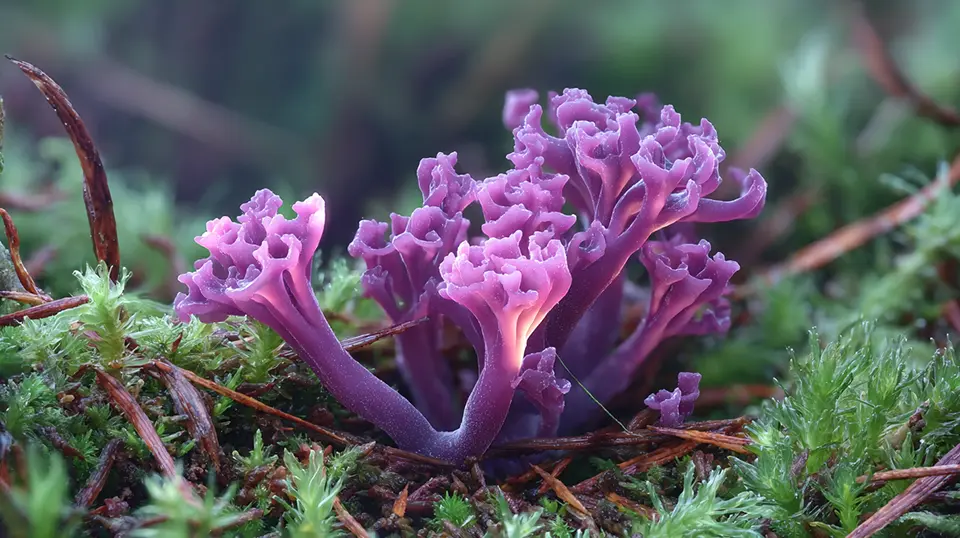
Clavaria zollingeri, known as the Violet Coral fungus, features branching coral-like fronds in shades of violet or magenta, typically reaching 3–10 cm in height. As it ages, its color may fade to grey or brown.
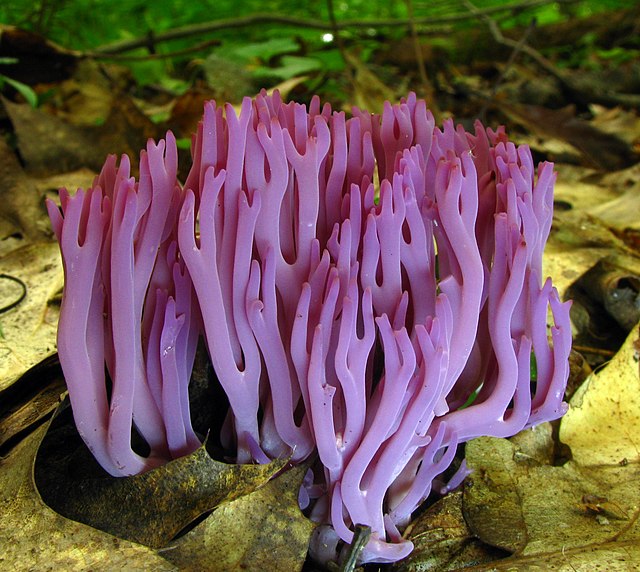
Source: Wikimedia Commons, CC BY-SA 3.0
It is saprotrophic—feeding on decaying organic matter—and is considered inedible.
In the UK, records of C. zollingeri have historically been few. Prior to the citizen survey, only about 183 sites were noted. The addition of 18 new sites greatly expanded known range information.
Because it often occurs in old, unfertilized grasslands—including lawns, meadows, and churchyards—it is highly vulnerable to agricultural intensification and habitat conversion.
Citizen Scientists: The Key to Hidden Discoveries
Many of the newly discovered sites were in private gardens, lawns, cemeteries, and small pastures—areas ordinarily inaccessible to field mycologists. The 2024 survey saw nearly 600 survey submissions, the highest ever in the five years of Waxcap Watch.
Dr. Aileen Baird of Plantlife notes that public interest in fungi is at an all-time high, and the expansion of volunteer surveys is uncovering fungi in places scientists would never reach otherwise.
Clare Blencowe, of the British Mycological Society (BMS), emphasizes that waxcaps are important indicator species—they signal high fungal richness and healthy grassland ecosystems.
Threats to Waxcap Grasslands
The very grasslands that sustain pink waxcaps and violet coral are under siege. Many have been lost or degraded by:
- Agricultural intensification: fertilizer use, reseeding, drainage
- Ploughing and soil disturbance
- Conversion to woodland or tree planting, often without regard to local fungal communities
- Use of fungicides and pesticides
- Urban development replacing lawns and meadows with impervious surfaces
Because waxcaps do poorly under nutrient enrichment or soil disruption, these practices can eliminate fungal populations.
Plantlife and mycologists caution that while tree planting is broadly positive, it must avoid ancient grassland patches—some tree planting inadvertently destroys waxcap habitat.
Conservation Implications & Next Steps
- Data expansion: The new locations for P. calyptriformis and C. zollingeri vastly improve mapping of fungal hotspots, helping conservation planning and habitat protection.
- Habitat identification: Waxcap and violet coral sites often identify remnants of ancient grassland. These sites can be prioritized for conservation.
- Management guidelines: Best practices may include low-intensity grazing, late mowing, avoidance of fertilizers, and careful planning of tree planting.
- Public engagement: Citizen science is proving indispensable. The accessible and colorful nature of waxcaps makes them excellent first targets for volunteer mycology.
- Research opportunities: Further work can examine genetic diversity across new sites, ecological preferences, and fungal community interactions.
My Perspective
Reading about these discoveries reminds me that the most biodiverse places are not always remote wildlands—they often hide in our gardens, cemeteries, and lawns. What looks ordinary may harbor rare life.
The success of Waxcap Watch shows the power of scaling public curiosity: with simple training and coordination, 850 people unearthed hundreds of fungal gems. It’s a reminder that conservation isn’t just top-down—it thrives when everyday people look closer.
Yet urgency must match optimism. Ancient grassland fungi are fragile, and their habitats vanish quietly. In the UK, where waxcap grasslands are already dwindling, these new finds present both opportunity and responsibility: to protect these species and the special ecosystems they signal.
Fungi like Porpolomopsis calyptriformis and Clavaria zollingeri are not just pretty colors in a field—they are sentinels. When they vanish, it signals deeper erosion of ecosystem integrity. The citizen scientists are revealing these signals; now, science and conservation must act to amplify them.
References
- Plantlife. (2024). Waxcap Watch 2024 results.
- International Union for Conservation of Nature (IUCN). (2023). Porpolomopsis calyptriformis assessment.
- British Mycological Society. (2024). Grassland fungi and waxcaps.
According to THE GUARDIAN
Key Takeaways
- Citizen science surveys have documented waxcap fungi (family Hygrophoraceae) in rare pink and purple colourations across grassland and churchyard habitats in the British Isles.
- Waxcaps are internationally recognised as indicator species for ancient, undisturbed grassland ecosystems—their presence signals habitat continuity spanning decades or centuries without chemical fertiliser application.
- The UK holds the majority of the world’s intact waxcap grasslands, placing it among the most important countries globally for this threatened ecological community.
- Modern citizen science platforms (iNaturalist, iRecord) are enabling unprecedented mapping of waxcap distributions, revealing previously unknown populations in unexpected urban and suburban locations.
- Despite their ecological significance, waxcap grasslands receive little statutory protection; most existing sites survive by accident in churchyards, parks, and estate lawns rather than through deliberate conservation.
Frequently Asked Questions
What are waxcap mushrooms and why are they significant?
Waxcaps (family Hygrophoraceae, primarily genus Hygrocybe) are brightly coloured mushrooms found in unfertilised grasslands across Europe and North America. They range in colour from bright red and orange through yellow, pink, purple, and pure white. Their ecological significance lies in their association with ancient, undisturbed soil ecosystems: waxcaps require decades (potentially centuries) of continuous grassland management without ploughing, reseeding, or fertiliser application to establish. They are thus indicators of rare ‘primary’ grassland habitats—places where the soil microbiome remains intact from pre-industrial times.
Why are waxcap grasslands so rare and threatened?
The intensification of agriculture in the 20th century destroyed the vast majority of old unfertilised grasslands across Europe. Ploughing, reseeding with modern grass varieties, and nitrogen fertiliser application all eliminate the conditions waxcaps require. In the UK, an estimated 97% of ancient grassland has been lost since the 1930s. Surviving waxcap grasslands—often on church land, country house estates, or nature reserves managed by traditional methods—represent irreplaceable ecological heritage that cannot be restored on human timescales even if management is improved.
Can waxcap grasslands be restored or created?
The evidence for restoration is not encouraging. Waxcap communities appear to require long-term soil continuity that cannot be recreated by simply stopping fertiliser use on improved grassland. Studies transplanting waxcap-associated soil fungi to new sites have had limited success. The most realistic strategy is protecting existing sites, as even after decades of sympathetic management (no fertilisers, appropriate cutting regimes), restored grasslands rarely develop the rich waxcap communities found in intact ancient sites. This makes the conservation of currently unprotected ancient grasslands extremely time-sensitive.
How can I help map waxcaps in my area?
Citizen scientists can contribute valuable data by recording waxcap sightings on iNaturalist (global) or iRecord (UK). Key identification features include the waxy texture of the gills (feeling like wax or butter), bright colours, and grassland habitat. Many UK waxcap species are identifiable from good photographs. October and November are peak waxcap season in the British Isles. Churchyards, old village greens, hay meadows, and historic parkland are the most likely locations. Local fungal societies (the British Mycological Society in the UK) organise waxcap forays and can assist with challenging identifications.
What makes pink and purple waxcaps particularly rare?
Certain Hygrocybe species with pink and purple colourations—including Hygrocybe calyptriformis (the pink waxcap, one of the most threatened UK species) and Porpolomopsis calyptriformis—are among the rarest waxcap species and are found almost exclusively in the most ancient and undisturbed grassland sites. H. calyptriformis is listed as a Priority Species under the UK Biodiversity Action Plan and is proposed for legal protection under Schedule 8 of the Wildlife and Countryside Act. Its appearance at a site is considered one of the strongest indicators of exceptional grassland ecological value.