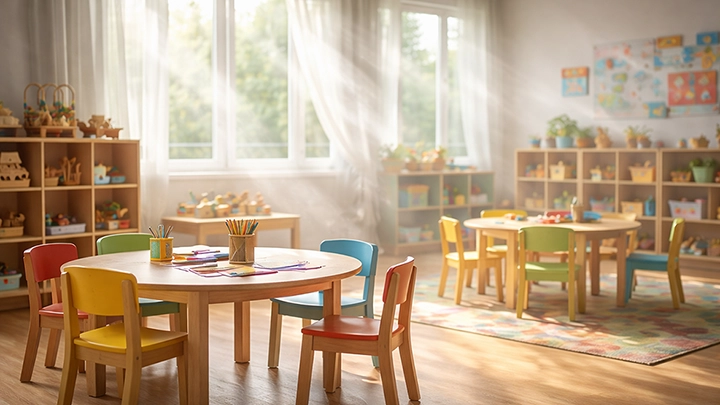

The Smallest Students, the Stagnant Air
Kindergartens are usually imagined as airy, cheerful worlds built for curiosity, yet a recent 2025 Scientific Reportsinvestigation shows that their indoor air can quietly drift toward imbalance. Across 15 Slovenian classrooms monitored throughout the year, researchers documented a recurring pattern: fresh air dwindled, carbon dioxide (CO₂)accumulated, and ventilation fell far short of what young lungs require. No fungal spores were counted, no mold cultures grown, but the environmental signals — elevated carbon dioxide, fine particulates suspended in still air, sealed windows through long winters — traced a familiar path for anyone who studies microbial ecology.

Children breathe quickly, deeply, and without thinking about airflow or architecture. They depend entirely on the building around them to exchange their exhaled air for something cleaner. When a classroom stops breathing, the room becomes a quiet ecosystem shaped by stagnant air and rising humidity — two conditions fungi interpret as an invitation.

The Air Quietly Told Its Story
Across the monitoring campaign, a distinct seasonal rhythm emerged. Winter transformed classrooms into sealed chambers. CO₂ values frequently exceeded the 1000-ppm threshold widely accepted as a sign of insufficient ventilation. Fine particulate matter built up during active play, drifting slowly downward to carpet fibers, toys, and desks. Volatile organic compounds (VOCs) — solvents, cleansers, traces from building materials — layered themselves into the indoor chemical signature.

Mechanical ventilation helped in a minority of classrooms, but most relied on manual window-opening. Once temperatures dropped, windows stayed shut, and air exchange slowed to a crawl. The data painted a consistent picture: these rooms held energy, movement, and warmth, yet hardly any fresh air entered them.
The result was not a dramatic hazard but an accumulation of environmental cues that microbial organisms can read long before humans do.
Mold Risk in the Spaces Between the Data
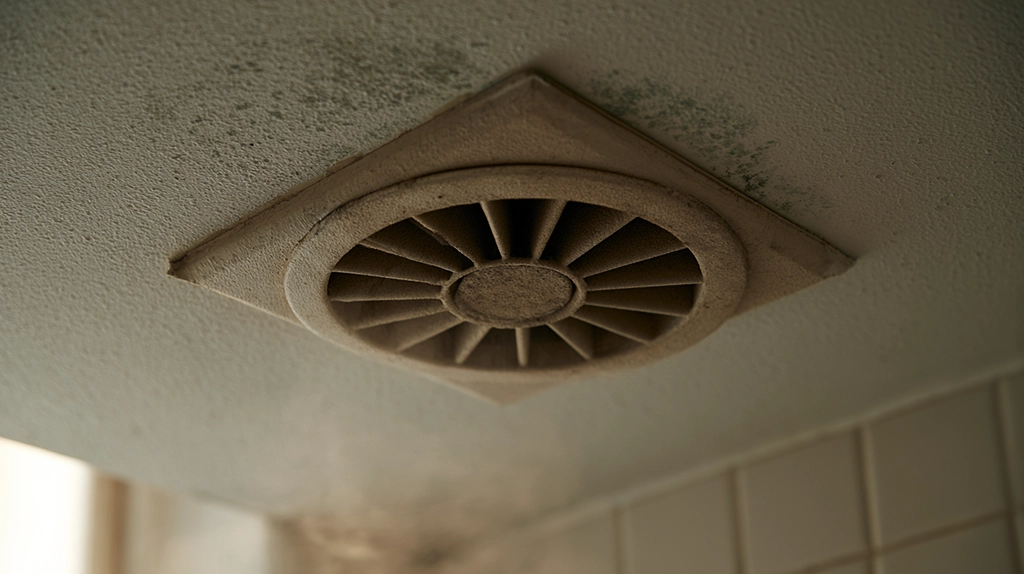
Although fungi were not directly measured, the conditions described in the study reflect the early stages of microbial suitability. Mold does not require visible leaks or standing water. It begins in subtler places: a corner where humidity lingers, the underside of a cabinet that never receives circulation, the fibers of a rug that trap moisture overnight.

When CO₂ rises, it signals that air exchange is limited. Limited air exchange leads to moisture retention, surface cooling, and small pockets where condensation forms. Over days and weeks, these microclimates can nudge dormant spores into metabolic activity. And kindergartens — filled with wood, paper, cloth, and densely occupied play zones — offer countless substrates where moisture can settle.
Children, with higher respiration rates relative to body weight, are more susceptible to airborne allergens, fungal fragments, and mold-derived metabolites. Their health becomes the first indicator of environmental imbalance, long before anyone sees mold itself.
What This Means for Public Health
The study’s findings underscore a larger truth about the relationship between ventilation and microbial ecology. Indoor air is not just a comfort metric; it is an environmental health indicator. Buildings that fail to exchange air also fail to disperse humidity, spores, and metabolic byproducts. For this reason, CO₂ monitoring can act as a real-time proxy for mold risk — a simple, quantifiable signal that the room is not adequately flushing airborne contaminants.

Effective mitigation requires infrastructure, not seasonal improvisation. Ventilation systems must function consistently across all weather patterns. Teachers and facility staff benefit from clear guidelines for interpreting CO₂ readings and understanding when environmental conditions suggest early risk. Prevention begins long before any fungal bloom is visible.
Airflow, in this context, is less a mechanical feature than a protective measure. A classroom that breathes is a classroom that defends.
Kindergartens as Ecological Case Studies
One reason this dataset feels so instructive is that kindergartens magnify environmental processes that most buildings experience more subtly. Their occupancy is dense, their daily rhythms predictable, and their architectural vulnerabilities easy to observe. Within these small ecosystems, changes in humidity, CO₂, and particle levels track almost directly with children’s presence, sleepiness, coughing, and concentration.

Kindergartens reveal how quickly a room transitions from healthy to strained when windows close and air stagnates. They act as microcosms for larger building systems, showing how behavior, climate, and structural design interact to shape microbial suitability. They are not inherently hazardous — but they are transparent. They let us see, without disguise, how mold risk evolves from ordinary habits.
A kindergarten is far more than a learning space; it is an indoor ecosystem shaped by breath, architecture, and the quiet physics of temperature and humidity. When CO₂ climbs and airflow slows, fungi sense opportunity long before humans recognize the warning signs. The Slovenian study reminds us that ventilation should be treated as a cornerstone of public health infrastructure. Protect the air, and you protect the children. Protect the children, and you interrupt the slow, opportunistic spread of mold before it ever becomes visible.
References
Academic Sources
Kolarik, B., et al. (2025). Indoor air quality in Slovenian kindergartens: Seasonal dynamics and ventilation challenges. Scientific Reports.
World Health Organization. (2009). WHO guidelines for indoor air quality: Dampness and mould.
Mendell, M. J., et al. (2011). Respiratory and allergic health effects of dampness, mold, and indoor air. Environmental Health Perspectives.
Official Sources
World Health Organization (WHO) — Indoor air quality and mold guidelines
https://www.who.int/publications
Centers for Disease Control and Prevention (CDC) — Mold and indoor environments
https://www.cdc.gov/mold
United States Environmental Protection Agency (EPA) — Indoor air quality and ventilation
https://www.epa.gov/indoor-air-quality-iaq
Key Takeaways
- Kindergartens are usually imagined as airy, cheerful worlds built for curiosity, yet a recent 2025 Scientific Reportsinvestigation shows that their indoor air can quietly drift toward imbalance.
- Children breathe quickly, deeply, and without thinking about airflow or architecture.
- When a classroom stops breathing, the room becomes a quiet ecosystem shaped by stagnant air and rising humidity — two conditions fungi interpret as an invitation.
- Fine particulate matter built up during active play, drifting slowly downward to carpet fibers, toys, and desks.
- Mechanical ventilation helped in a minority of classrooms, but most relied on manual window-opening.
Frequently Asked Questions
What should you know about the Air Quietly Told Its Story?
Across the monitoring campaign, a distinct seasonal rhythm emerged. Winter transformed classrooms into sealed chambers. CO₂ values frequently exceeded the 1000-ppm threshold widely accepted as a sign of insufficient ventilation. Fine particulate matter built up during active play, drifting slowly do
What should you know about mold Risk in the Spaces Between the Data?
Although fungi were not directly measured, the conditions described in the study reflect the early stages of microbial suitability. Mold does not require visible leaks or standing water. It begins in subtler places: a corner where humidity lingers, the underside of a cabinet that never receives circ
What This Means for Public Health?
The study’s findings underscore a larger truth about the relationship between ventilation and microbial ecology. Indoor air is not just a comfort metric; it is an environmental health indicator. Buildings that fail to exchange air also fail to disperse humidity, spores, and metabolic byproducts. For
What should you know about kindergartens as Ecological Case Studies?
One reason this dataset feels so instructive is that kindergartens magnify environmental processes that most buildings experience more subtly. Their occupancy is dense, their daily rhythms predictable, and their architectural vulnerabilities easy to observe. Within these small ecosystems, changes in
What should you know about academic Sources?
Kolarik, B., et al. (2025). Indoor air quality in Slovenian kindergartens: Seasonal dynamics and ventilation challenges. Scientific Reports.