Few mushrooms carry as much cultural weight as Amanita muscaria. Its red cap and white-spotted surface have become near-universal symbols of the fungal kingdom — appearing in fairy tales, video games, holiday imagery, and children’s media across multiple continents. That familiarity, however, does not reflect the biological reality of the species. Amanita muscaria is a biologically active fungus with genuine toxic and psychoactive properties, and the gap between public perception and scientific understanding has direct public health implications.
The Recognition Gap: Cultural Familiarity as a Risk Factor
Research in mushroom-related poisoning cases consistently identifies misidentification and underestimated risk as primary contributing factors. Amanita muscaria presents a specific variation on this pattern: cultural overexposure creates the impression of a well-understood, manageable species. In practice, widespread recognition in popular media does not translate to accurate toxicological knowledge among general populations. The mushroom’s aesthetic familiarity can lower perceived caution, increasing the likelihood of experimental ingestion or unsupervised interaction — particularly among younger individuals or those seeking psychoactive experiences.
Taxonomy and Chemical Identity
Amanita muscaria belongs to the family Amanitaceae — a group that also includes Amanita phalloides (the death cap), responsible for the majority of fatal mushroom poisonings worldwide. While A. muscaria does not share the amatoxins that make A. phalloides lethal, its chemistry is medically significant in its own right. The primary active compounds are ibotenic acid and muscimol. Ibotenic acid functions as an excitatory neurotoxin acting on glutamate receptors, while muscimol — its principal decarboxylation product — is a potent GABAA receptor agonist. These mechanisms produce neurological effects that are chemically and experientially distinct from psilocybin, and should not be equated with it in either risk profile or pharmacological action.
Ecological Function: Mycorrhizal Networks in Forest Systems
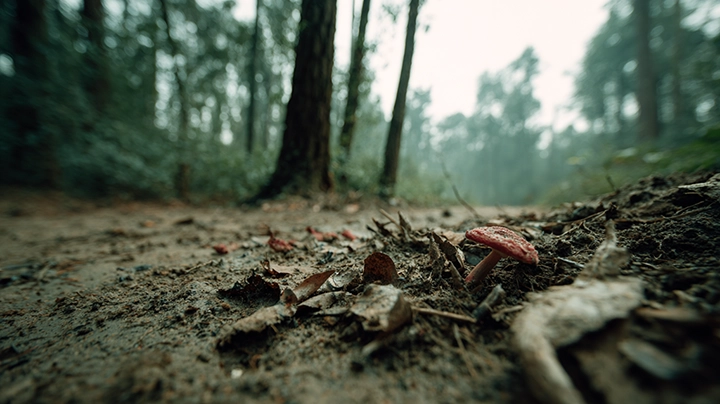
Below its striking exterior, A. muscaria plays a foundational ecological role. It is an ectomycorrhizal fungus, forming obligate symbiotic associations with the root systems of trees including birch, pine, spruce, and fir. Through these mycorrhizal relationships, the fungus transfers water and mineral nutrients — particularly phosphorus — to host trees, receiving photosynthetic sugars in return. The visible fruiting body represents only a fraction of the organism; the bulk exists as a subterranean network of mycelium interwoven with root structures across forest soils.
These associations are not passive. Mycorrhizal networks contribute to forest resilience, seedling survival in nutrient-poor soils, and carbon sequestration dynamics in boreal and temperate ecosystems. A. muscaria is a foundational participant in these processes across Europe, North America, and Asia, and its removal from an ecosystem would have measurable downstream effects on the tree species with which it associates.
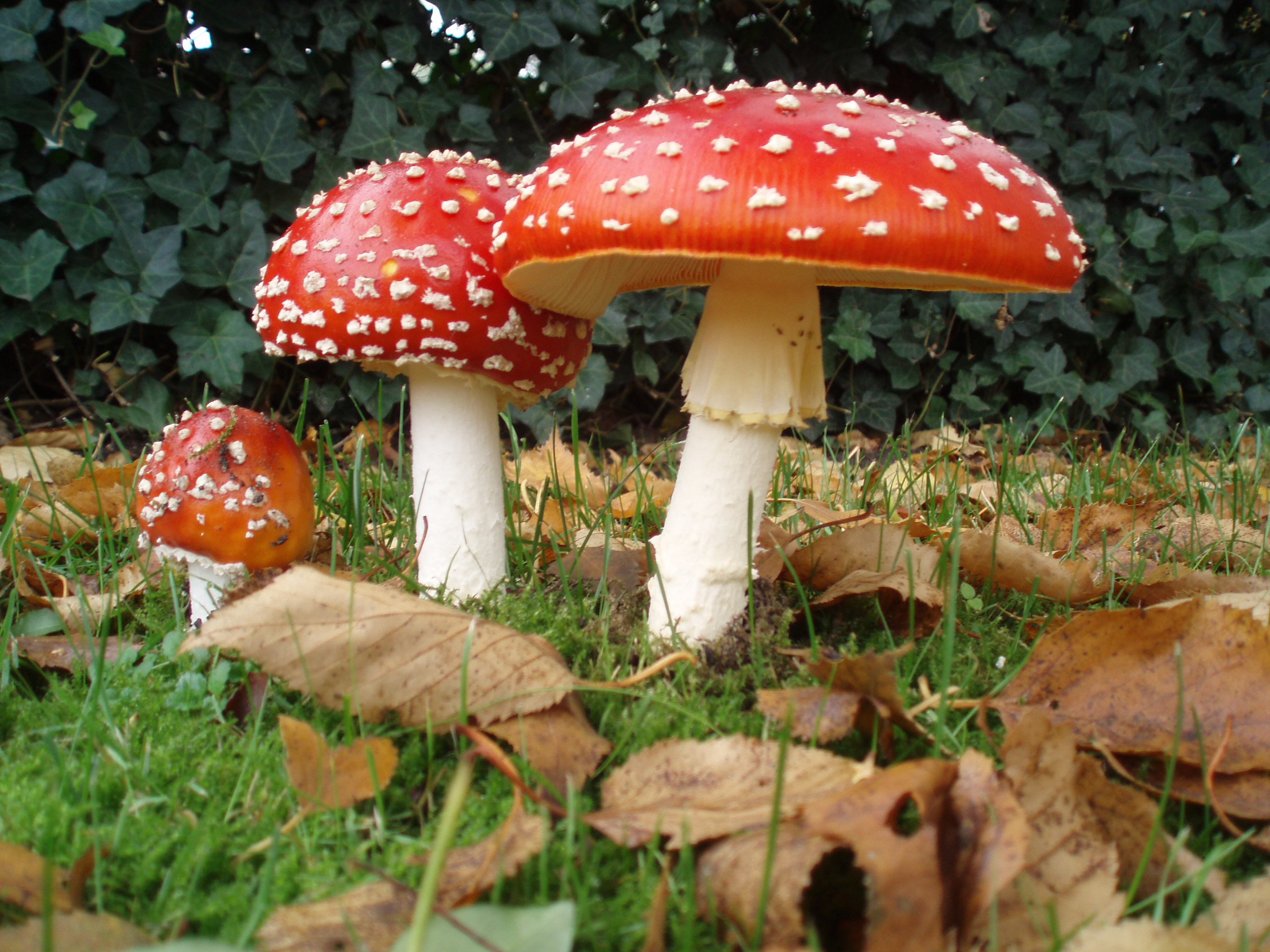
Morphological Variability and the Limits of Visual Identification
Despite its iconic appearance, A. muscaria demonstrates considerable visual variability under field conditions. The white warts that characterize the cap are remnants of the universal veil — a membranous tissue that fully encloses the developing fruiting body. Rain, wind, or physical contact can partially or completely remove these markings, leaving a cap that may not match common illustrations. Cap color varies from classic red to orange or yellow depending on geographic region, sunlight exposure, and specimen age. Juvenile specimens may appear as rounded white forms resembling other Amanita species. These variables make reliable identification from visual appearance alone unreliable, even among experienced foragers.
Toxicological Profile: Symptom Onset, Severity, and Variability
Ingestion of A. muscaria produces what toxicologists classify as pantherina-muscaria syndrome. Symptom onset typically occurs within 30 minutes to two hours of ingestion. The clinical presentation may include nausea, vomiting, dizziness, confusion, agitation, excessive salivation, diaphoresis, drowsiness, and impaired coordination. Severe cases may involve seizures, respiratory depression, or loss of consciousness, though fatality is uncommon in otherwise healthy adults who receive prompt medical attention.
A significant complicating factor is chemical variability. The concentration of ibotenic acid and muscimol within a given specimen varies substantially based on geographic origin, substrate conditions, season of collection, age at harvest, and post-harvest processing. Drying is known to accelerate the decarboxylation of ibotenic acid to muscimol, altering effective potency in ways that cannot be determined without laboratory analysis. This variability makes predictable dosing practically impossible, even for individuals with prior exposure to the species.
Commercial Products and the Regulatory Gap
A growing market has emerged around A. muscaria-derived products — gummies, chocolates, tinctures, and capsules marketed as “legal mushroom” alternatives, mushroom nootropics, or wellness supplements. These products frequently reference muscimol or Amanita muscaria extract in their labeling. The commercial appeal is partly driven by regulatory status: unlike psilocybin, muscimol is not currently a Schedule I controlled substance under US federal law, creating a gap that has allowed a range of products to reach retail channels.
The FDA has stated that A. muscaria and its constituents are not approved food ingredients or dietary supplement components. Independent testing of commercial products has identified inconsistent potency, undisclosed additives, and significant discrepancies between labeled and actual compound content. Consumers who encounter these products in familiar food formats may systematically underestimate both the variability and the effective doses involved.

Risk by Behavior: A Practical Assessment
The risk profile of A. muscaria is substantially behavior-dependent. Ibotenic acid and muscimol are not meaningfully absorbed through intact skin, meaning that observation, photography, and incidental contact carry minimal risk. Ingestion — whether intentional or accidental — is the primary exposure pathway of concern. Populations at elevated risk include children, who may be attracted to the mushroom’s visual presentation; pets, particularly dogs that may consume mushrooms encountered outdoors; and adults seeking psychoactive experiences who may underestimate the challenge of managing chemical variability without standardized dosing information. Misidentification risk also applies in areas where foraging is practiced, as juvenile A. muscaria can resemble several other species at certain developmental stages.
The Broader Amanita Context: Related Species of Concern
Situating A. muscaria within its genus provides important comparative context. The Amanita family spans a wide range of toxicity profiles, and the shared genus name does not imply equivalent risk:
- Amanita phalloides (death cap) — contains amatoxins; responsible for the majority of fatal mushroom poisonings globally
- Amanita virosa (destroying angel) — similarly lethal amatoxin chemistry
- Amanita bisporigera (eastern destroying angel) — highly toxic, commonly mistaken for edible species in North America
- Amanita pantherina (panther cap) — shares ibotenic acid/muscimol chemistry with A. muscaria, considered to produce more severe effects at equivalent doses
- Amanita citrina — resembles more dangerous species; generally considered non-toxic but not recommended for consumption
Public Awareness at the Intersection of Culture and Science
Amanita muscaria occupies an unusual position in public consciousness: it is simultaneously one of the most culturally visible and scientifically misunderstood fungi in the world. Its image promotes familiarity while its biology demands caution. The challenge for public health communication is not to eliminate curiosity about the species — its ecological role, chemical properties, and cultural history are genuinely compelling — but to ensure that awareness is calibrated to accurate risk information rather than aesthetic familiarity or market-driven wellness framing. As commercial interest in A. muscaria-derived products continues to grow, the gap between perception and evidence becomes a more pressing concern.
Frequently Asked Questions
Is Amanita muscaria deadly like other Amanita mushrooms?
It is generally not lethal at typical ingested doses, unlike species such as A. phalloides. However, it is toxic and capable of causing significant neurological and gastrointestinal effects that may require medical intervention. Severe cases have been documented, particularly involving children or large ingested quantities.
Is it the same as psilocybin mushrooms?
No. Psilocybin-containing mushrooms act primarily on serotonin receptors (5-HT2A). A. muscaria’s active compounds — ibotenic acid and muscimol — act on glutamate and GABA receptors respectively. The subjective effects, pharmacological mechanisms, risk profiles, and regulatory classifications differ substantially between these categories.
Can it be consumed safely with proper preparation?
Preparation methods such as drying or parboiling can reduce ibotenic acid content. However, chemical variability between specimens means predictable dosing is not achievable without laboratory analysis of specific batches. Consumption is not recommended based on available evidence.
Are commercial muscimol products safe?
A. muscaria and its constituents are not FDA-approved food ingredients. Independent testing has identified inconsistent potency and labeling inaccuracies across commercial products. Consumers should apply the same scrutiny as to any unregulated substance, including consideration of undisclosed ingredients and variable dosing.
Is it safe to touch or photograph?
Yes. The primary toxic compounds are not significantly absorbed through intact skin. Observation and photography present negligible risk. Ingestion remains the primary exposure pathway of concern.