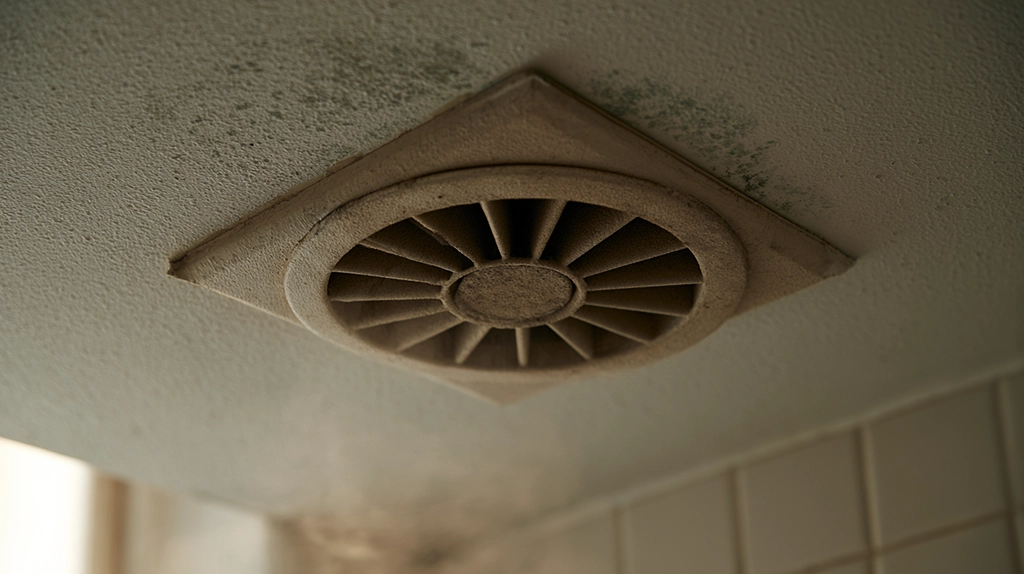

When mold appears indoors, cleaning habits are often blamed first. Dust, maintenance, or daily use become the focus. Yet in many documented cases, mold develops in spaces that appear clean, well managed, and orderly.
The issue is rarely cleanliness.
It is far more often about how air moves and whether moisture is effectively removed.

Mold is driven by moisture, not dirt
Mold does not require visible dirt to grow. What it needs is moisture that remains available long enough. Reviews examining indoor mold occurrence consistently show that persistent dampness and high relative humidity, rather than surface cleanliness, are the primary drivers of fungal growth. This has been clearly described in a comprehensive ScienceDirect review on moisture-related mold growth in buildings.
In indoor environments, moisture originates from many routine activities, including human respiration, cleaning, cooking, and equipment operation. When this moisture is not removed efficiently, it accumulates in places where air movement is weakest.

Why modern buildings tend to trap moisture
Contemporary buildings are increasingly airtight. This design approach improves energy efficiency, but it also reduces unintended air leakage that once helped remove indoor moisture.
As a result, moisture generated indoors depends heavily on intentional ventilation pathways to exit the building. When those pathways are insufficient or poorly distributed, moisture migrates toward colder surfaces, such as wall cavities, window frames, ceilings, and structural junctions. Condensation forms, often out of sight.
These hidden zones provide stable, undisturbed conditions that favor mold establishment.

Ventilation is not the same as air conditioning
A common misconception is that air conditioning ensures good indoor air conditions. In practice, air conditioning primarily controls temperature. While it may reduce overall humidity, it does not necessarily remove moisture from the building envelope.
If supply air, return air, and exhaust air are not properly balanced, indoor air may circulate repeatedly within the same zone. Moisture is cooled but not expelled. The result is a space that feels comfortable at the surface, while concealed areas remain damp.
This distinction between cooling and ventilation is emphasized in the ASHRAE position document on limiting indoor mold and dampness in buildings, which identifies moisture control through ventilation as a core design responsibility rather than a maintenance issue.

Air movement can slow mold development
Experimental studies on building materials have demonstrated that airflow plays a measurable role in mold behavior. Research examining the influence of air velocity on mold growth on construction materials shows that increased air movement reduces surface moisture availability and delays fungal colonization, even when humidity remains relatively high. These findings are reported in a recent ScienceDirect study on airflow and material surface mold development.
This does not mean ventilation eliminates risk entirely, but it does alter the conditions mold depends on, often slowing growth enough to prevent establishment.
Where mold often starts is not where it is first seen
Mold rarely begins on exposed, frequently cleaned surfaces. It typically develops in areas with minimal airflow, such as behind partitions, above ceilings, inside wall cavities, and near HVAC components.
Once established, spores are released and transported by indoor air currents. By the time visible mold appears in occupied areas, the underlying moisture problem has often existed for an extended period.
Ventilation improvements produce measurable results
Field studies in occupied buildings support this pattern. In educational facilities, where ventilation systems were evaluated and improved, researchers observed clear reductions in indoor humidity and mold-related indicators following ventilation optimization. One such analysis is detailed in a Springer study on ventilation performance and mold risk in school buildings.
These outcomes highlight that ventilation design and operation can influence mold risk in measurable, not merely theoretical, ways.
Materials respond differently to the same environment
Not all building materials react to moisture in the same way. Their surface properties, moisture absorption behavior, and drying rates influence how easily mold can colonize them.
Experimental work on common building materials under controlled humidity conditions shows that material type strongly affects mold growth potential, even when environmental exposure is similar. This relationship is documented in Taiwan-based experimental studies on mold growth behavior of building materials.
This helps explain why mold often appears selectively rather than uniformly across indoor surfaces.
Mold as an indicator, not a cause
Mold is rarely the root cause of indoor environmental problems. More often, it signals a breakdown in moisture management and air movement.
From a building science perspective, mold reflects how ventilation design, material selection, and environmental conditions interact over time. It does not emerge because a space is poorly cleaned, but because moisture remains where air does not reach.
When air stops moving, mold finds time to grow.
References
Academic Sources
- Pietrzyk, K., & Strąk, M. (2015). A systemic approach to moisture problems in buildings for mold prevention. Building and Environment, 86, 11–20. https://doi.org/10.1016/j.buildenv.2014.12.016
- Zhang, H., et al. (2024). A study of the inhibitory effect and mechanism of airflow on mould growth on wet building materials. Building Engineering, 2024.
- Menneer, T., et al. (2022). Modelling mould growth in domestic environments using moisture-related indicators. Building and Environment, 2022. https://www.sciencedirect.com/science/article/pii/S0360132321009756
Official Sources
- ASHRAE. (2021). Limiting Indoor Mold and Dampness in Buildings (Position Document).
https://www.ashrae.org/file%20library/about/position%20documents/pd-on-limiting-indoor-mold-and-dampness-in-buildings-english.pdf - U.S. Environmental Protection Agency (EPA). (2008). Moisture Control Guidance for Building Design, Construction and Maintenance.
https://www.epa.gov/sites/default/files/2014-08/documents/moisture-control.pdf
Key Takeaways
- When mold appears indoors, cleaning habits are often blamed first.
- It is far more often about how air moves and whether moisture is effectively removed.
- When this moisture is not removed efficiently, it accumulates in places where air movement is weakest.
- A common misconception is that air conditioning ensures good indoor air conditions.
- Mold rarely begins on exposed, frequently cleaned surfaces.
Frequently Asked Questions
What should you know about mold is driven by moisture, not dirt?
Mold does not require visible dirt to grow. What it needs is moisture that remains available long enough. Reviews examining indoor mold occurrence consistently show that persistent dampness and high relative humidity, rather than surface cleanliness, are the primary drivers of fungal growth. This ha
Why modern buildings tend to trap moisture?
Contemporary buildings are increasingly airtight. This design approach improves energy efficiency, but it also reduces unintended air leakage that once helped remove indoor moisture.As a result, moisture generated indoors depends heavily on intentional ventilation pathways to exit the building. When
What should you know about ventilation is not the same as air conditioning?
A common misconception is that air conditioning ensures good indoor air conditions. In practice, air conditioning primarily controls temperature. While it may reduce overall humidity, it does not necessarily remove moisture from the building envelope.If supply air, return air, and exhaust air are no
What should you know about air movement can slow mold development?
Experimental studies on building materials have demonstrated that airflow plays a measurable role in mold behavior. Research examining the influence of air velocity on mold growth on construction materials shows that increased air movement reduces surface moisture availability and delays fungal colo
Where mold often starts is not where it is first seen?
Mold rarely begins on exposed, frequently cleaned surfaces. It typically develops in areas with minimal airflow, such as behind partitions, above ceilings, inside wall cavities, and near HVAC components.Once established, spores are released and transported by indoor air currents. By the time visible