
Most homeowners discover attic mold by accident — during a home inspection, a roof repair, or a rare trip up to retrieve stored items. The reaction is usually the same: surprise, followed by the assumption that something went wrong with the roof.
The roof is rarely the problem.
Attic mold is one of the most consistently misdiagnosed mold problems in residential buildings — not because it’s rare, but because its causes are invisible. The mold is on the wood. The problem is in the air.
Why the Attic Is Vulnerable
An attic is not designed to be a living space. It is designed to be a cold, dry buffer zone between the conditioned interior of a building and the exterior environment. When it functions correctly, outside air moves through continuously, humidity stays low, and wood surfaces remain dry.
When it doesn’t function correctly — when air movement is inadequate, when warm interior air finds a path in, when exhaust systems terminate in the wrong place — conditions shift. Wood surfaces that should be dry become repeatedly damp. And wood is exactly what mold needs: an organic substrate that holds moisture and provides nutrition.
The mold itself is doing what mold does. The question is always why the conditions allowed it to establish.
The Core Physics: Condensation on Cold Surfaces
The primary mechanism of attic mold is condensation. Warm indoor air — produced continuously by occupant activities, cooking, bathing, even breathing — rises through a building and carries moisture with it. In a well-sealed, well-insulated ceiling, most of this air stays in the living space. In most real buildings, some of it doesn’t.
When warm, moisture-laden air enters the attic and contacts the colder surfaces of the roof sheathing or rafters, it reaches its dew point and deposits moisture on those surfaces. A single condensation event is inconsequential. Repeated condensation over days and weeks — particularly during cold seasons when the temperature differential between interior air and roof sheathing is greatest — creates persistently damp conditions on structural wood.
Mold colonizes wood at moisture content levels above approximately 19 percent. Condensation-driven wetting can reach and sustain those levels without any visible leak, without any rain intrusion, without any obvious external cause. The building’s own air is delivering the water.
Ventilation: The First Line of Failure
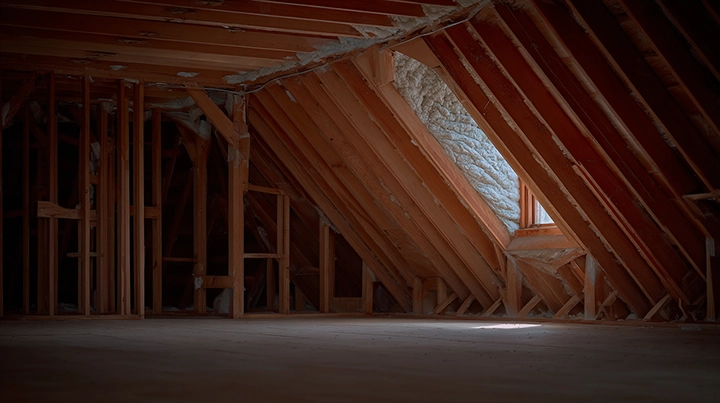
Proper attic ventilation is the primary defense against moisture accumulation. The system is straightforward in principle: outdoor air enters through soffit vents at the eaves, rises as it warms, and exits through ridge vents at the peak. This continuous air exchange carries moisture out before it can condense in damaging quantities.
When this system fails, the consequences accumulate slowly and invisibly. Blocked soffit vents — often obstructed by insulation that has been pushed too far toward the eaves — restrict intake. Insufficient ridge venting limits exhaust. Poorly designed airflow paths create stagnant zones where air movement is negligible.
In these conditions, moisture-laden air that enters the attic has nowhere to go. Humidity rises. Surfaces remain damp longer after each condensation event. The threshold for mold growth is reached and maintained.
What makes this particularly problematic is that the failure is invisible from below. The ceiling looks normal. The living space feels fine. The mold develops in darkness, on the underside of roof sheathing, where it may go undetected for months or years.

Air Leakage: The Invisible Moisture Pipeline
Ventilation failure explains why moisture can’t leave. Air leakage explains how it gets in.
Ceilings are not airtight. Light fixture housings, attic hatch frames, plumbing and electrical penetrations, and structural gaps at the ceiling-wall junction all create pathways through which interior air can move into the attic space. This process is driven by the stack effect — the physical tendency of warm air to rise and push toward any available opening.
The result is a continuous, low-level flow of interior air into the attic. Each cubic foot of air that enters carries moisture from the living space into a cold environment. Over a heating season, the cumulative moisture load from air leakage can be substantial — far exceeding what a reasonable ventilation system can handle if the leakage points are significant.
The insidious aspect of this mechanism is that it requires nothing to go wrong in an obvious sense. A home can have a perfectly functional roof, no plumbing leaks, no flooding, and still develop attic mold from nothing more than the normal stack effect operating through normal construction gaps.
Exhaust Misrouting: Active Moisture Injection
Air leakage is passive — a slow seepage driven by temperature differentials. Improperly terminated exhaust systems are something more concentrated and damaging.
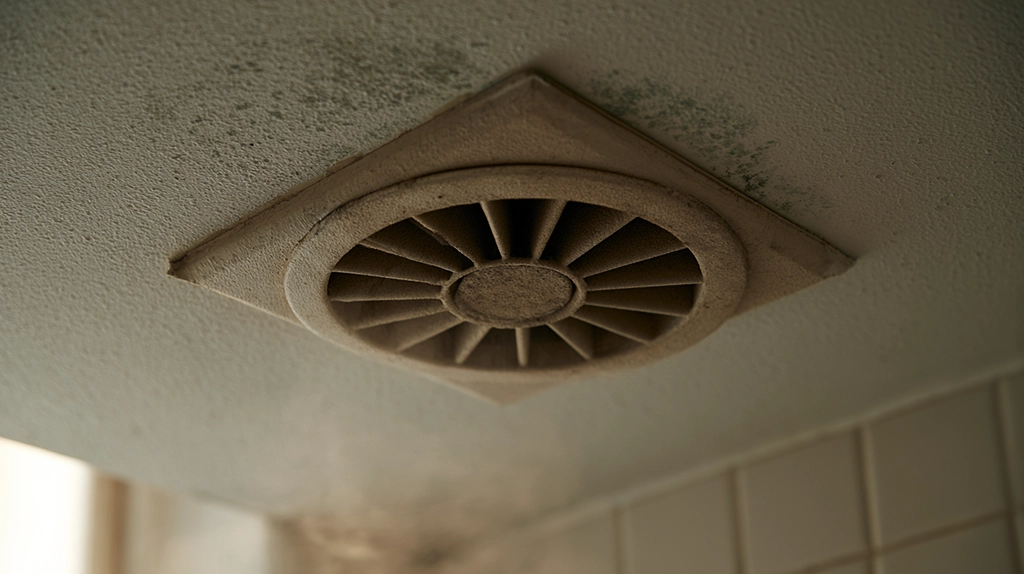
Bathroom and kitchen exhaust fans exist to remove humid air from the home. They are designed to vent directly to the exterior. When they terminate inside the attic — a common installation error that was more prevalent before building codes tightened — they deliver a concentrated stream of warm, moist air into a cold, enclosed space.
The condensation that results is not subtle. Visible frost or ice formation on roof sheathing near duct outlets during cold weather is a documented consequence. Localized mold growth around termination points is characteristic. Unlike the diffuse condensation from air leakage, exhaust misrouting creates a point source of moisture that accelerates mold formation dramatically in the immediate area.
Insulation: Cold Spots and Localized Risk
Insulation failures contribute to attic mold through a different mechanism: by creating cold spots that function as preferential condensation surfaces.
In a well-insulated attic, the ceiling below is kept warm, and the temperature differential between the living space and the roof sheathing is managed by the insulation layer. When insulation is absent in areas, compressed by stored items, or improperly installed at the eaves where it matters most, localized zones of the ceiling become colder than they should be.
These cold spots attract condensation more readily than adequately insulated areas. Over time, they develop damp conditions and mold growth in patterns that mirror the insulation deficiencies — a diagnostic signature that trained inspectors can use to identify the underlying cause.

Why Roof Leaks Are the Wrong Starting Assumption
The default assumption when attic mold is found is that the roof is leaking. This assumption leads to inspections that find no evidence of water intrusion — and conclusions that the inspector must have missed something, or that the mold appeared spontaneously.
Roof leaks can and do cause attic mold, but they are not the most common cause. Condensation-driven mold can develop extensively in attics with perfectly intact roofs. The diagnostic signature is different: roof leak damage tends to be localized near penetrations and follows water staining patterns, while condensation damage tends to be distributed across roof sheathing in patterns that correlate with ventilation and air leakage rather than with exterior water entry points.
Misdiagnosing condensation as a leak leads to roof repairs that don’t address the actual problem. The mold returns, the homeowner concludes the repair was inadequate, and the cycle repeats — while the ventilation and air sealing issues that caused the mold continue unchanged.
The System Perspective
Attic mold is not a single-cause problem. It results from the interaction of moisture load, temperature differential, air movement, and ventilation capacity — all operating simultaneously within a building that is itself a system of interconnected components.
This has a practical implication for remediation. Cleaning visible mold from roof sheathing removes the current growth but does nothing to alter the conditions that produced it. Without correcting ventilation, sealing air leakage pathways, rerouting exhaust fans, and addressing insulation deficiencies, mold will recolonize the same surfaces.
Effective response begins with diagnosis — understanding which combination of factors is driving the moisture accumulation in a specific attic. The cleaning comes after. The structural correction is the intervention that matters.
FAQ
What is the most common cause of mold in attics? Inadequate ventilation combined with warm interior air entering through ceiling leakage is the most frequent cause. The two factors typically operate together, with ventilation failure preventing the moisture from being removed once it enters.
Can attic mold occur without a roof leak? Yes, and this is more common than leak-driven mold. Condensation from interior air leakage produces attic mold in buildings with perfectly intact roofs.
Why does bathroom exhaust cause attic mold? When exhaust fans terminate inside the attic rather than venting to the exterior, they release concentrated streams of warm, moist air into a cold space. The condensation that results is immediate and localized.
Does insulation affect mold risk in attics? Yes. Insulation gaps and compressions create cold zones that attract condensation disproportionately. Mold growth often traces the pattern of insulation deficiency.
Can attic mold be permanently removed? Only if the underlying causes are corrected. Surface cleaning without addressing ventilation, air sealing, and exhaust routing will result in recurrence.
References
- MoldSci — Attic Mold: Common Causes and Cures: https://www.moldsci.com/blog/posts/attic-mold-common-causes-and-cures
Key Takeaways
- Most homeowners discover attic mold by accident — during a home inspection, a roof repair, or a rare trip up to retrieve stored items.
- Attic mold is one of the most consistently misdiagnosed mold problems in residential buildings — not because it’s rare, but because its causes are invisible.
- When it functions correctly, outside air moves through continuously, humidity stays low, and wood surfaces remain dry.
- And wood is exactly what mold needs: an organic substrate that holds moisture and provides nutrition.
- Warm indoor air — produced continuously by occupant activities, cooking, bathing, even breathing — rises through a building and carries moisture with it.
Frequently Asked Questions
Why the Attic Is Vulnerable?
An attic is not designed to be a living space. It is designed to be a cold, dry buffer zone between the conditioned interior of a building and the exterior environment. When it functions correctly, outside air moves through continuously, humidity stays low, and wood surfaces remain dry.
What should you know about the Core Physics: Condensation on Cold Surfaces?
The primary mechanism of attic mold is condensation. Warm indoor air — produced continuously by occupant activities, cooking, bathing, even breathing — rises through a building and carries moisture with it. In a well-sealed, well-insulated ceiling, most of this air stays in the living space. In most
What should you know about ventilation: The First Line of Failure?
Proper attic ventilation is the primary defense against moisture accumulation. The system is straightforward in principle: outdoor air enters through soffit vents at the eaves, rises as it warms, and exits through ridge vents at the peak. This continuous air exchange carries moisture out b
What should you know about air Leakage: The Invisible Moisture Pipeline?
Ventilation failure explains why moisture can’t leave. Air leakage explains how it gets in.
What should you know about exhaust Misrouting: Active Moisture Injection?
Air leakage is passive — a slow seepage driven by temperature differentials. Improperly terminated exhaust systems are something more concentrated and damaging.