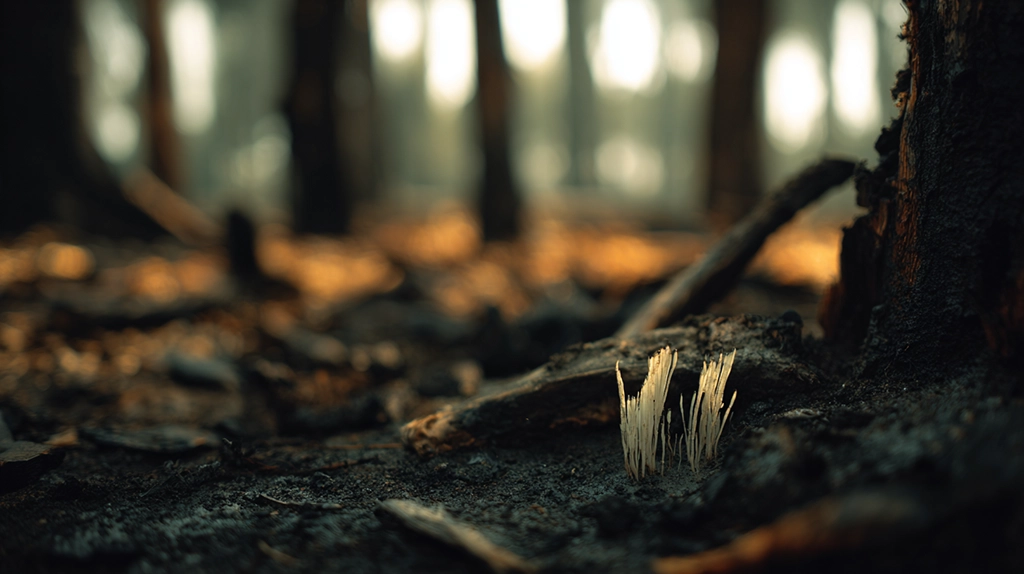
Wildfire leaves a visible record of what it destroys. Burned trees. Blackened soil. A landscape stripped of color and shelter. But the most consequential damage may be happening somewhere else entirely — beneath the surface, in a living web of fungi, bacteria, and organic matter that keeps ecosystems running long before and long after any fire passes through.
A global study analyzing more than 2,600 microbial sequencing samples from 19 research projects found that fire doesn’t simply kill soil organisms or alter their growing conditions. It also disrupts the movement that allows those organisms to return. And for fungi in particular, that loss of mobility may quietly shape the trajectory of everything that grows back above the ground.
Soil Is Not Just Dirt
Most people who walk a burned landscape see dirt. What they’re actually walking on is one of Earth’s most complex biological systems — a network of fungi, bacteria, plant roots, organic matter, and minerals in continuous interaction. This living infrastructure regulates decomposition, nutrient cycling, soil structure, and plant regeneration. Alter it, and you alter everything that grows from it.
Fungi are central to that network. They break down organic material, including the charred residue that fire leaves behind. They form mycorrhizal partnerships with plant roots, extending the reach of root systems and helping plants access water and nutrients in ways they could not manage alone. They influence soil aggregation, carbon storage, and disease suppression. Remove fungi, and you don’t just lose one component. You weaken an entire operating system.
Fire as a Wall, Not Just a Force
For decades, fire ecology focused on what fire does to the growing environment — soil temperature, moisture, pH, and nutrient content. Under this model, recovery depended on how quickly conditions improved enough for surviving microorganisms to thrive. That process still matters. But this study introduces a second mechanism that operates alongside it: dispersal limitation.
Dispersal is how living things move across landscapes. Plants send seeds. Fungi move through air currents, water, soil particles, plant roots, and organic debris. After disturbance, dispersal is how biological diversity refills a damaged ecosystem. But fire doesn’t just alter what organisms remain. It reduces how effectively organisms can move back into burned areas. Even if conditions improve, the organisms needed to rebuild may never arrive in sufficient variety.
In this light, fire becomes something more than a destructive event. It becomes a wall — one that separates surviving biological communities from the places that need them most.

When Chance Takes Over
Among the findings, one pattern stood out specifically for fungi: increased ecological drift. Ecological drift is what happens when the predictable forces that shape a community weaken, and chance becomes the dominant influence. Normally, fungal communities in similar environments develop in similar directions — certain species establish, form relationships, and support specific ecological functions. The system follows a logic.
After fire, that logic loosens. Fungal recovery becomes more random. Two burned sites with nearly identical soil conditions may develop entirely different fungal communities simply because different organisms happened to arrive, or didn’t. One site might recover a rich network of mycorrhizal fungi. Another might not. Neither outcome was guaranteed. Both were shaped by chance.
That randomness matters because fungal communities are not interchangeable. Different species do different things. Some decompose woody material. Others partner with specific plants. Some affect nutrient cycling, soil aggregation, and disease resistance. When fungal recovery becomes random, the functions that depend on specific organisms become uncertain too.
A Narrower Web Below Ground
Fire can also reduce fungal diversity and evenness — the range of species present and the balance between them. In their place, a smaller number of fire-adapted or disturbance-tolerant organisms may dominate, reshaping the fungal landscape without restoring it.
The result is a simpler ecosystem underground. And in ecology, simplicity often means fragility. A diverse fungal community gives an ecosystem options — when conditions shift, multiple species may be capable of maintaining essential functions. When diversity narrows, those options narrow too. Reduced fungal diversity can slow plant recovery, alter how nutrients and carbon are cycled, and leave the system more vulnerable to future disturbance. The visible forest may begin to green. But the network supporting it may be thinner than it appears.
The Gap Between Green and Recovered
This may be the most practical implication of the research: a burned landscape can look recovered before it actually is. Plants are visible. Fungi are not. Restoration is often measured by vegetation cover, tree survival, and erosion reduction — all meaningful, all visible. But they are surface indicators measuring a surface story.
Fungi work underground to support plant roots, process organic matter, and stabilize soil structure. If fungal recolonization is delayed or incomplete, the plant recovery visible above may be more fragile than it looks. Plants growing in depleted fungal soils may be more stressed, less capable of reproducing, and more vulnerable to drought or secondary disturbance. The visible green doesn’t confirm that the system beneath it has returned.
When Fires Come Too Close Together
The research takes on additional urgency in a warming world. Climate change is lengthening fire seasons, expanding burned areas, and compressing the intervals between disturbances. Fungal communities need time to recover. If fires return faster than soil microbiomes can rebuild, the damage becomes cumulative.
Each subsequent fire doesn’t simply restart the recovery clock. It may begin from a more depleted baseline — fewer species, weaker networks, reduced dispersal capacity. Over decades, repeated disturbance could gradually simplify fungal diversity across entire landscapes, not through a single catastrophic event, but through layered, overlapping disruptions that never fully resolve.
What Restoration Gets Wrong
Post-fire restoration has long prioritized what can be seen and measured: plant cover, erosion control, tree replanting, soil stabilization. These remain essential. But if fire limits microbial dispersal, then restoration frameworks may need to expand to address what happens below the ground.
Unburned patches adjacent to burned areas may be critical microbial reservoirs — places from which fungi and bacteria can gradually recolonize. Vegetation corridors, slope conditions, rainfall patterns, and fire severity all influence whether that recolonization can happen. Restoration planning that ignores these pathways may produce landscapes that look healthy while remaining biologically incomplete underground.
This doesn’t require inoculating every burned field with laboratory fungi. But it does mean recognizing soil fungi as part of the recovery infrastructure — not invisible afterthoughts, but essential components of resilience that need the same intentional consideration given to what grows above them.
The Fungi That Follow Fire
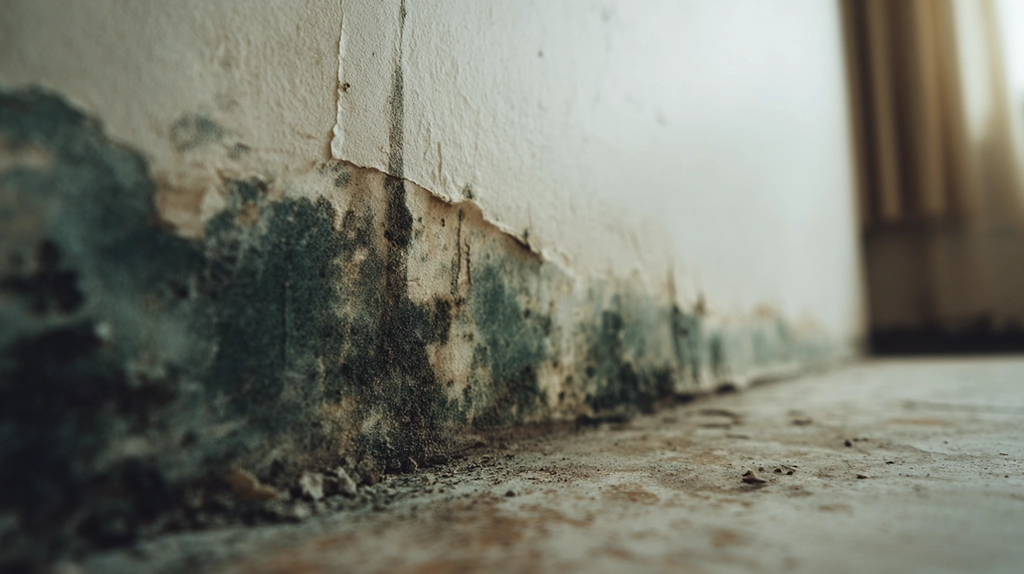
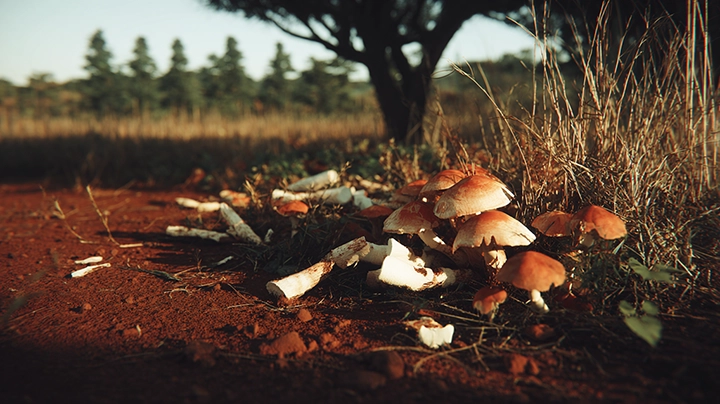
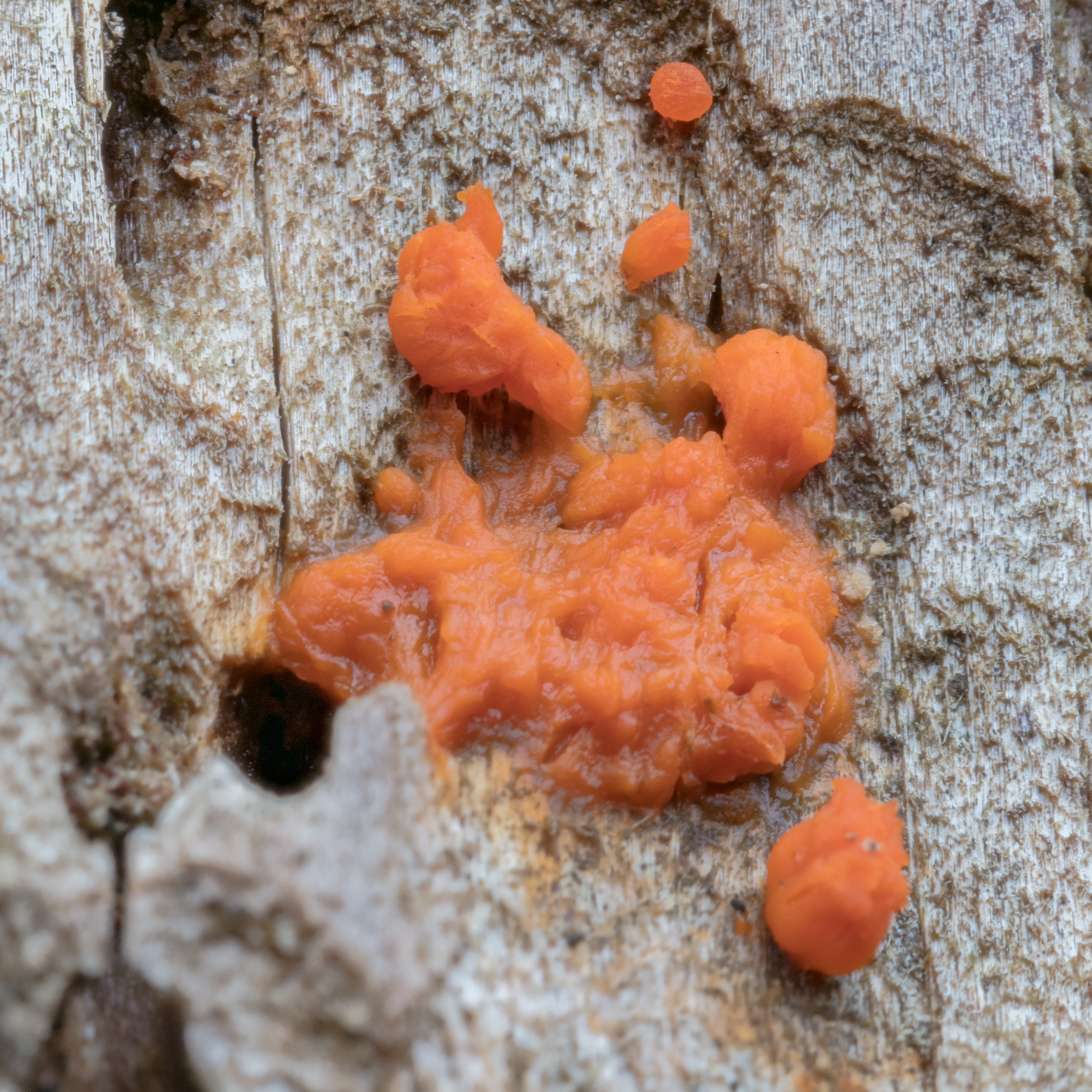
Not every fungus suffers after fire. A small group of species are adapted specifically to burned, disturbed, or charred environments. Pyronema domesticum and Pyronema omphalodes are pyrophilous fungi — organisms that actively favor burned ground. They appear in the first weeks and months after fire, colonizing ash and char before other fungi can establish. Their presence is visually striking and ecologically telling.
Aspergillus fumigatus, Penicillium chrysogenum, and Trichoderma harzianum may also be found in post-disturbance soils, taking advantage of reduced competition and altered conditions. These are not indicators of full recovery. They are opportunists — early arrivals in a simplified landscape, occupying space that a richer, more diverse fungal community would once have claimed. Their presence marks not where the ecosystem is going, but where the more complex system that burned used to be.
FAQ: Wildfire, Soil Fungi, and Microbial Recovery
How does wildfire affect soil fungi?
Wildfire can reduce fungal diversity, alter community composition, and limit the dispersal of fungi into burned areas. This may slow soil recovery and make fungal communities less predictable and stable after disturbance.
What is microbial dispersal and why does it matter after fire?
Microbial dispersal is the movement of microorganisms across environments — through air, water, soil particles, and plant roots. After fire, dispersal is how soil communities rebuild. If fire blocks dispersal pathways, recovery may be slower and more uneven than environmental conditions alone would suggest.
What is ecological drift in fungal communities?
Ecological drift is random change in community composition. After fire, fungal recovery may be more influenced by chance, meaning two similarly burned sites can develop different fungal communities regardless of their environmental conditions.
Can an ecosystem look recovered while still being ecologically incomplete underground?
Yes. Vegetation may regrow before the soil fungal network has fully recovered. Plants growing without adequate fungal partners may be more fragile, less productive, and more vulnerable to future stress, even when they appear healthy from above.
Why does increasing wildfire frequency make this problem worse?
Fungal communities require time to recover between disturbances. More frequent fires reduce that recovery window, allowing damage to compound. Each new fire may start from a more depleted microbial baseline, gradually reducing diversity across landscapes over time.
References
Krah, F.S. et al. (2025). Fire limits soil microbial dispersal and differentially impacts bacterial and fungal communities. ResearchGate. https://doi.org/10.1101/2025.04.14.648664