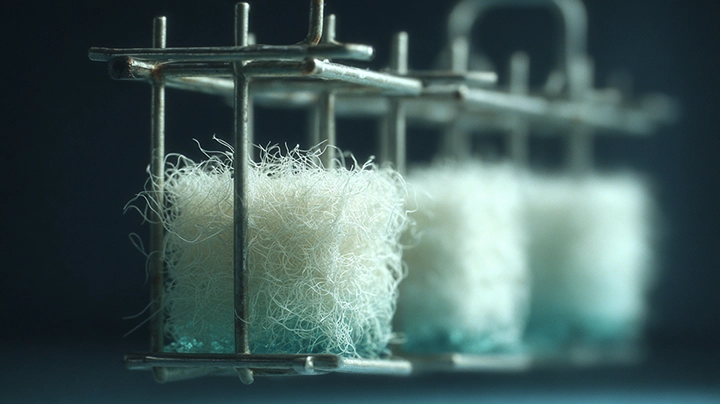

Mycoponics is a fungal cultivation method that replaces solid growth substrates with engineered ceramic scaffolds and circulating liquid nutrients. A study published in Biotechnology Journal describes a system where microporous ceramics provide physical structure while nutrient-rich liquid delivers inputs directly to growing mycelium. The result is a production environment that is less agricultural and more analogous to industrial bioprocessing.
From Cultivation to Control: A Structural Shift in Fungal Production
For most of human history, fungal cultivation has remained anchored in agricultural logic. Whether grown on logs, compost, or engineered substrates, the process has depended on bulk colonization, environmental timing, and constant vigilance against contamination. These systems are reliable, but they are not precise. They operate within biological tolerance rather than engineered control.
The research introduces a different trajectory. Mycoponics replaces solid substrates with a hybrid system built on microporous ceramic scaffolds and circulating liquid nutrients. This transition is not incremental—it redefines the operational model. Instead of managing growth indirectly, the system enables direct control over nutrient delivery, structural support, and contamination boundaries. Fungal cultivation, in this context, is no longer agriculture. It is beginning to resemble process engineering.
Material as a System: The Role of Microporous Ceramics
At the core of mycoponics lies a material innovation that addresses one of the most persistent challenges in fungal production: contamination. The ceramic scaffolds are engineered with pore sizes below 300 nanometers—small enough to block most bacteria while still allowing water and dissolved nutrients to pass through. This creates a passive filtration system embedded directly into the growth structure. Instead of relying on repeated sterilization or tightly controlled environments, contamination resistance becomes a built-in feature of the material itself.
The implication is structural. Systems become simpler, cleaner, and potentially continuous. Control is no longer enforced externally—it is designed into the architecture.

Compressing Time and Controlling Growth
Performance data from the study reveals a clear shift in efficiency. Colonization times are shortened by approximately nine days, and fruiting can occur within two weeks from liquid culture. Biomass production increases significantly under optimized conditions, particularly when scaffold properties are modified. These outcomes are not isolated improvements—they indicate that fungal growth is becoming tunable. Nutrient delivery, surface chemistry, and environmental inputs can be adjusted to influence growth rate, density, and structure.
This marks the early stage of a transition toward parameterized fungal production, where biological processes are no longer passively observed but actively controlled.
Growing Form Instead of Cutting It
Mycoponics also introduces a shift in how fungal materials are manufactured. In conventional systems, materials are grown first and shaped afterward—a sequence that creates waste and requires additional processing. In a mycoponic system, growth follows structure. The ceramic scaffold defines geometry, and the mycelium expands along that framework. Materials can therefore be formed directly during the growth phase.
This reverses the traditional manufacturing logic. Instead of shaping after production, form is defined before growth begins. The result is a process that reduces waste, lowers energy consumption, and aligns with the principles of additive manufacturing.
Designed for Closed Systems
The system’s architecture also makes it suitable for controlled and resource-limited environments. Because nutrient delivery is managed through liquid flow and contamination is inherently constrained, mycoponics integrates naturally into closed-loop systems. This has implications beyond Earth. In environments such as space habitats, where efficiency and reliability are critical, fungi can serve as multi-functional production systems—capable of generating food, materials, and bioactive compounds within a single biological platform.
Mycoponics provides the control layer needed to make that versatility usable in constrained systems.
Biological Platforms: Key Fungal Species
Several fungal species are commonly applied in mycelium biotechnology due to their growth characteristics and material properties:
- Pleurotus ostreatus (oyster mushroom)
- Ganoderma lucidum (reishi mushroom)
- Trametes versicolor (turkey tail)
- Schizophyllum commune
- Fusarium venenatum (industrial fungal protein)
These organisms function as adaptable biological platforms, each offering different structural and biochemical capabilities depending on the target application.

Where the System Meets Resistance
Despite its potential, mycoponics remains in an early stage of development. The scalability of ceramic scaffolds, long-term stability of the porous structure, and consistency of nutrient flow in larger systems are unresolved challenges. Economic feasibility will ultimately determine adoption. If the system cannot compete with low-cost substrate cultivation, its use may remain limited to high-value applications. Biological and mechanical stability must also be demonstrated under continuous operation before industrial deployment becomes viable.
These constraints define the boundary between experimental promise and industrial reality.
Reframing Fungi in the Bioeconomy
What mycoponics ultimately reveals is a shift in how fungi are positioned within production systems. They are no longer treated purely as agricultural organisms, but as components of engineered processes. This places them on a trajectory similar to fermentation and cell culture technologies, which evolved into foundational industrial platforms.
If mycoponics continues to develop, fungi may become central to a new generation of bio-integrated manufacturing systems. The boundary between farm, factory, and laboratory is beginning to dissolve. In its place emerges a unified model of production—one that is controlled, efficient, and biologically driven.
FAQ: Understanding Mycoponics and Its Industrial Potential
What is mycoponics and how is it different from traditional mushroom cultivation?
Mycoponics is a cultivation system that replaces solid substrates with engineered scaffolds and liquid nutrients, allowing fungi to grow in a more controlled, bioreactor-like environment instead of traditional agricultural setups.
Why are microporous ceramics important in this system?
They act as a built-in contamination filter. Their nanoscale pores allow nutrients to pass through while blocking most bacteria, reducing the need for intensive sterilization.
Does mycoponics improve production efficiency?
Yes. It shortens growth cycles, increases biomass yield, and allows more precise control over fungal development compared to traditional methods.
Can this system be used to produce materials like mycelium leather?
Yes. Because fungi grow along predefined structures, materials can be formed directly during growth, reducing the need for cutting and shaping post-production.
What are the main limitations today?
Scalability, cost of materials, long-term system stability, and fluid distribution remain key challenges before large-scale industrial adoption is viable.
References
Ting, Y. et al. (2025). Mycoponics: A novel hydroponic approach for fungi cultivation using microporous ceramic scaffolds. Biotechnology Journal. https://doi.org/10.1002/biot.70184
Key Takeaways
- Mycoponics is a fungal cultivation method that replaces solid growth substrates with engineered ceramic scaffolds and circulating liquid nutrients.
- The result is a production environment that is less agricultural and more analogous to industrial bioprocessing.
- They operate within biological tolerance rather than engineered control.
- Instead of managing growth indirectly, the system enables direct control over nutrient delivery, structural support, and contamination boundaries.
- The ceramic scaffolds are engineered with pore sizes below 300 nanometers—small enough to block most bacteria while still allowing water and dissolved nutrients to pass through.
Frequently Asked Questions
What should you know about from Cultivation to Control: A Structural Shift in Fungal Production?
For most of human history, fungal cultivation has remained anchored in agricultural logic. Whether grown on logs, compost, or engineered substrates, the process has depended on bulk colonization, environmental timing, and constant vigilance against contamination. These systems are reliable, but they
What should you know about material as a System: The Role of Microporous Ceramics?
At the core of mycoponics lies a material innovation that addresses one of the most persistent challenges in fungal production: contamination. The ceramic scaffolds are engineered with pore sizes below 300 nanometers—small enough to block most bacteria while still allowing water and dissolved nutrie
What should you know about compressing Time and Controlling Growth?
Performance data from the study reveals a clear shift in efficiency. Colonization times are shortened by approximately nine days, and fruiting can occur within two weeks from liquid culture. Biomass production increases significantly under optimized conditions, particularly when scaffold properties
What should you know about growing Form Instead of Cutting It?
Mycoponics also introduces a shift in how fungal materials are manufactured. In conventional systems, materials are grown first and shaped afterward—a sequence that creates waste and requires additional processing. In a mycoponic system, growth follows structure. The ceramic scaffold defines geometr
What should you know about designed for Closed Systems?
The system’s architecture also makes it suitable for controlled and resource-limited environments. Because nutrient delivery is managed through liquid flow and contamination is inherently constrained, mycoponics integrates naturally into closed-loop systems. This has implications beyond Earth.