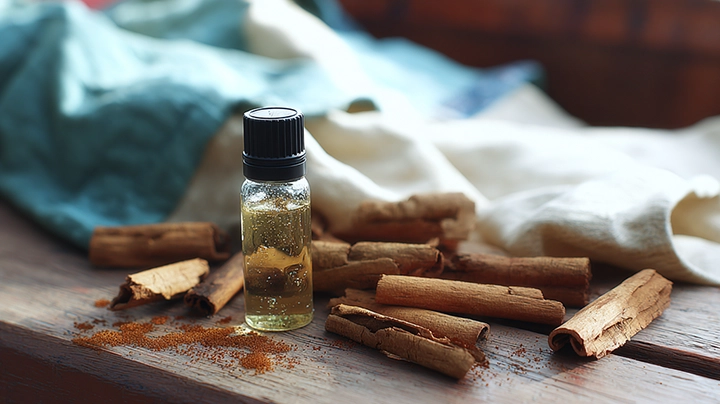
Cinnamon has been used as a preservative for centuries. What’s changing is how scientists are deploying it.
A new study on storage mold prevention doesn’t just confirm that cinnamon essential oil works against fungal contamination. It demonstrates something more important: that when cinnamon oil is enclosed in microscopic capsules designed for controlled release, it works much longer. And in long-term storage protection, longevity matters more than initial potency.
The Mold That Waits
Many agricultural products face their greatest threat not in the field, but afterward. Grains, medicinal herbs, spices, seeds, and other biological materials may leave harvest in excellent condition, only to deteriorate in the warehouses and containers where they wait to be used. Fungal spores don’t sleep — they find moisture, temperature, and substrate, then quietly begin to colonize.
The economic toll is significant. Beyond visible spoilage, storage mold reduces quality, shortens shelf life, and in some cases produces mycotoxins — compounds that create food-safety concerns even when the fungal growth itself is no longer visible. Traditional responses have relied on synthetic fungicides and environmental control systems. Growing pressure around chemical residues, sustainability, and consumer preferences has pushed researchers toward plant-derived alternatives.

Knowing the Enemy First
Before developing a preservation strategy, the researchers did something that’s easy to skip: they identified the actual fungal species responsible for storage contamination. Not all molds behave alike. Species vary in growth rates, environmental tolerance, and responses to antifungal compounds — which means a strategy designed against one species may perform poorly against another.
Using morphological observation and molecular identification techniques, the team isolated and characterized the dominant fungi associated with mildew development during storage. This shifted the research from generic antifungal screening to a practical investigation of real-world spoilage organisms — the kind of organisms that would actually challenge a commercial preservation system.
The Problem Isn’t the Chemistry — It’s the Clock
Cinnamon essential oil demonstrated strong antifungal activity against the identified species. This isn’t especially surprising — its bioactive compounds are capable of disrupting fungal cell membranes, interfering with metabolism, and inhibiting growth at relatively low concentrations. In the laboratory, performance was impressive.
In real-world storage, the problem isn’t potency. It’s persistence.
Essential oils are chemically active precisely because they’re volatile. The same reactive properties that make cinnamon oil effective against fungi also make it unstable. It evaporates. It degrades under light and oxygen exposure. Its concentration in a storage environment drops steadily over time — often before the storage period is over. Strong initial performance. Declining effectiveness. Insufficient protection when it’s needed most.
This pattern has limited natural preservatives for decades. The researchers knew the antifungal answer. What they needed was an engineering answer.
The Capsule Changes Everything
Microencapsulation involves enclosing active compounds within microscopic protective structures. The technology is already established in pharmaceuticals, agriculture, and controlled-release fertilizers. What this study explored was applying the same logic to mold prevention.
Rather than dispersing cinnamon essential oil directly into a storage environment, the researchers enclosed it in microcapsules engineered to release the oil gradually over time. The capsule protects the compound from evaporation and environmental degradation. And instead of delivering its antifungal payload all at once — a burst that fades — it releases gradually, maintaining protective concentrations throughout the entire storage period.
This is the distinction that matters: not a stronger antifungal compound, but a more reliable delivery system. The cinnamon oil is no longer simply a natural extract. It becomes an engineered preservation platform.

Proof Under Pressure
To test whether the microencapsulated system would hold up over time, the researchers conducted accelerated aging experiments — controlled stress tests that simulate extended storage in a compressed timeframe. By exposing materials to elevated temperature, humidity, and other stressors, researchers can evaluate long-term preservation performance without waiting through a full storage cycle.
The microencapsulated cinnamon oil performed well. It maintained antifungal activity against the target species throughout the testing period, providing protection that direct essential oil application could not sustain. The capsules successfully addressed what has long been the central limitation of natural preservatives: keeping them working when they need to work.
Delivery Is the New Discovery
The broader significance of this research lies in what it suggests about the future of preservation science.
For most of its history, antimicrobial research focused on finding more potent compounds. The underlying assumption: higher biological activity leads to better protection. That remains true — but it’s no longer a sufficient framework on its own.
Modern preservation science is increasingly recognizing that how a compound is delivered can matter as much as what the compound is. A moderately effective antifungal agent delivered consistently over sixty days may outperform a highly potent extract that degrades in two weeks. A controlled-release system reframes the whole equation — shifting the question from “what kills this mold?” to “how do we keep the protection active?”
Potential applications extend across agricultural storage, food processing, medicinal herb preservation, natural products, and packaging technologies designed to release antifungal agents passively within sealed containers. The lesson is simple but significant: nature already provides many compounds capable of suppressing fungal growth. The challenge now is engineering the way they’re delivered.
Common Storage-Associated Molds
Several fungal species commonly drive storage contamination and product deterioration: Aspergillus niger and Aspergillus flavus (capable of mycotoxin production under certain conditions), Penicillium chrysogenum, Rhizopus stolonifer, and Fusarium oxysporum. Each species differs in environmental tolerance and antifungal response — one reason species identification is a critical first step in any preservation strategy.
FAQ
Why is cinnamon essential oil effective against fungi? Cinnamon oil contains bioactive compounds — primarily cinnamaldehyde — that disrupt fungal cell membranes and interfere with metabolic processes. It’s among the most consistently active natural antifungal agents studied in food and agricultural science.
What is microencapsulation? A formulation technology that encloses active compounds within microscopic protective shells. In preservation applications, it protects cinnamon oil from evaporation and degradation while enabling controlled, sustained release throughout storage.
Why not apply cinnamon oil directly? Direct application produces strong initial antifungal activity, but concentrations drop rapidly through evaporation and oxidation — often before the full storage period is over.
Could this technology reduce reliance on synthetic fungicides? Not entirely, and not immediately. But it represents a practical pathway toward reducing synthetic preservative use in applications where a more sustainable option is needed.
What industries could benefit from this approach? Agricultural storage, food processing, medicinal herb preservation, natural products, and packaging systems designed to passively release antifungal agents within sealed containers.
References
Microencapsulation of cinnamon essential oil for controlled antifungal release during storage. Europe PMC. https://europepmc.org/article/pmc/pmc12877010