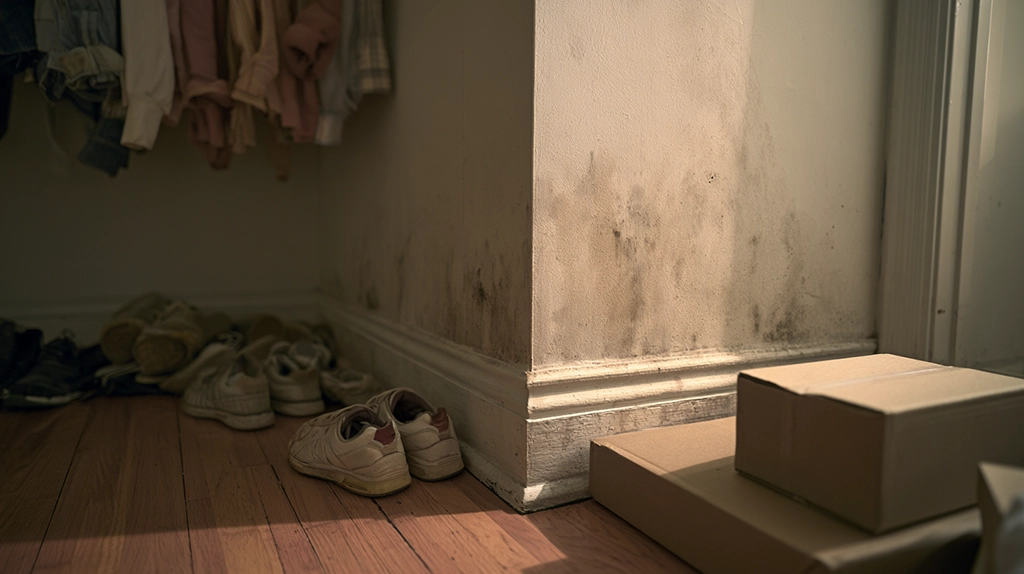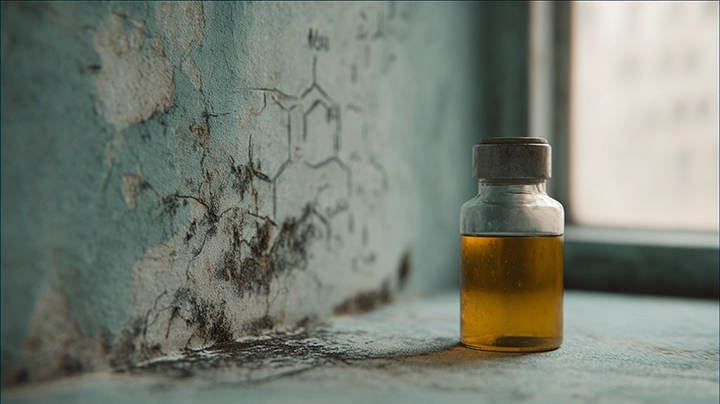
Picture an indoor environmental consultant walking through a water-damaged building.
The protocol is familiar. Locate the moisture source. Document visible fungal growth. Collect air samples. Send them to a laboratory for spore analysis. The results will come back as numbers — spore concentrations per cubic metre of air — and those numbers will shape everything that follows: the remediation plan, the clearance testing, the occupant communication.
It is a well-established process, built over decades of research and field experience. And it may be missing something.
A recent study focuses on a question that is becoming harder to ignore in indoor environmental science: what if fungal exposure is not fully explained by mold growth or spore counts alone? What if the more consequential part of what mold leaves behind in an indoor environment is invisible to the methods currently used to find it?
What Spores Leave Out
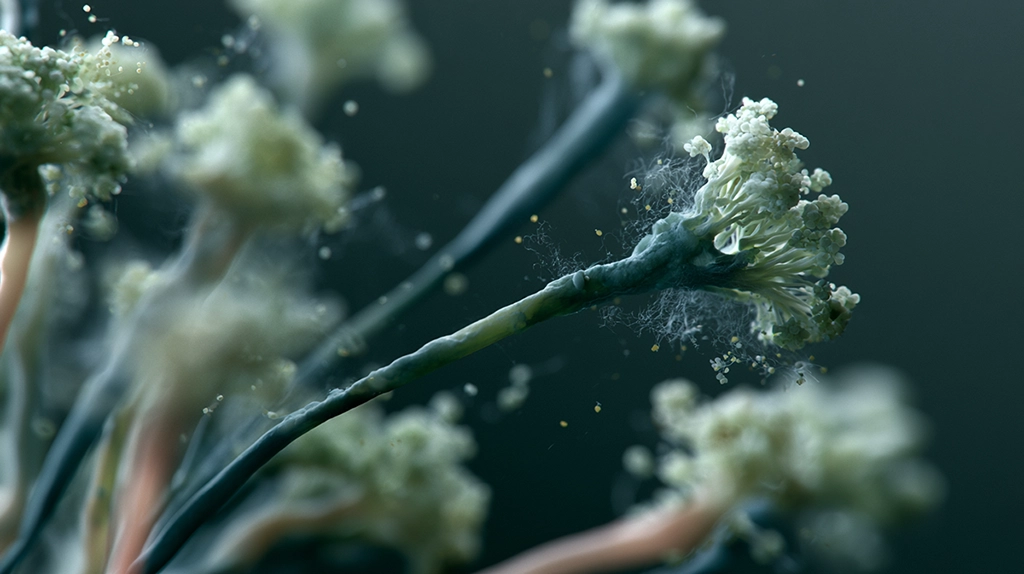
Fungi are biological organisms, but they are also chemical factories.
Under certain environmental conditions — stress, competition, moisture fluctuation — many fungal species produce secondary metabolites known as mycotoxins. These are not spores. They are chemical compounds: structurally complex molecules that interact with living systems in ways that are distinct from the biological effects of fungal presence itself.
Mycotoxins have been studied intensively in agriculture, where contamination of grain, maize, and other food crops represents a serious and well-documented public health concern. The science is mature. The regulatory frameworks exist. The detection methods are established.
Indoor environments are a different problem entirely.
Airborne mycotoxins inside buildings can exist at extremely low concentrations, attached to spores, fungal fragments, dust particles, or microscopic debris released from mold-contaminated materials. They do not announce themselves. Standard mold assessments are not designed to find them. And until recently, the analytical tools capable of detecting trace chemical compounds in complex indoor air samples were difficult to apply in this context.
This is where the science has been running up against a wall.

Two Buildings, Same Spore Count
Here is a scenario that illustrates the gap.
Two buildings. Both show elevated airborne spore concentrations. Both contain water damage. By conventional assessment metrics, they look similar.
But the study highlights a critical limitation of spore-based analysis: biological presence and chemical exposure are not the same thing. One building may carry significant concentrations of mycotoxins associated with its fungal contamination. The other may not — because mycotoxin production depends on specific environmental conditions that vary considerably between sites, species, and growth phases.
The reverse is also possible. A building with modest spore counts may still contain fungal fragments or dust-bound particles carrying biologically active chemical compounds — compounds that a spore trap and a microscope would never detect.
Indoor occupants do not interact only with spores. They breathe a complex mixture: particles of different sizes, microbial fragments, volatile compounds, chemical residues, and biological debris in continuous suspension within the indoor air column. Understanding what that mixture actually contains requires tools beyond biological identification.
A More Precise Question
The method the researchers developed is based on liquid chromatography coupled with tandem mass spectrometry — LC-MS/MS.
Think of it this way. A standard spore count is like identifying a person by their height and hair colour. LC-MS/MS is closer to reading their fingerprints under high magnification. It can separate, identify, and quantify individual chemical compounds within a mixed sample even when those compounds are present in vanishingly small amounts — parts per billion or lower.
This precision matters enormously when the target compounds are airborne mycotoxins drifting through indoor environments at concentrations that conventional methods cannot resolve.
The significance of the study is not that it discovered a new mycotoxin. The significance is that it demonstrated a workflow capable of asking a question that indoor environmental science has struggled to answer: not just what fungi are present, but what chemical compounds those fungi are releasing into the air.
That shift — from organism to compound — is more consequential than it might first appear.
Air as the Evidence
People spend the vast majority of their lives indoors. The air inside a building is not static. It circulates continuously — through rooms, through ventilation systems, across building materials, through furnishings that have absorbed decades of airborne particles.
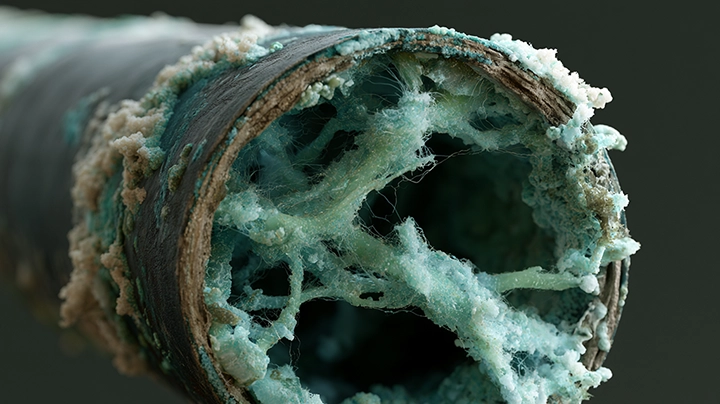
When fungal growth develops within water-damaged materials — drywall, insulation, flooring assemblies, HVAC components — it does not stay contained to the surface. It releases material into that circulation: spores, yes, but also fragments, metabolites, and associated chemical compounds that enter the indoor air and become part of what occupants breathe.
Fungal contamination, in this sense, is not a surface problem that stops at the wall. It is an air-quality problem that moves with the building’s air.
The ability to directly detect and measure airborne mycotoxins — not just infer their possible presence from spore data — could allow researchers to trace how fungal contamination propagates through a building’s air envelope and contributes to occupant exposure in ways that biological monitoring alone cannot capture.
Two Sciences in the Same Room
One of the quieter contributions of this research is what it represents structurally: the integration of two scientific disciplines that have historically worked in parallel without much overlap.
Indoor mold investigation belongs to microbiology. Identify the organisms. Quantify the spores. Evaluate the ecological conditions that sustain growth. The expertise is biological.
Analytical chemistry works differently. It is not asking who is present. It is asking what molecules are there, in what concentrations, with what structural characteristics. The expertise is chemical.
Placed together, these two approaches form a more complete picture. Microbiology explains the source of contamination. Analytical chemistry characterises what that contamination is producing. Neither answer makes the other redundant — they address different aspects of the same problem.
This kind of disciplinary convergence is how environmental science tends to advance. Air quality research, water contamination analysis, and occupational health investigation have all been transformed by the integration of biological and chemical monitoring. Indoor mold science may be reaching that same inflection point.

What the Study Does — and Does Not — Claim
It is worth being precise about what this research establishes and what it does not.
The study does not claim that mold-contaminated buildings routinely contain hazardous airborne mycotoxin concentrations. It does not claim that airborne mycotoxins are the primary driver of health concerns associated with indoor mold. It does not establish dose-response relationships or make clinical recommendations.
What it demonstrates is measurement capability. A sensitive, validated analytical method for detecting airborne fungal toxins in indoor environments now exists. That is the contribution — and it is a meaningful one, because measurement is what makes scientific investigation possible.
Detection does not equal health risk. What the detection data actually means for human exposure requires a body of research that does not yet exist at scale. The method creates the conditions under which that research can begin.
In science, better tools precede better answers. This study provides a tool.
From Seeing Mold to Measuring Exposure
For most of the history of indoor mold investigation, the science has been anchored to what investigators could see, culture, count, or identify under a microscope. That is not a criticism — those methods were developed for good reasons and continue to provide genuine value.
But the building sciences have been evolving alongside the analytical sciences. Instruments that were once confined to research laboratories are now practical tools for environmental monitoring. Detection thresholds that once required large sample volumes can now be achieved with small, carefully collected air samples.
The direction of travel is toward greater precision — not toward replacing existing methods, but toward supplementing them. Future building investigations may combine moisture assessment, fungal ecology, airborne spore analysis, particle characterisation, and chemical exposure measurement into a single investigative framework rather than treating each as a separate question.
The future of mold science may not be defined by finding more mold. It may be defined by understanding what mold leaves behind — in the walls, in the air, and in the environments where people spend most of their lives.
FAQ: Airborne Mycotoxins and Indoor Mold Assessment
What are mycotoxins?
Mycotoxins are secondary metabolites produced by certain fungi. Unlike spores, they are chemical compounds that may be associated with fungal growth under specific environmental conditions.
Why are airborne mycotoxins difficult to measure?
Airborne mycotoxins often exist at extremely low concentrations and may be attached to spores, fungal fragments, or dust particles. Detecting them requires highly sensitive analytical instruments.
What is LC-MS/MS?
LC-MS/MS stands for liquid chromatography coupled with tandem mass spectrometry. It is a powerful analytical technique capable of identifying and quantifying trace chemical compounds with high precision.
Are airborne spore counts enough to assess mold exposure?
Spore counts provide important information about fungal presence, but they do not directly measure mycotoxins or other chemical compounds associated with fungal activity.
Does finding mycotoxins automatically indicate a health risk?
Not necessarily. Detection alone does not determine health outcomes. Exposure levels, environmental conditions, and other factors must be considered when evaluating risk.
How could this research change future mold investigations?
Future assessments may increasingly combine moisture evaluation, microbial analysis, and chemical exposure measurements to create a more comprehensive understanding of indoor environmental quality.
References
Airborne mycotoxin detection in indoor environments using LC-MS/MS. PMC / National Library of Medicine. https://pmc.ncbi.nlm.nih.gov/articles/PMC12325524/