According to SFGATE
San Juan Island, WA – In the quiet forests and moss-laced trails of the Pacific Northwest, where bat colonies flit through dusky skies, an invisible threat is taking hold. Wildlife officials in Oregon and Washington have confirmed the spread of a lethal fungus responsible for the death of millions of bats across North America — marking a grim milestone in the battle to preserve fragile native ecosystems.
The U.S. Geological Survey (USGS) announced on Friday that Pseudogymnoascus destructans, the cold-loving fungus that causes white-nose syndrome (WNS), was recently detected on bats at San Juan Island National Historical Park in Washington and in bat droppings (guano) at Lewis and Clark National Historical Park in Oregon. This detection marks the first-ever confirmation of the fungus in Oregon, raising urgent alarms among conservationists, researchers, and federal wildlife agencies.
Although the disease poses no threat to humans, its reach into two key national parks signals a disturbing expansion of one of the most devastating wildlife diseases ever recorded in North America.
The Disease Behind the Decline
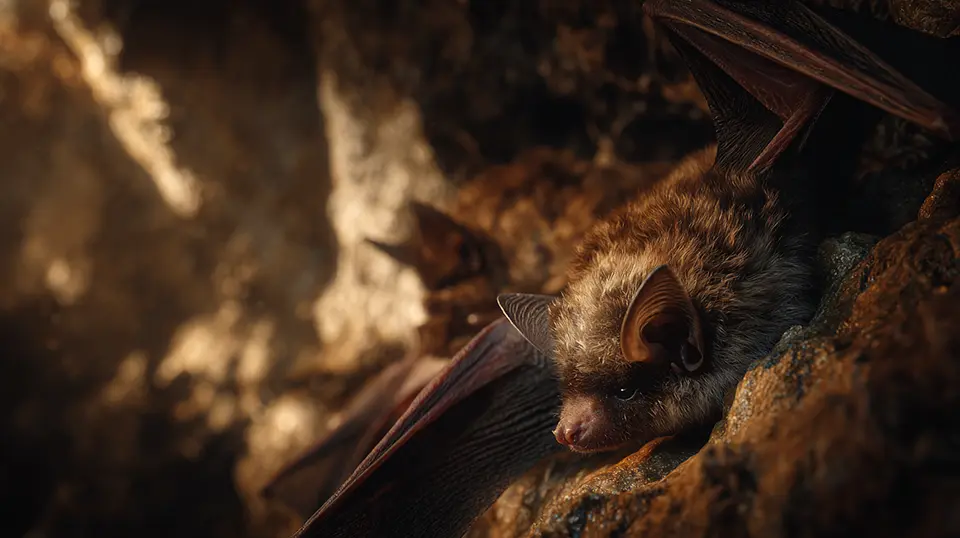
White-nose syndrome is a disease caused by the psychrophilic (cold-loving) fungus Pseudogymnoascus destructans, which thrives in the dark, humid conditions of caves and roosting sites. It invades the exposed skin of hibernating bats, particularly the wings, ears, and muzzle, manifesting as a distinctive white fungal growth.
But the visible signs are only the beginning. The real danger lies beneath the surface.
WNS causes frequent arousals from hibernation, which severely depletes the energy reserves bats need to survive winter. These premature awakenings, paired with disrupted immune responses and tissue damage, often lead to starvation, dehydration, and death. Mortality rates among affected bat colonies can reach 90 to 100 percent in a single hibernaculum.

Source: Wikimedia Commons, Public Domain
The Arrival in the Pacific Northwest
The latest confirmed detection involves a colony of Yuma Myotis bats (Myotis yumanensis), which had been roosting in a man-made bat box located at English Camp within San Juan Island National Historical Park. These bats were found carrying the fungus on their skin, although no reports of symptomatic illness have yet been made public.
In Oregon, while no infected bats were found directly, researchers detected the fungal DNA in guano samples collected from within Lewis and Clark National Historical Park. This method of detection — indirect but reliable — indicates the likely presence of colonized individuals within the area.
“This is a pivotal moment for bat conservation in the Northwest,” a spokesperson from USGS said in a statement. “Detection of Pseudogymnoascus destructans in these iconic parks signifies a wider geographical spread than we previously recorded. Monitoring, containment, and public education will be critical moving forward.”
A Contagion That Spreads Quietly
The primary transmission route for WNS is bat-to-bat contact during hibernation. However, humans can also inadvertently carry spores between roosting sites on contaminated gear or clothing, making caving, climbing, and spelunking potential contributors to the spread if decontamination protocols aren’t followed.
The disease is seasonal and spreads most aggressively during winter hibernation. Once established in a region, eradication of the fungus is virtually impossible due to its persistence in cave environments and its ability to survive without a host for extended periods.
To mitigate risk, national parks and wildlife agencies now require visitors to decontaminate footwear and equipment before entering bat habitats — a policy that has become increasingly important with the spread into Oregon.
The Larger Ecological Cost
While bats may not receive the same level of attention as polar bears or tigers in conservation campaigns, they play a critical role in controlling insect populations, pollinating plants, and dispersing seeds. A single bat can eat thousands of insects in a night — a natural pest control service that is both economically and ecologically invaluable.
The collapse of bat populations due to WNS has the potential to disrupt entire ecosystems, especially in regions where certain bat species are keystone species.
The economic impact is equally concerning. According to a 2011 study published in Science, bats provide pest control services valued at up to $3.7 billion annually in the U.S. agricultural sector. As WNS continues its deadly march westward, these benefits are increasingly at risk.
A History of Devastation
WNS was first identified in a cave in New York State in 2006 and confirmed in 2007. Since then, it has spread to over 41 states and several Canadian provinces, decimating populations of hibernating bat species, including the little brown bat (Myotis lucifugus), the northern long-eared bat (Myotis septentrionalis), and the tricolored bat (Perimyotis subflavus).
In 2023, the fungus reached California for the first time, detected in Humboldt County. Its arrival in Oregon and Washington in 2025 represents the most recent phase of westward expansion — and underscores how even remote or protected habitats are not immune.
Conservationists fear that, without effective intervention, entire species could face extinction in the coming decades. The northern long-eared bat was officially listed as endangered by the U.S. Fish and Wildlife Service in 2022 due largely to the effects of WNS.
What Can Be Done?
Although there is currently no known cure or vaccine for white-nose syndrome, researchers across the U.S. are exploring multiple avenues:
- Biological control agents that suppress fungal growth on bats.
- UV light treatments that can damage fungal DNA.
- Selective breeding or genetic studies to identify natural resistance within bat populations.
- Microclimate manipulation in hibernation sites to reduce conditions favorable for fungal growth.
Public education and citizen science initiatives also play a vital role. Hikers, campers, and cave enthusiasts are urged to report unusual bat behavior — such as flying during winter or appearing lethargic — and to avoid disturbing known bat roosts.

Source: Wikimedia Commons, Public Domain
The Road Ahead
The detection of Pseudogymnoascus destructans in two national parks of the Pacific Northwest underscores the persistent threat of white-nose syndrome and the challenges involved in containing it. While the presence of the fungus does not guarantee immediate population collapse, its history elsewhere in North America is sobering.
Officials from the National Park Service, U.S. Fish and Wildlife Service, and local wildlife organizations are expected to increase monitoring efforts, tighten biosecurity measures, and continue working with research institutions to track the disease’s progress.
In the meantime, the public is urged to stay informed, respect bat habitats, and report suspected sightings or behaviors that might indicate illness.
For many species already fighting for survival in a changing climate, WNS could be the final blow. But with increased awareness, scientific dedication, and proactive conservation, there is still hope that some bat populations may persist — and even recover — in the face of this deadly fungal invasion.
References
- White-Nose Syndrome – USGS
- White-Nose Syndrome – USFWS
- Science Journal – Economic Value of Bats in Agriculture
- Northern Long-Eared Bat – U.S. Fish & Wildlife Service
- Pseudogymnoascus destructans – Wikipedia
- Little Brown Bat – Wikipedia
- Tricolored Bat – Wikipedia
According to SFGATE
Key Takeaways
- White-nose syndrome (WNS), caused by the fungus Pseudogymnoascus destructans, has killed over 6.7 million bats in North America since its introduction from Europe around 2006—one of the fastest wildlife die-offs in recorded history.
- The fungus invades the skin of hibernating bats, disrupting their torpor cycles and causing them to burn through fat reserves during winter when no insects are available, leading to starvation before spring.
- Oregon’s confirmation of WNS represents a significant westward expansion that threatens the bat populations of the Pacific Northwest, which were previously considered one of the last refugia.
- Probiotic bacteria (particularly Pseudomonas fluorescens strain CL145A and Janthinobacterium lividum) applied to bat fur have shown promise in field trials as a biological control approach to reduce P. destructans infection rates.
- The disease exemplifies the ‘invasion ecology’ of emerging fungal pathogens—P. destructans causes limited disease in European bats that co-evolved with it, but is lethal to naive North American species with no prior exposure.
Frequently Asked Questions
What is white-nose syndrome and which fungus causes it?
White-nose syndrome (WNS) is a devastating infectious disease of hibernating bats caused by the fungus Pseudogymnoascus destructans (previously called Geomyces destructans). The disease was first documented in a cave near Albany, New York, in the winter of 2006–2007, and has since spread across North America at alarming speed. The name ‘white-nose syndrome’ comes from the characteristic white powdery fungal growth that appears on the muzzle, ears, and wing membranes of infected bats. P. destructans is a psychrophilic (‘cold-loving’) fungus that grows optimally at 5–15°C—the temperature range of bat hibernacula (caves and mines where bats hibernate); it invades the skin of hibernating bats, forming characteristic cup-shaped erosions (described histologically as ‘cupping erosions’) in the wing membrane and facial skin. The fungus is unusual in targeting the integument (skin) rather than internal organs; skin damage disrupts the physiological processes of hibernation by altering wing membrane gas exchange and water balance, causing bats to arouse from torpor more frequently; each arousal burns critical fat reserves; bats depleted of fat die of starvation before spring insect emergence. European bats (in the same cave environments where P. destructans originated) show infection but much lower mortality than North American species, suggesting that co-evolutionary history with the pathogen provides a degree of resistance or tolerance that North American bats lack.
How did white-nose syndrome spread so quickly across North America?
White-nose syndrome’s rapid geographic spread across North America reflects the ecology and social behaviour of colonial bats, the characteristics of P. destructans as an environmental pathogen, and the connectivity of cave systems. Mechanisms of spread: bat-to-bat contact during hibernation—hibernating bats cluster in dense groups (some hibernacula contain tens of thousands of bats) where direct fungal transfer between individuals occurs readily; a single infected bat introduced to a new hibernaculum can initiate an outbreak that kills the entire colony. Cave-to-cave bat movement—some bat species (particularly little brown bats, Myotis lucifugus) travel hundreds of kilometres between summer roosts and winter hibernacula, carrying P. destructans spores between geographically separated cave systems; colonial breeding behaviour means infected individuals mix with large numbers of potential new hosts. Environmental persistence—P. destructans can survive in cave soil and rock for years without bat hosts, creating persistent reservoirs that infect new bat populations entering a cave long after the original infected bats are gone; cave decontamination is extremely difficult for this reason. Human transmission—cavers (cave explorers) who enter multiple cave systems can carry fungal spores on clothing and gear; the adoption of decontamination protocols by cavers (bleach treatment of equipment, clothing bans between caves) has become standard practice. Geographic spread timeline: first documented in New York 2006–2007; reached Tennessee and Virginia 2009; Great Lakes 2010; Texas 2012–2013; Kansas 2016; Pacific coast by the late 2010s. The spread roughly follows bat migration routes and cave system connectivity.
Why is Oregon’s bat population especially vulnerable to white-nose syndrome?
Oregon’s bat fauna, like that of the broader Pacific Northwest and Mountain West, is considered especially vulnerable to white-nose syndrome because these populations have had no prior exposure to Pseudogymnoascus destructans—they have no evolutionary experience with the pathogen and no acquired immunity. Oregon bat diversity: Oregon is home to 15 bat species, many of which use caves, mines, and rock crevices as hibernacula; species of particular concern include Townsend’s big-eared bat (Corynorhinus townsendii), Myotis species (little brown bat, long-legged myotis, Yuma myotis), and western long-eared myotis—all of which have shown high vulnerability to WNS in eastern North America. Little brown bat decimation: little brown bats in eastern North America have experienced population declines of 90–99% in WNS-affected areas; preliminary models suggested that some populations might be extinction-prone without recovery; Oregon populations of this and related species face similar risk. Western bat ecological importance: Oregon’s bats are major insect predators—a single little brown bat can consume thousands of insects per night; bats provide estimated billions of dollars in pest control services to US agriculture; WNS-driven bat population collapse in the Pacific Northwest would dramatically impact agricultural pest dynamics and forestry pest control. Cave ecosystem disruption: large bat colonies contribute enormous quantities of guano to cave ecosystems, supporting cave-adapted invertebrate communities; collapse of bat populations would fundamentally alter cave food webs. The arrival of WNS in Oregon triggers state-level emergency response protocols, intensive hibernacula monitoring, and coordination between Oregon Department of Fish and Wildlife, USDA Forest Service, and USFWS.
Are there any treatments or cures for white-nose syndrome?
Several promising treatment approaches for white-nose syndrome are in various stages of research and field trial, though no fully approved, deployable treatment currently exists at the scale needed to protect bat populations across North America. Probiotic biocontrol: the most extensively researched intervention involves applying beneficial bacteria to bats or cave surfaces that produce antifungal compounds inhibiting P. destructans; Janthinobacterium lividum produces violacein, an antifungal compound that inhibits P. destructans in laboratory studies; early field applications of J. lividum to bat fur showed some promise but inconsistent results in the field. Pseudomonas fluorescens CL145A (now commercialised as Zequanox) is registered as a biopesticide and has been tested for WNS management; treatment of cave environments aims to create antifungal conditions that reduce P. destructans persistence. Ultraviolet (UV) light treatment: a discovery at Georgia State University found that exposing P. destructans to UV light damages the fungus more effectively than it damages bat skin; this led to development of UV light treatment devices for use at hibernacula; USDA APHIS and state wildlife agencies have conducted field trials applying UV-C light to hibernating bats; early results are encouraging, with treated bats showing reduced P. destructans infection loads. Volatile compounds: research has identified several naturally occurring volatile compounds (including those produced by specific cave bacteria) that inhibit P. destructans growth; these may be applicable as cave treatments. Vaccine research: novel vaccine approaches using P. destructans antigens to induce bat immune responses are in early development; delivering vaccines to wild bat populations presents significant logistical challenges.
How does white-nose syndrome affect the broader ecosystem?
The mass mortality of bats from white-nose syndrome has profound cascading effects on ecosystems that extend far beyond the caves where the disease occurs. Insect pest dynamics: North American insectivorous bats collectively consume billions of insects nightly; little brown bat populations have declined by 90%+ in WNS-affected areas; studies measuring insect abundance in WNS-affected versus unaffected areas have documented increases in agricultural pest insect populations; the economic value of bat insectivory services to US agriculture has been estimated at $3.7–$53 billion annually (Boyles et al., 2011, Science); WNS-driven bat declines in apple-growing regions have been associated with increased codling moth pressure. Pesticide use: reduced bat populations increase reliance on chemical pesticides for agricultural pest control; this has secondary effects on non-target organisms including pollinators and other insect-eating birds. Forest insect management: bats consume bark beetle species, budworm moths, and other forest pests; bat declines may contribute to increased susceptibility of forests to insect outbreak damage in an era of climate change already stressing trees. Cave ecosystem disruption: as noted, bat guano supports cave invertebrate communities; species that feed on bat guano (guanophilic beetle species, cave crickets, cave invertebrates) would be severely affected by loss of bat colonies. Nutrient cycling: bat guano is a significant nutrient input to cave systems, some of which have no other significant organic carbon input; loss of bat colonies effectively ‘starves’ cave ecosystems that depend on guano as their primary energy source.