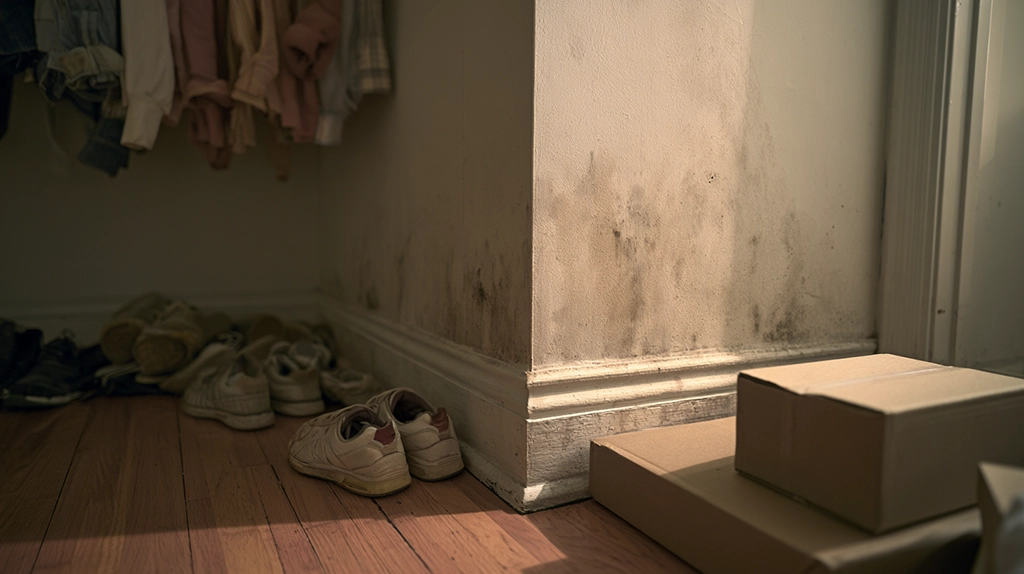
You open a bedroom closet after several warm, humid days and notice a stale, musty odor. The back corner feels slightly damp. Shoes smell stronger than usual. Cardboard boxes or fabric bins look dusty around the edges. Maybe you even see faint gray or dark specks near the wall, baseboard, storage bag, or shoe rack.
At first, it may seem like a small household problem. Maybe the closet has been closed too long. Maybe the shoes need airing out. Maybe the room just feels humid.
But a musty closet is often more than an unpleasant smell. It can be an early moisture clue.
Closets are common places for mold risk because they are often closed, crowded, and poorly ventilated. When humid air enters the home, moisture can linger in corners, behind stored items, and around materials that do not dry quickly.
What Mold May Be Doing There
Mold spores are naturally present in indoor air. Most of the time, they remain inactive. But when they land in a damp, dusty, and poorly ventilated area, they may begin to settle and grow.
A closet corner can provide many surfaces that mold can use: dust, fabric fibers, cardboard, leather shoes, wood trim, painted drywall, and storage bags. These materials may hold tiny organic particles that support microbial growth when moisture is present.
The musty odor is often a sign that moisture and poor airflow are allowing microbial activity to build up. It does not always prove that visible mold is present, but it does mean the area deserves attention.
A closet should not smell musty when you open the door. If it does, your home may be asking you to check for hidden dampness.
Why Closet Corners Trap Moisture
Closets are designed for storage, not airflow. Doors stay shut. Clothing hangs close together. Boxes sit against walls. Shoes rest on the floor. Corners receive little air movement, especially when the closet is packed.
During humid weather, moisture can enter the home and collect on cooler surfaces. Closet corners near exterior walls are especially vulnerable because they may be cooler than the rest of the room. When air cannot circulate, dampness remains longer.
Dust makes the problem worse. Dust on shelves, shoes, boxes, and baseboards gives mold something to cling to. Cardboard boxes and fabric bins can also absorb moisture, especially when placed directly on the floor or pressed against a wall.
This is why a musty closet is not only a storage issue. It may also point to high indoor humidity, condensation, poor ventilation, or even a hidden leak.

What You Should Do First
Start with airflow. Open the closet door and remove items from the affected corner. Do not just spray fragrance over the smell. Air freshener may hide the warning sign, but it will not fix moisture.
Check the wall, baseboard, floor, shelves, shoes, cardboard boxes, fabric bins, and storage bags. Look for staining, specks, dampness, swelling, peeling paint, or a smell that becomes stronger near one area.
If the affected area is small and limited to hard, non-porous surfaces, clean it carefully with ordinary household cleaning methods and dry the area completely. Wash washable fabrics according to care labels. Wipe dust from shelves, baseboards, and shoe racks.
Move stored items a few inches away from walls so air can circulate. Replace damp cardboard boxes with cleanable plastic bins. Avoid keeping wet shoes, umbrellas, gym bags, or laundry in a closed closet.
If available, use a hygrometer to check indoor humidity. A general target for many homes is around 30% to 50% relative humidity. If humidity stays high, ventilation or dehumidification may be needed.

When the Problem Needs More Than Cleaning
Some closet problems should not be handled as simple housekeeping.
Professional inspection may be needed if you see large visible mold growth, mold that returns after cleaning, damp drywall, swollen baseboards, water stains, a strong odor with no clear source, or signs of a leak. These clues may suggest moisture behind walls, under flooring, or inside building materials.
Do not paint over suspected mold or damp spots. Paint may cover the surface temporarily, but it does not remove the moisture source. Do not disturb large moldy areas or water-damaged materials without proper protection and assessment, especially if drywall, carpet, insulation, or wood appears affected.
The key question is simple: does the closet dry out and stay fresh, or does the odor keep returning?
If the smell returns, the moisture source has not been solved.
Simple Closet Moisture Checklist
- Open the closet door and improve airflow
- Remove items from the musty corner
- Check walls, baseboards, shoes, boxes, and fabric bins
- Clean small surface spots on hard materials and dry fully
- Wash washable fabrics and dry them completely
- Replace damp cardboard with cleanable storage bins
- Leave space between stored items and walls
- Measure indoor humidity if possible
- Look for leaks, condensation, or water stains
- Call a professional if mold is large, recurring, hidden, or linked to water damage
FAQ — Musty Closet and Mold Risk
Does a musty closet smell always mean mold is present?
Not always. A musty smell does not prove visible mold is present, but it often suggests moisture, poor airflow, damp materials, or microbial activity. If the odor returns in the same closet corner, the area should be checked for hidden dampness.
Why do closets smell musty after humid weather?
Closets often stay closed and crowded, so humid air can become trapped inside. Clothing, shoes, cardboard boxes, fabric bins, and dusty corners can hold moisture. When airflow is weak, the closet may dry slowly and develop a stale or musty odor.
Can mold grow on clothes, shoes, or cardboard boxes in a closet?
Yes. Mold can grow on materials that hold moisture and contain organic particles, including fabric, leather, cardboard, dust, and wood. Damp shoes, packed clothing, and cardboard boxes pressed against walls are common risk areas.
What should I do first if my closet smells musty?
Open the closet door, remove items from the affected corner, and improve airflow. Check walls, baseboards, shoes, boxes, and fabric bins for dampness, staining, or specks. Dry the area fully, clean small spots on hard surfaces, and avoid spraying fragrance to cover the smell.
When should I call a professional for closet mold?
Consider professional help if mold growth is large, keeps returning after cleaning, has no clear source, or appears with damp drywall, swollen baseboards, water stains, or signs of a leak. These may indicate hidden moisture behind walls, under flooring, or inside building materials.
References
Why is mold growing in my home? U.S. EPA. https://www.epa.gov/mold/why-mold-growing-my-home
Structure and properties of organic compounds. Monash University. https://www.monash.edu/student-academic-success/chemistry/structure-and-properties-of-organic-compounds