
Credit: Inklein / Wikimedia Commons, CC BY-SA 4.0
Wildfires are often measured by what they destroy. Burned forests, consumed vegetation, displaced wildlife, and darkened skies form the visible record of fire’s passage through an ecosystem.
Yet some of the most important changes occur where fire cannot be seen. Beneath the soil surface, fire transforms the chemical and biological foundations of entire landscapes. Organic matter becomes ash, charcoal, and complex aromatic compounds. Nutrient cycles stall. Microbial populations collapse. The world fire leaves behind is radically different from the one that existed before.
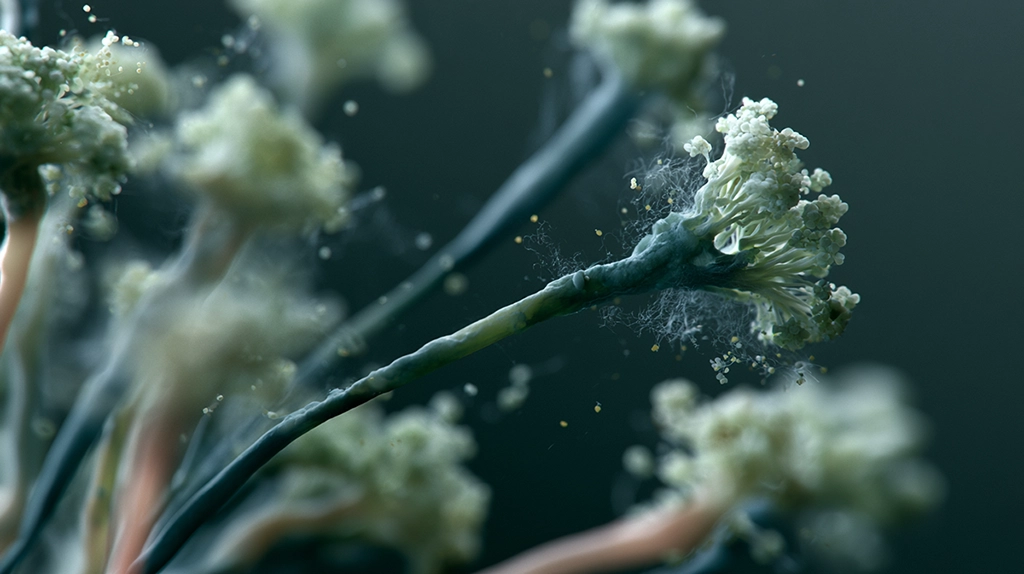
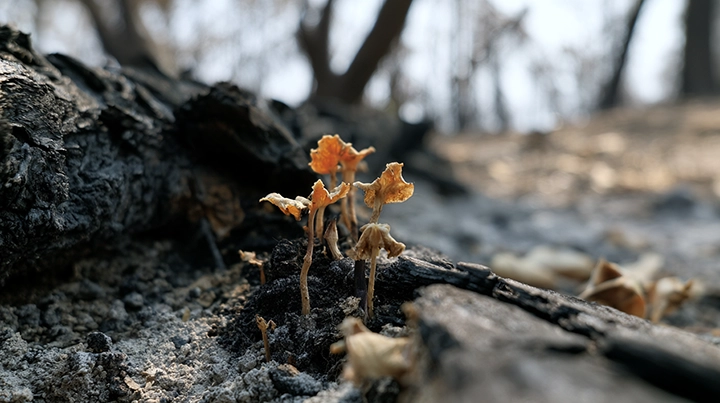
For most organisms, this new world is hostile. For a specialized group of pyrophilous fungi — fire-loving organisms uniquely adapted to postfire conditions — it represents something else: an opening.
A 2026 study examined the genomic strategies that allow pyrophilous fungi to survive and capitalize on the unusual conditions created by wildfire. Analyzing 18 fungal species isolated from wildfire-affected soils, researchers mapped the genetic tools these organisms use to acquire carbon and nitrogen after fire, and uncovered the evolutionary trade-offs that shape their success.
The findings reveal fungi not as passive survivors of ecological disaster but as active architects of what comes next.
A Landscape Reorganized by Fire
When a wildfire passes through a forest or grassland, the visible damage is only part of the transformation.
Beneath the surface, fire alters the chemistry of the soil itself. Fresh plant material that once provided accessible carbohydrates and nutrients is converted into pyrogenic organic matter — complex carbon compounds with aromatic ring structures and charcoal-like chemical stability. These materials resist biological breakdown. The nutrients they contain are effectively locked away from most organisms.
At the same time, overall microbial diversity typically declines after fire. Bacteria, fungi, and other soil organisms that thrived in pre-fire conditions are reduced or eliminated. The competitive landscape shifts dramatically.
The PNAS study notes that wildfires affect nearly 4% of Earth’s land surface each year and significantly alter carbon and nitrogen cycling. The first microbes to establish after fire can strongly influence how nutrients move through the recovering ecosystem, how quickly plant communities return, and how effectively soil functions are restored.
Pyrophilous fungi are often among the first organisms to fill that space.
The Problem of Eating Burned Carbon
Understanding why pyrophilous fungi matter requires understanding what fire does to food.
In unburned ecosystems, soil organisms can access a wide range of carbon sources — cellulose, sugars, proteins, and other relatively digestible compounds. Fire degrades most of this. What remains is dominated by chemically stable aromatic compounds that most microorganisms cannot process.
This is not a minor challenge. For a fungus trying to rebuild populations in postfire soil, the ability to break down these compounds determines whether it can grow, reproduce, and compete for position in the recovering ecosystem.
The researchers hypothesized that pyrophilous fungi possess unique genomic features allowing them to degrade aromatic carbon compounds and acquire nitrogen under postfire conditions. Their analysis confirmed this hypothesis — and revealed something more complex in the process.
The Trade-Off Between Speed and Specialization

Credit: Alan Rockefeller / Wikimedia Commons, CC BY-SA 3.0
One of the study’s most striking findings involves a fundamental tension between two survival strategies.
Fungi possessing larger numbers of genes associated with aromatic carbon degradation tended to grow more slowly. Fungi that grew rapidly tended to carry fewer genes dedicated to breaking down complex carbon compounds.
This trade-off reflects a principle that runs throughout evolutionary biology: building sophisticated tools has costs.
Maintaining an extensive toolkit of aromatic degradation enzymes requires biological investment. A fungus cannot simultaneously maximize growth speed and biochemical complexity without paying a price somewhere. Natural selection has shaped different pyrophilous fungi toward different points along this spectrum.
In ordinary soil conditions, rapid growth often provides a competitive edge. After wildfire, however, the environment changes what success requires. Slow growers with extensive biochemical capabilities may be better positioned to exploit the unusual carbon sources that now dominate the soil landscape.
Fire does not just change the ecology of a place. It changes which traits are valuable.
A Genomic Toolbox Built for Fire
The researchers identified several evolutionary mechanisms that have equipped pyrophilous fungi for postfire survival.
Gene duplication appears to play an important role. When a useful gene is duplicated within a genome, the organism gains additional capacity for producing the enzymes that gene encodes. For aromatic carbon degradation, this translates to increased ability to process difficult carbon sources. The researchers described this as a biological copy-and-paste mechanism — a way for fungi to amplify existing capabilities without evolving entirely new ones from scratch.
Sexual recombination provides another source of innovation. By reshuffling genetic material during reproduction, fungi can generate novel trait combinations that may prove advantageous in postfire conditions.
Somatic mutation contributes additional genetic variation as fungal populations grow and spread through burned soil.
Together, these mechanisms help create populations capable of evolving responses to the highly unusual selective pressures that postfire environments impose.
Borrowing Genes Across Kingdoms
Perhaps the most remarkable finding in the study involves a form of genetic exchange rarely observed between fungi and bacteria.
Horizontal gene transfer — the acquisition of genetic material from unrelated organisms rather than through normal inheritance — is well established among bacteria. Transfers between bacteria and fungi, however, cross not just species boundaries but entire kingdoms of life. Such events are considered far less common.
The study identified several genes involved in aromatic carbon degradation that appear to have entered fungal genomes through bacterial-to-fungal horizontal gene transfer. One notable case involved Coniochaeta hoffmannii, which appears to have acquired useful metabolic capabilities through this cross-kingdom process.
The ecological implications extend beyond individual species. Postfire environments may not simply select for fungi with existing useful traits. They may actively promote the spread of genetic innovations across biological boundaries — creating opportunities for rapid adaptation that would otherwise require far longer timescales through conventional evolutionary mechanisms.
Nitrogen: The Other Half of the Problem

Credit: Holger Krisp / Wikimedia Commons, CC BY 3.0
Carbon receives most of the attention in postfire ecology, but nitrogen presents an equally important challenge.
Wildfires redistribute nitrogen in complex ways. Some is lost to the atmosphere during combustion. Other forms become temporarily concentrated or reorganized within the soil matrix. Plants, microbes, and fungi entering the postfire landscape must all compete for nitrogen resources that may be scarcer, differently distributed, or chemically altered compared with pre-fire conditions.
The PNAS study found that pyrophilous fungi carry specialized nitrogen-acquisition genes alongside their carbon-degradation machinery. These organisms are not simply charcoal processors. They are nutrient-management systems capable of navigating both carbon and nitrogen limitations simultaneously.
This dual capability matters enormously for ecosystem recovery. Nitrogen availability influences plant regrowth rates, microbial competition outcomes, soil fertility trajectories, and long-term ecosystem productivity. By participating actively in postfire nitrogen cycling, fungi may indirectly influence which plant species return first, how stable the recovering vegetation becomes, and how quickly the ecosystem rebuilds productive capacity.
Pyrophilous fungi are not merely responding to recovery. They are helping to determine its direction.
A Growing Ecological Role in a Warming World

Credit: U.S. Forest Service / NOAA / Wikimedia Commons, Public Domain
The significance of pyrophilous fungi extends beyond what current landscapes require.
Many regions worldwide are experiencing increases in wildfire frequency, severity, and geographic extent as climate change alters temperature and precipitation patterns. Larger fires create larger areas of altered soil, greater quantities of pyrogenic organic matter, and more extensive disruptions to nutrient cycling that may persist for years.
The PNAS study notes that despite growing wildfire frequency, the microbial strategies governing postfire soil recovery remain poorly understood. This knowledge gap has practical consequences. Soil recovery influences carbon storage, erosion resistance, water retention, and the overall trajectory of ecosystem restoration.
If pyrophilous fungi play central roles in restarting carbon and nitrogen cycling after fire, they become important variables in climate-related ecosystem modeling and land management planning. Understanding which fungi thrive under different fire intensities, how quickly they establish, and what ecological functions they perform could eventually improve restoration strategies in an era of increasing wildfire activity.
From Description to Prediction
One of the most valuable contributions of the PNAS research lies in its shift from describing postfire fungal communities to explaining them.
Rather than cataloging which species appear after wildfire, the study links specific genomic traits to ecological function. This connection enables more sophisticated questions: Which fungi are most likely to dominate after high-intensity burns? How do different quantities of pyrogenic carbon shape fungal community composition? Which nutrient-cycling pathways become most critical under different recovery scenarios?
Connecting genes to traits to ecosystem processes creates the foundation for predictive modeling — the ability to anticipate ecological outcomes rather than simply document them after the fact. That capacity could eventually transform how scientists and land managers approach wildfire recovery.
Fire as an Evolutionary Laboratory
The PNAS study offers something beyond an account of fungal adaptation. It reframes the postfire landscape as a site of ongoing evolutionary activity.
Gene duplication, recombination, mutation, and rare cross-kingdom gene transfer all generate diversity in pyrophilous fungal populations. Fire then selects from that diversity with unusual intensity, favoring organisms that can exploit conditions most others cannot survive.
Wildfire does not simply test existing biological diversity. It may also accelerate the creation of new biological capabilities, making burned soils environments where evolutionary innovation concentrates.
Before trees return, before grasses emerge, and before landscapes appear recovered, microbial communities are already rebuilding the foundations of ecosystem function. Pyrophilous fungi are among the first organisms leading that process — and some of the most important architects of the world that grows back.
Fire-Associated Fungi Featured in This Article
Pyronema domesticum, Neopyronema domesticum, Morchella sextelata, Geopyxis carbonaria, and Pholiota highlandensis are among the fire-associated fungal species found in burned soils. These organisms represent diverse functional groups within postfire communities — including cup fungi, morels, and wood-associated species — each with varying genomic strategies for carbon and nitrogen acquisition after fire.
FAQ: Fire-Loving Fungi and Wildfire Recovery
What are pyrophilous fungi?
Pyrophilous fungi are fire-associated organisms that appear, survive, or become highly abundant after wildfires, and play important roles in postfire carbon and nitrogen cycling.
What is pyrogenic organic matter?
It is carbon-rich material produced when organic matter is chemically altered by fire, including charcoal-like compounds that are difficult for most microorganisms to break down.
Why are pyrophilous fungi important after wildfires?
They help restart carbon and nitrogen cycling, support soil recovery, and may influence how ecosystems regenerate after fire.
What is horizontal gene transfer?
It is the movement of genetic material between unrelated organisms, bypassing normal inheritance. The study identified rare bacterial-to-fungal gene transfer events that may have expanded the carbon-degradation capabilities of some pyrophilous fungi.
How does climate change affect this research?
As wildfire frequency and severity increase in many regions, understanding the fungi responsible for postfire soil recovery becomes increasingly important for ecosystem management and climate resilience planning.
References
- Genomic strategies of pyrophilous fungi in postfire environments. PNAS (2026). https://www.pnas.org/doi/10.1073/pnas.2519152123