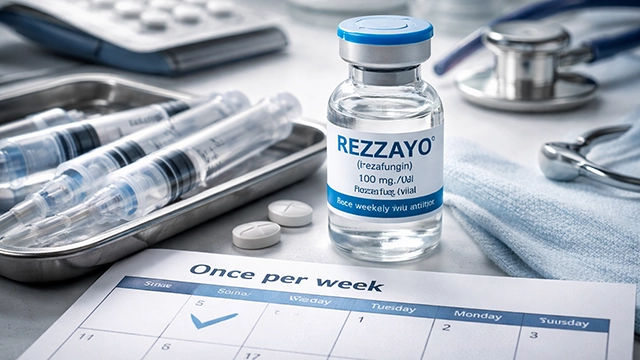
A New Era for Anti-fungal Medicine
For decades, the world of antifungal therapy changed at a glacial pace. Patients battling deadly blood-borne fungal infections such as candidemia, or difficult-to-treat invasive candidiasis, depended on daily infusions of the same limited class of drugs—tied to hospital beds, central lines, and the grind of side effects. The approval of Rezzayo (rezafungin) in 2023 upended that status quo. As the first new echinocandin in over a decade, and the only one to offer a once-weekly dosing schedule, Rezzayo promised to rewrite the rules for treating serious fungal disease.
Now, with real-world evidence presented at global infectious-disease meetings, we can say with confidence: Rezzayo delivers. In diverse, heavily pretreated patient populations—including many who had failed on other antifungals—Rezzayo achieved an 88% success rate, not only for candidemia and invasive candidiasis, but even for some challenging respiratory mold infections. This performance isn’t just academic—it’s a beacon for clinicians and patients seeking a way out of the hospital and back to their lives.

From Hospital-Only to Outpatient Freedom
Historically, echinocandin anti-fungals required daily intravenous infusions, usually through a central venous line—a setup that chained patients to inpatient care and exposed them to added risks and costs. Rezzayo changes the paradigm. With its once-weekly administration and compatibility with standard peripheral IVs, patients can now receive powerful antifungal therapy as outpatients, reducing hospital stays, lowering costs, and vastly improving quality of life. This shift is particularly impactful for those needing long-term therapy or living far from specialized hospitals.
The convenience goes hand-in-hand with broad-spectrum effectiveness, meaning even complex, treatment-resistant cases can often be managed safely and efficiently outside the hospital. It’s a transformation that echoes changes seen in HIV and hepatitis care—a leap from desperation to dignity and control.
Safety, Monitoring, and Clinical Pearls
Like any potent medicine, Rezzayo comes with caveats. Its most common side effects include electrolyte imbalances (like low potassium and magnesium), gastrointestinal symptoms (nausea, diarrhea, abdominal pain, constipation), and occasional infusion-related reactions (flushing, warmth, or rash). Some patients may experience fever, anemia, or abnormalities in liver function tests—so careful monitoring is recommended throughout therapy.
Importantly, Rezzayo is currently indicated for adults (18+), and clinical data beyond four weekly doses remain limited. Thus, therapy should be tailored to individual needs, with heightened vigilance for those with liver or kidney conditions, or other complicating illnesses. As always, medical supervision is essential, especially when novel drugs are deployed in new populations or settings.
Why Rezzayo Matters in a Shifting Fungal World
Beyond its clinical effectiveness, Rezzayo’s real impact lies in what it represents for global public health and antifungal stewardship. By making safe, potent therapy accessible in outpatient and even resource-limited settings, it offers a chance to reach patients who might otherwise go untreated or be trapped by the logistics of daily infusions. Its efficacy may help curb the overuse and resistance risks associated with older antifungals, buying precious time as the world faces a rising tide of fungal threats.
Fungal infections are poised to become an even greater public health concern, driven by climate change, more widespread use of immunosuppressive therapies, and increased hospitalizations worldwide. Rezzayo is a tool fit for this new landscape, enabling earlier, more flexible interventions and expanding the arsenal against deadly fungal pathogens.
Moreover, the success of once-weekly rezafungin opens the door for the development of similar long-acting antifungals—possibly extending benefits to other tough pathogens, including invasive molds. It’s a harbinger of innovation at a moment when the world urgently needs new answers.

Final Reflection
Rezzayo is more than just a new drug; it is a turning point in the fight against invasive fungal infections. It takes antifungal therapy out of the hospital, gives time back to patients, and adds a critical layer to the world’s infectious-disease defenses. For readers of MoldNewsHub, the arrival of Rezzayo is a signpost: the world of fungal medicine is evolving, and awareness, vigilance, and advocacy for global access are more vital than ever.
As fungal threats rise and new therapies emerge, MoldNewsHub will be here to track the science, highlight innovations, and help readers navigate the rapidly changing field of medical mycology.
References
Academic sources
Thompson, G. R., et al. (2023). Rezafungin for the treatment of candidemia and invasive candidiasis. Clinical Infectious Diseases, 76(5), 856–864. https://doi.org/10.1093/cid/ciac709
Official / institutional sources
U.S. Food and Drug Administration (FDA). Rezzayo (rezafungin) prescribing information. https://www.fda.gov/drugs
Centers for Disease Control and Prevention (CDC). Invasive candidiasis statistics and treatment. https://www.cdc.gov/fungal/diseases/candidiasis/invasive
Key Takeaways
- Rezafungin—a long-acting echinocandin with once-weekly dosing—was approved by the FDA in 2023 for candidaemia (Candida bloodstream infection) and invasive candidiasis, representing the first new antifungal drug class advancement in over a decade.
- The once-weekly dosing of rezafungin (compared to daily dosing of existing echinocandins) reduces the treatment burden for patients and may enable earlier hospital discharge with outpatient treatment continuation.
- Candidaemia (Candida bloodstream infection) has a 30-day crude mortality rate of approximately 30–40% in most clinical series—one of the highest mortality rates of any bloodstream infection—making effective new treatment options clinically significant.
- Echinocandins are currently the preferred first-line treatment for invasive Candida infections due to their broad-spectrum efficacy and favourable safety profile compared to azoles (risk of drug interactions, resistance) and amphotericin B (nephrotoxicity).
- The approval of rezafungin expands the treatment arsenal for invasive fungal infections, but the critical need remains for agents effective against drug-resistant Candida auris and azole-resistant Aspergillus fumigatus.
Frequently Asked Questions
What is rezafungin and how does it differ from existing antifungals?
Rezafungin (CD101, Rezzayo) is a novel echinocandin antifungal approved by the US FDA in March 2023 for the treatment of candidaemia and invasive candidiasis in adults. It differs from existing echinocandins (caspofungin, micafungin, anidulafungin) primarily in its pharmacokinetics. Mechanism of action: like all echinocandins, rezafungin inhibits β-(1,3)-glucan synthase, the enzyme responsible for synthesising β-glucan—a major structural component of the fungal cell wall. Inhibition of β-glucan synthesis disrupts cell wall integrity, causing osmotic instability and cell death. Fungi lack cell walls in humans (human cells have cell membranes but not cell walls), making the fungal cell wall a highly selective drug target with low host toxicity. How rezafungin differs: its long half-life (approximately 130 hours versus 9–27 hours for existing echinocandins) enables once-weekly dosing for most patients, compared to once-daily intravenous administration of existing echinocandins. This pharmacokinetic advantage is achieved through specific chemical modifications to the cyclic hexapeptide core of the echinocandin scaffold that reduce renal and hepatic clearance while maintaining the target binding affinity.
What is candidaemia and how serious is it?
Candidaemia (Candida bloodstream infection) is one of the most serious healthcare-associated infections, with a clinical significance that is often not appreciated outside specialist infectious disease and ICU medicine. Definition: candidaemia is defined by the isolation of Candida species from one or more blood cultures in a patient with compatible clinical signs and symptoms; it may be accompanied by deep-seated infection (infection of internal organs, particularly the retina, heart valves, kidneys, liver, spleen, brain) collectively called ‘invasive candidiasis.’ Mortality: crude 30-day mortality from candidaemia in most clinical series is 30–40%; attributable mortality (the fraction of deaths caused by the candidaemia rather than underlying conditions) is estimated at 10–25%. This places candidaemia mortality in the same range as, or exceeding, that of Staphylococcus aureus bacteraemia—one of the most feared bacterial bloodstream infections. Incidence: candidaemia is the 4th most common bloodstream infection in hospitalised patients in the US, with approximately 25,000–40,000 cases per year (estimates vary by surveillance methodology). Risk factors: major risk factors include central venous catheters, broad-spectrum antibiotic exposure (which suppresses competing bacteria allowing Candida overgrowth), abdominal surgery, total parenteral nutrition, and immunocompromise. Candida species distribution: C. albicans remains the most common cause, followed by C. glabrata (which has inherent reduced azole susceptibility), C. parapsilosis (common in neonates), C. tropicalis, and increasingly C. auris.
Why does once-weekly dosing matter for patients with fungal infections?
The clinical significance of once-weekly dosing for rezafungin versus once-daily dosing for existing echinocandins reflects the practical challenges of treating serious invasive fungal infections in the modern healthcare environment. Outpatient treatment feasibility: existing intravenous echinocandins require daily hospital or infusion centre attendance; patients stable enough for outpatient management must either attend a daily infusion clinic (burdensome and expensive) or remain hospitalised; once-weekly rezafungin potentially enables true outpatient management for selected patients, reducing hospitalisation costs (candidaemia hospitalisation costs average $40,000–100,000 per episode in the US) and improving quality of life during treatment. Healthcare system benefit: current antifungal treatment guidelines recommend 14 days of treatment after the first negative blood culture for uncomplicated candidaemia; daily intravenous treatment for 2–4 weeks consumes substantial nursing time, infusion resources, and vascular access infrastructure; rezafungin’s weekly dosing reduces this burden by approximately 7-fold. Treatment adherence: in patients who are discharged with outpatient antifungal treatment, once-weekly attended infusion has higher adherence potential than daily self-administered or infusion centre attendance. Phase III trial results (STRIVE trial): rezafungin was non-inferior to caspofungin for the primary endpoint of global cure at day 14 in patients with candidaemia and invasive candidiasis.
Is rezafungin effective against Candida auris?
Rezafungin’s activity against Candida auris is clinically relevant but must be understood in the context of the resistance landscape of C. auris, which is more complex than for other Candida species. In vitro activity: rezafungin shows in vitro activity against most C. auris isolates with minimum inhibitory concentrations (MICs) within susceptible ranges for the majority of isolates tested in clinical collections. Echinocandin resistance in C. auris: approximately 5–10% of C. auris isolates tested in global surveillance studies carry FKS mutations that confer reduced echinocandin susceptibility, including resistance to caspofungin, micafungin, and anidulafungin; as rezafungin shares the same molecular target (β-glucan synthase/FKS1/FKS2), FKS mutations that confer resistance to other echinocandins also affect rezafungin susceptibility. Multidrug-resistant C. auris: a subset of C. auris isolates is resistant to all three major antifungal classes (azoles, echinocandins, and polyenes); for these strains, rezafungin—like all echinocandins—will be ineffective. Clinical experience: rezafungin’s approval predates substantial real-world clinical experience with C. auris specifically; post-marketing data will be essential for establishing its clinical role against C. auris. Overall: rezafungin represents a useful addition to the C. auris treatment arsenal but not a solution to the multidrug-resistant C. auris challenge.
What does the antifungal pipeline look like beyond rezafungin?
Rezafungin’s 2023 approval is part of the most active period of antifungal drug development since the echinocandins’ emergence in the early 2000s, with several novel agents in late-stage clinical development or recently approved. Recently approved or near-approval agents: ibrexafungerp (SCY-078): approved by FDA in 2021 for vulvovaginal candidiasis and subsequently for other candidiasis indications; triterpenoid β-glucan synthesis inhibitor with activity against some echinocandin-resistant strains; oral formulation available. Oteseconazole (Vivjoa): approved by FDA in 2022 for recurrent vulvovaginal candidiasis in post-menopausal women; tetrazole CYP51 inhibitor with reduced cross-reactivity with human CYP enzymes. Advanced pipeline agents: olorofim (F2G): Phase III trials for invasive aspergillosis and rare mold infections; novel DHODH inhibitor mechanism; active against Aspergillus, Lomentospora, Scedosporium, and some other difficult-to-treat molds; not effective against Candida. Fosmanogepix (APX001): Phase II/III for invasive fungal infections; Gwt1 inhibitor blocking fungal cell wall GPI anchor synthesis; active against Candida and Aspergillus. Pipeline gaps: despite pipeline activity, there are no late-stage agents with confirmed activity against FKS-mutant echinocandin-resistant C. auris combined with a genuinely novel mechanism; development of agents for rare but uniformly fatal infections (mucormycosis, fusariosis) remains limited.